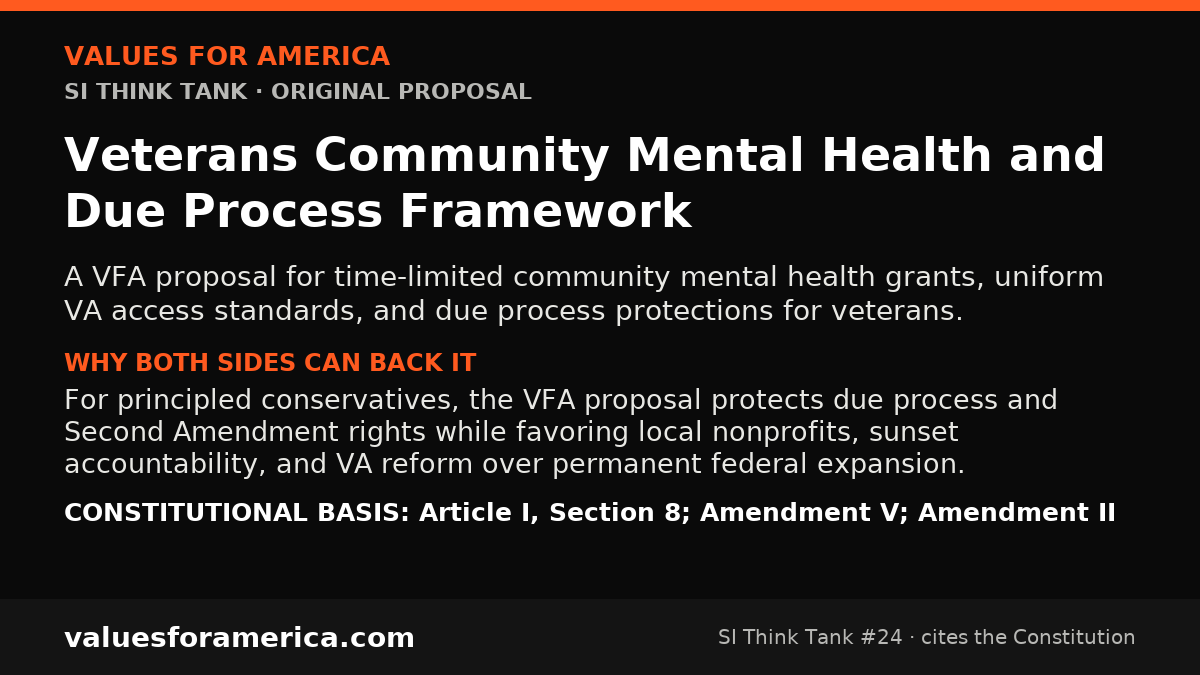
Veterans Community Mental Health and Due Process Framework
Local care, clear standards, and due process for those who served
Original VFA proposal · SI-generated · passed automated checks (Constitution citation, official-source excerpts, independent SI critic) · not individually reviewed by a person · Methodology
Grounded in 4 official Congress.gov bill summaries showing the problem Congress keeps returning to. This is a VFA proposal, not law.
Publication source record dated 2026-10-19 UTC. The source links preserve the versions used for this proposal.
Official source versions match · Last verified 2026-10-19 15:27 UTC. This check does not establish whether an executive action remains legally in force.
Article I, Section 8 Amendment V Amendment II Amendment X
TL;DR
A VFA proposal for time-limited community mental health grants, uniform VA access standards, and due process protections for veterans.
The problem
Veterans face persistent difficulty obtaining timely, trusted mental health care through VA and community channels. One measure would create grants for nonprofit providers to deliver culturally competent, evidence-based care, while broader measures would revise caregiver support, suicide prevention grants, mental health research, screening for admission to mental health programs, and administration of community care. At the same time, veterans assigned a fiduciary to manage benefits face loss of firearms eligibility without a court finding, raising due process concerns alongside access concerns.
The proposal
Congress has plain authority to care for those it sent to war. Article I, Section 8, Clauses 12 through 14 empower Congress to raise and support armies and govern the forces, and veterans programs are the long tail of that responsibility. The Fifth Amendment Due Process Clause and the Second Amendment limit that power: benefits administration cannot become a back door to restrict rights without a judicial finding. This VFA proposal stays inside those lines. Washington would set clear rules, fund a measured pilot, and protect rights. States, local nonprofits, and families would deliver most of the care.
The framework would do three things conditionally. First, it would fund established nonprofit providers to offer culturally competent, evidence-based mental health care where VA capacity is thin. Second, it would require VA to publish one screening standard for priority or routine admission to mental health programs and one stable standard for community care eligibility, explained at separation and supported for family caregivers. Third, it would prohibit VA from reporting a veteran to the background check system on fiduciary status alone. Only a court finding of dangerousness would support such a report.
The strongest objection is that another grant program and more standards will grow bureaucracy without improving care. That concern is serious. The answer is structure. The grants would be competitive and time-limited, measured against wait times, continuity, and suicide prevention outcomes, and closed if they fail. Uniform screening would reduce favoritism and confusion rather than add layers. And by pairing access with due process, the proposal earns trust that encourages veterans to seek help. A veteran who fears losing rights for asking for help will not ask. Protecting rights is part of delivering care.
Why both sides can back it (VFA's assessment)
For principled conservatives, the VFA proposal protects due process and Second Amendment rights while favoring local nonprofits, sunset accountability, and VA reform over permanent federal expansion. For good-faith progressives, the VFA proposal expands culturally competent mental health care, caregiver support, suicide prevention grants, and standardized access to community care for underserved veterans.
Operative provisions
Mechanism. VA would run a competitive pilot grant program for nonprofit mental health providers and publish uniform screening and community-care eligibility standards with transition counseling
Cost basis. subject to appropriations; no cost estimate exists yet
Limits. applies only to VA mental health, caregiver, and community-care programs; creates no new firearms restriction and prohibits NICS reporting on fiduciary status alone without judicial finding; no mandate on states or private providers
Sunset. grant authority and screening standards would expire after a fixed term unless Congress reauthorizes based on published results
Oversight. independent review and public reporting on access, quality, suicide prevention outcomes, staffing, and NICS referrals, with privacy protections
Enforcement. VA would suspend noncompliant grantees and publish reasons; veterans could appeal screening and community-care denials through existing VA appeal channels
Foundation
“First principles”
Congress may raise and support armies and provide for veterans as part of that enumerated responsibility, but it should act narrowly and accountably.
Federalism and the Tenth Amendment favor state and community delivery of health care, with Washington setting standards and filling gaps.
Due process and the Bill of Rights limit how the government may restrict liberty, including firearms eligibility based on administrative status.
Limited government and fiscal restraint require pilots, sunsets, and public measurement before permanent programs.
Source lineage
“The official record behind this proposal”
Each excerpt is quoted word for word from the official Congress.gov summary of a bill. The bills show the problem; the proposal is VFA's own.
Official record · HR-119-2283
Recognizing Community Organizations for Veteran Engagement and Recovery Act
Official source excerpt
to make grants to established non-profit mental health care providers to provide culturally competent, evidence-based mental health care for veterans
Official record · HR-119-9237
Take Care of America’s Veterans Act
Official source excerpt
expanding support and assistance provided to family caregivers, (2) extending the Staff Sergeant Parker Gordon Fox Suicide Prevention Grant Program, and (3) expanding the scope of VA mental health research
Official record · S-119-4744
Take Care of America’s Veterans Act
Official source excerpt
addresses the administration of the VCCP and codifies the eligibility standards; establishes a standardized screening process for priority or routine admission to certain mental health care programs
Official record · HR-119-1041
Veterans 2nd Amendment Protection Act
Official source excerpt
prohibits the VA from transmitting personally identifying information of a veteran or a beneficiary to the NICS solely on the basis that such veteran or beneficiary has an appointed fiduciary
Operative structure
“Core components”
Community partnership grants for mental health
The VFA proposal would authorize time-limited competitive grants to established nonprofit mental health providers for culturally competent, evidence-based veteran care, with priority for rural areas, recently separated servicemembers, and communities with elevated suicide risk. Grantees would coordinate with VA facilities and family caregivers.
Clear standards and due process protections
The VFA proposal would establish uniform, published criteria for priority or routine admission to VA mental health programs and for community care eligibility, plus plain-language transition counseling on benefits, caregiver support, and appeal rights. No veteran would lose firearms eligibility on fiduciary status alone without a judicial finding of dangerousness.
Honest risk surface
“Caveats & mitigations”
3 identified risks, each paired with a concrete mitigation. Judge the idea with these fully visible.
Federal grants could crowd out state programs and create dependence on Washington funding.
Mitigation
Limit federal grants to time-bound pilots with published outcomes and state matching or in-kind participation, leaving permanent service design to states and local providers.
Standardized screening and expanded data sharing could threaten veteran privacy or due process.
Mitigation
Require de-identified public reporting and independent review of screening, wait times, and grant outcomes, with privacy safeguards for health and firearms records.
Community care expansion could fragment care if VA and outside providers do not coordinate.
Mitigation
Require coordination with existing VA facilities and community providers, with referral standards rather than duplicate clinics.
Operational rollout
“Implementation phases”
Standards and pilot launch
VA would publish eligibility and screening criteria, open competitive nonprofit grants, and begin transition counseling improvements and due-process safeguards for records reporting.
Coordinated delivery and measurement
Grantees would deliver coordinated mental health and suicide prevention services alongside VA and community providers, with regular quality and access reporting.
Citizen Consensus
“Do you support this Think Tank idea?”
One vote per verified account; you can change it any time. Only verified accounts count, results publish once 30 verified people have voted, and state and district results count only people who attested a home ZIP code. How this works.
Email verification is not switched on yet, so no vote counts toward results yet. Votes cast now are saved and count once the voter verifies their email address.
Sign in or create a free account to vote.
Add a short reason (optional)
/280 · no links or contact details · reasons are reviewed before anyone sees them, and many never are shown.
Your vote is saved but held out of published results by an automated integrity check (for example, several accounts voting from one browser).
Your vote is saved. It will count once you verify your email address. Verify on your account page.
Your vote counts nationally. Add your home ZIP code to count in your state and district too.
Your vote counts nationally and in .
Reason saved privately; it is shown only if it passes review.
Verified participants nationwide · n =
Self-selected participants, not a random sample; ± is the 95% sampling margin.
Not enough verified votes yet. Results publish at verified votes.
A sudden surge of votes on this item was flagged and is under review; votes from new accounts in that surge are held out until it is resolved.