H.R. 9237 explained · 119th Congress · Pending in Congress
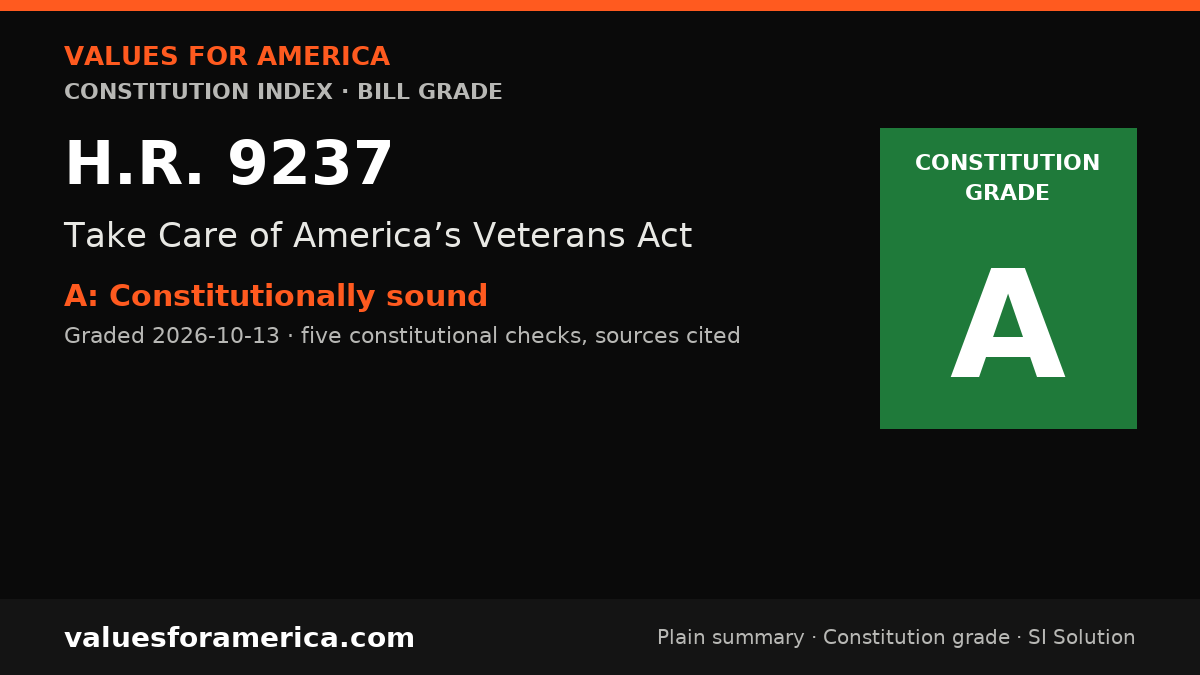
Take Care of America’s Veterans Act
Cosponsors: 30 (0 D, 30 R) · per Congress.gov, 2026-10-08
Introduced: 2026-06-10
Latest action (2026-07-16): POSTPONED PROCEEDINGS - Pursuant to clause 1(c) of rule XIX, the Chair announced further proceedings on H.R. 9237 is postponed.
What H.R. 9237 does, in plain terms
Take Care of America's Veterans Act This bill addresses veterans’ benefits, health care, counseling, Department of Veterans Affairs (VA) personnel, VA infrastructure, and the Veterans Community Care Program (VCCP). The bill modifies various compensation programs for veterans, including by (1) allowing concurrent receipt of disability compensation and military retired pay for certain retirees with a combat-related disability, (2) extending entitlement for various benefits and services to remarried surviving spouses, (3) increasing the rate of dependency and indemnity compensation, and (4) establishing a supplemental monthly allowance for certain disabled veterans. The bill also addresses VA education and training benefits, including by (1) modifying which independent study programs are covered under veterans’ educational assistance benefits, (2) requiring Transition Assistance Program counseling to include a presentation about VA benefits, and (3) increasing the housing allowance rate for individuals pursuing apprenticeships. The bill revises health care provisions, including by (1) expanding support and assistance provided to family caregivers, (2) extending the Staff Sergeant Parker Gordon Fox Suicide Prevention Grant Program, and (3) expanding the scope of VA mental health research. Among other elements, the bill revises VA disability ratings for sleep apnea and tinnitus; expands eligibility for a memorial headstone or marker for the spouse, surviving spouse, child, or dependent of a veteran or member of the Armed Forces; addresses the administration of the VCCP and codifies the eligibility standards; establishes a standardized screening process for priority or routine admission to certain mental health care programs; and addresses VA personnel, hiring, and infrastructure matters.
Official summary by the Congressional Research Service, via Congress.gov.
Constitution Index
“VFA Constitution grade”
Constitutionally sound
Graded 2026-10-13
SI-generated grade · five published checks · not individually reviewed by a person · methodology
The Take Care of America's Veterans Act is a federal exercise of the enumerated power to provide for the common defense and to raise and support armies, as well as the power to make rules for the government and regulation of the land and naval forces. It expands benefits and services for veterans, which is a traditional and well-established federal function. The bill does not infringe on any constitutional rights; rather, it extends benefits and protections. It does not centralize power beyond the necessary federal role in veterans' affairs, and it does not violate due process or takings clauses. The bill is fully consistent with the Constitution.
-
✓ Passes · Enumerated powers
The federal government has explicit constitutional authority to legislate on matters of veterans' affairs under Article I, Section 8, Clause 12 (the power to raise and support armies) and Clause 14 (the power to make rules for the government and regulation of the land and naval forces). Additionally, the provision of veterans' benefits is a long-standing exercise of federal power under the Necessa… -
✓ Passes · Bill of Rights
The bill does not infringe on any of the rights protected by the Bill of Rights. It does not restrict speech, religion, assembly, press, or petition (First Amendment). It does not affect the right to keep and bear arms (Second Amendment). It does not involve quartering of soldiers (Third Amendment). It does not authorize unreasonable searches or seizures (Fourth Amendment). It does not compel self… -
✓ Passes · Individual sovereignty
The bill does not restrict individual liberty; rather, it expands the freedom and well-being of veterans and their families by providing additional benefits, health care, and support. It does not impose any new restrictions on personal conduct, property, speech, labor, or belief. The government is not burdening individuals but rather fulfilling its obligation to care for those who have served. The… -
✓ Passes · Decentralization
The bill addresses matters that are inherently federal in nature. Veterans' benefits and the administration of the Department of Veterans Affairs are national responsibilities, as the federal government has exclusive authority over military affairs and veterans' services. An individual, family, local community, or state cannot adequately provide for the comprehensive needs of all veterans, especia… -
✓ Passes · Due process and takings
The bill does not bypass due process or take property without just compensation. It provides benefits and services, and any changes to eligibility or compensation are made through the legislative process with clear standards. The bill does not deprive any person of life, liberty, or property without due process of law. It does not involve any taking of private property for public use without just …
Sources: Congress.gov: HR 9237 summary
Report an error in this grade
What should pass
“VFA SI Solution”
No solution yet
A sourced SI draft appears here once it passes automated checks (Constitution citation, source verification, independent SI critic). How publication works.
Related on VFA

For journalists and bloggers
“Embed this grade”
Free to use with the link back. The badge and card update when the grade changes. Embed terms →
