H.R. 2283 explained · 119th Congress · Pending in Congress
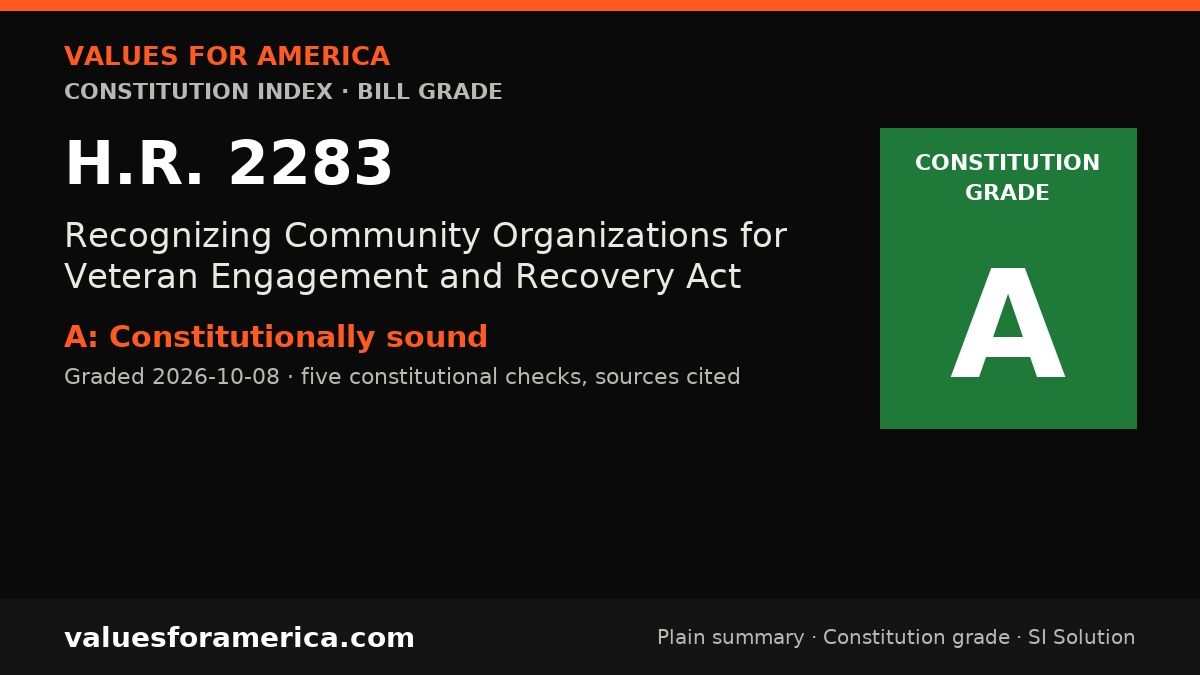
Recognizing Community Organizations for Veteran Engagement and Recovery Act
Cosponsors: 5 (0 D, 5 R) · per Congress.gov, 2026-10-14
Introduced: 2025-03-24
Latest action (2026-10-05): Placed on the Union Calendar, Calendar No. 736.
What H.R. 2283 does, in plain terms
Recognizing Community Organizations for Veteran Engagement and Recovery Act or the RECOVER Act This bill requires the Department of Veterans Affairs to implement a three-year pilot program to make grants to established non-profit mental health care providers to provide culturally competent, evidence-based mental health care for veterans.
Official summary by the Congressional Research Service, via Congress.gov.
Constitution Index
“VFA Constitution grade”
Constitutionally sound
Graded 2026-10-08
SI-generated grade · five published checks · not individually reviewed by a person · methodology
HR 2283 operates within Congress's veteran-care and spending powers, funds voluntary community-based mental health care through a limited SI-reviewed pilot structure, and infringes no rights, sovereignty, or due process protections. It supports rather than displaces local providers.
-
✓ Passes · Enumerated powers
Congress has explicit authority for this federal veterans program. Article I, Section 8, Clause 1 authorizes spending to provide for the general Welfare, which supports grants for veteran health. Article I, Section 8, Clauses 12-14 authorize Congress to raise and support Armies, provide and maintain a Navy, and make rules for the land and naval forces, which has long grounded the Department of Vet… -
✓ Passes · Bill of Rights
The bill provides voluntary, culturally competent mental health care through grants to non-profit providers. It compels no speech, worship, assembly, or press activity under the First Amendment, disarms no one under the Second Amendment, authorizes no search, seizure, or surveillance under the Fourth Amendment, and imposes no criminal process, punishment, or taking under the Fifth, Sixth, Seventh,… -
✓ Passes · Individual sovereignty
The bill restricts no person in body, property, speech, labor, or belief. Veterans are offered, not ordered into, care from non-profit providers, preserving medical choice and First Amendment and Ninth Amendment liberty interests. Providers voluntarily apply for grants. The government bears the burden to justify restrictions, and here there is no restriction to justify, so sovereignty is fully pre… -
✓ Passes · Decentralization
Under the Four-Question Test: (1) Individuals and families cannot alone supply evidence-based clinical mental health care at scale, so individual_can_handle is false. (2) Local communities and counties, including the non-profit providers funded here, can deliver such care, so local_can_handle is true. (3) States can also deliver veteran care, so state_can_handle is true. (4) The bill does not cons… -
✓ Passes · Due process and takings
No liberty or property is deprived without procedure under the Fifth Amendment Due Process Clause and Fourteenth Amendment Section 1. The bill creates a grant program with eligibility criteria for providers, not fines, seizures, civil forfeiture, or presumptions of guilt. No property is taken for public use, so no just compensation is owed under the Fifth Amendment Takings Clause. Any future grant…
Sources: Congress.gov: HR 2283 summary
Report an error in this grade
What should pass
“VFA SI Solution”
No solution yet
A sourced SI draft appears here once it passes automated checks (Constitution citation, source verification, independent SI critic). How publication works.
Related on VFA

For journalists and bloggers
“Embed this grade”
Free to use with the link back. The badge and card update when the grade changes. Embed terms →
