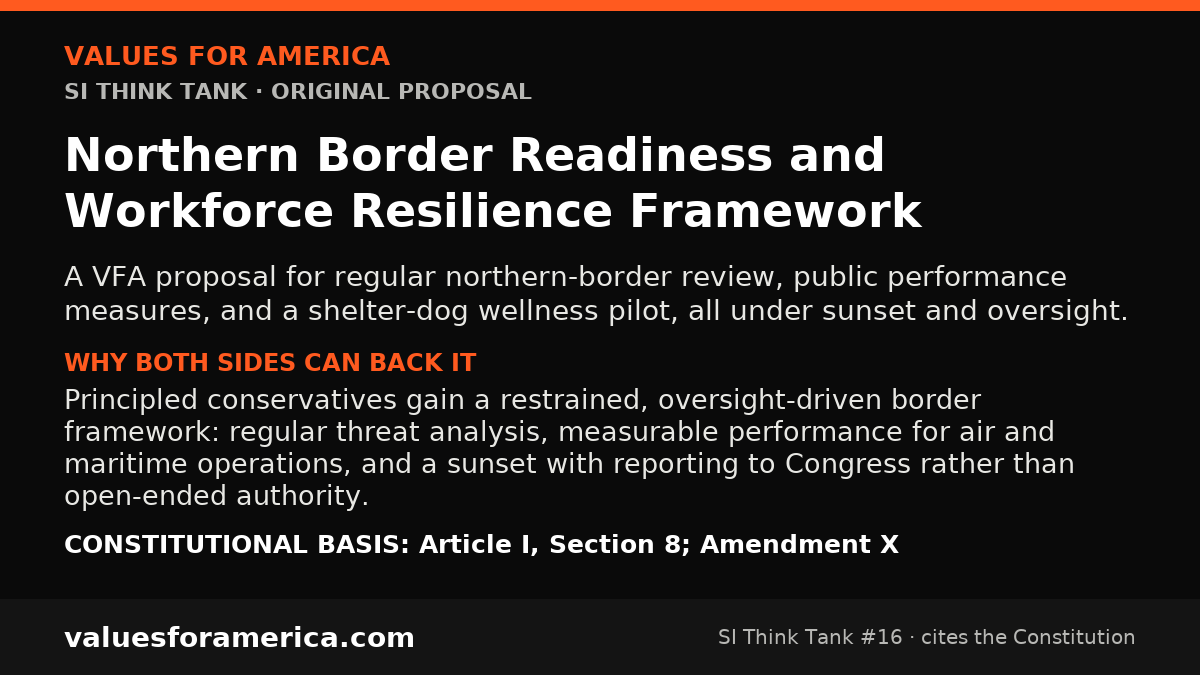
Northern Border Readiness and Workforce Resilience Framework
Regular review, honest measures, and resilient personnel for the northern border
Original VFA proposal · SI-generated · passed automated checks (Constitution citation, official-source excerpts, independent SI critic) · not individually reviewed by a person · Methodology
Grounded in 4 official Congress.gov bill summaries showing the problem Congress keeps returning to. This is a VFA proposal, not law.
Publication source record dated 2026-10-17 UTC. The source links preserve the versions used for this proposal.
Official source versions match · Last verified 2026-10-19 10:00 UTC. This check does not establish whether an executive action remains legally in force.
Article I, Section 8 Amendment X
TL;DR
A VFA proposal for regular northern-border review, public performance measures, and a shelter-dog wellness pilot, all under sunset and oversight.
The problem
Congress is considering two linked gaps in northern-border operations. One set of bills would require regular analysis of terroristic and criminal threats at the northern border and measurable assessment of air and maritime effectiveness between ports of entry. Another set would address the human strain of border service through support dogs for grief assistance, trauma mitigation, and morale. Together they point to a management problem: strategy without regular review and measurement, and personnel demands without structured resilience support.
The proposal
The Constitution assigns this work to Congress. Article I, Section 8, Clauses 3 and 4 grant power to regulate foreign commerce and establish a uniform rule of naturalization, joined by the duty to provide for the common defence and the guarantee in Article IV, Section 4 of protection against invasion. The Clause 18 authority to make laws necessary and proper to carry those powers into effect supports review, measurement, and reporting. The Tenth Amendment limits the design: Washington should set standards and account for results, not commandeer states or local shelters.
This VFA proposal would create one disciplined framework. DHS would conduct recurring threat analysis of the northern border, update its northern border strategy from that analysis, and brief Congress. Air and Marine Operations would publish performance measures for effectiveness between ports of entry in air and maritime environments. Separately, CBP would run a time-limited pilot adopting dogs from local shelters as support dogs for grief assistance, trauma mitigation, and morale. Every element would sunset unless Congress reauthorizes it.
The strongest objection is that reviews and wellness pilots distract from enforcement. The answer is that undisciplined enforcement fails. Without regular analysis of terroristic and criminal threats and honest measures of what works between ports of entry, resources drift and gaps persist. Without attention to trauma and morale, retention and judgment suffer. Measurement plus resilience would make protection more effective, not softer, while sunset and appropriations control keep the program limited and accountable.
Why both sides can back it (VFA's assessment)
Principled conservatives gain a restrained, oversight-driven border framework: regular threat analysis, measurable performance for air and maritime operations, and a sunset with reporting to Congress rather than open-ended authority. Good-faith progressives gain humane and effective operations: strategy updates tied to changing conditions, attention to trauma and morale for frontline personnel, and use of shelter-dog adoption for support roles. VFA assesses both gains as consistent with limited, accountable government.
Operative provisions
Mechanism. would direct periodic northern-border threat analysis, strategy updates with congressional briefing, published performance measures for air and maritime operations, and a separate time-limited support-canine pilot using shelter dogs
Cost basis. subject to appropriations; no cost estimate exists yet
Limits. would create no new border search, detention, or removal authority; would not direct state or local participation; canine pilot limited to adopted shelter dogs and support roles
Sunset. would terminate new authorities after five years unless Congress reauthorizes following review of metrics and pilot results
Oversight. would require strategy updates or written notice when no update is needed, classified briefings to appropriate committees, and public summaries consistent with security
Enforcement. would rely on reporting, congressional oversight, and appropriations control; proposes no new civil or criminal penalty
Foundation
“First principles”
The Constitution grants Congress authority over naturalization, foreign commerce, and the common defence, with power to make laws necessary and proper to carry those powers into effect.
Protection against invasion and domestic violence is a federal guarantee, but policing and community welfare remain principally state responsibilities under the Tenth Amendment.
Separation of powers requires Congress to define missions, measures, and sunsets while the executive carries out operations subject to oversight.
Fiscal restraint requires pilots and reviews to be limited, measurable, and subject to appropriations rather than permanent entitlements.
Source lineage
“The official record behind this proposal”
Each excerpt is quoted word for word from the official Congress.gov summary of a bill. The bills show the problem; the proposal is VFA's own.
Official record · HR-119-5517
Northern Border Security Enhancement and Review Act
Official source excerpt
This bill requires the Department of Homeland Security (DHS) to regularly perform a threat analysis of the northern U.S. border. The analysis must be performed every two years and include terroristic and criminal threats, improvements needed to prevent terrorism and reduce criminal activity
Official record · S-119-850
Northern Border Security Enhancement and Review Act
Official source excerpt
DHS must update its northern border strategy not later than September 2, 2026, and every five years thereafter, incorporating the results from the latest threat analysis. DHS must also provide a classified briefing to the appropriate congressional committees.
Official record · HR-119-9327
PEARL Act
Official source excerpt
This bill requires U.S. Customs and Border Protection (CBP) to establish a pilot program to adopt dogs from local animal shelters to be trained as support dogs for CBP’s Support Canine Program.
Official record · S-119-4079
PEARL Act
Official source excerpt
Support dogs are used for grief assistance, trauma mitigation, and morale.
Operative structure
“Core components”
Regular review and measurable border protection
Would require regular northern-border threat analysis covering terroristic and criminal threats and needed improvements, with strategy updates and briefings to Congress. Measurement would focus on effectiveness between ports of entry in air and maritime environments.
Workforce resilience through shelter-dog pilot
Would authorize a time-limited pilot to adopt dogs from local shelters and train them as support dogs for grief assistance, trauma mitigation, and morale within the border workforce.
Accountability and public reporting
Would require public reporting on what was reviewed, what changed, and what remains unresolved, so Congress and the public can judge whether the framework improves security and workforce readiness.
Honest risk surface
“Caveats & mitigations”
3 identified risks, each paired with a concrete mitigation. Judge the idea with these fully visible.
Threat analysis and performance metrics could expand into broader surveillance.
Mitigation
Require metrics and strategy updates to be published in unclassified form where possible, with classified details briefed separately, and prohibit use of analysis to justify unrelated domestic activity.
A national framework could centralize operational decisions better left to field leaders.
Mitigation
Limit the federal role to standards, measurement, and voluntary coordination; leave staffing, deployment, and local partnerships to existing authorities and states.
Wellness pilot could become permanent without evidence of benefit.
Mitigation
Authorize the support-canine pilot as time-limited, adoption-based, and subject to appropriations, with independent review before any continuation.
Operational rollout
“Implementation phases”
Standards and measures
Would establish review cycle, definitions, performance measures for air and maritime effectiveness, and pilot standards for adoption, training, and welfare of support dogs.
Analysis, strategy, and pilot operation
Would conduct threat analysis, update border strategy, operate the shelter-dog support pilot, and report results to Congress.
Independent review and sunset decision
Would compare outcomes against measures, assess whether reviews improved prevention of terrorism and criminal activity and whether the pilot aided morale and trauma mitigation, then recommend continuation or termination.
Citizen Consensus
“Do you support this Think Tank idea?”
One vote per verified account; you can change it any time. Only verified accounts count, results publish once 30 verified people have voted, and state and district results count only people who attested a home ZIP code. How this works.
Email verification is not switched on yet, so no vote counts toward results yet. Votes cast now are saved and count once the voter verifies their email address.
Sign in or create a free account to vote.
Add a short reason (optional)
/280 · no links or contact details · reasons are reviewed before anyone sees them, and many never are shown.
Your vote is saved but held out of published results by an automated integrity check (for example, several accounts voting from one browser).
Your vote is saved. It will count once you verify your email address. Verify on your account page.
Your vote counts nationally. Add your home ZIP code to count in your state and district too.
Your vote counts nationally and in .
Reason saved privately; it is shown only if it passes review.
Verified participants nationwide · n =
Self-selected participants, not a random sample; ± is the 95% sampling margin.
Not enough verified votes yet. Results publish at verified votes.
A sudden surge of votes on this item was flagged and is under review; votes from new accounts in that surge are held out until it is resolved.