Archived SI output (machine-generated)
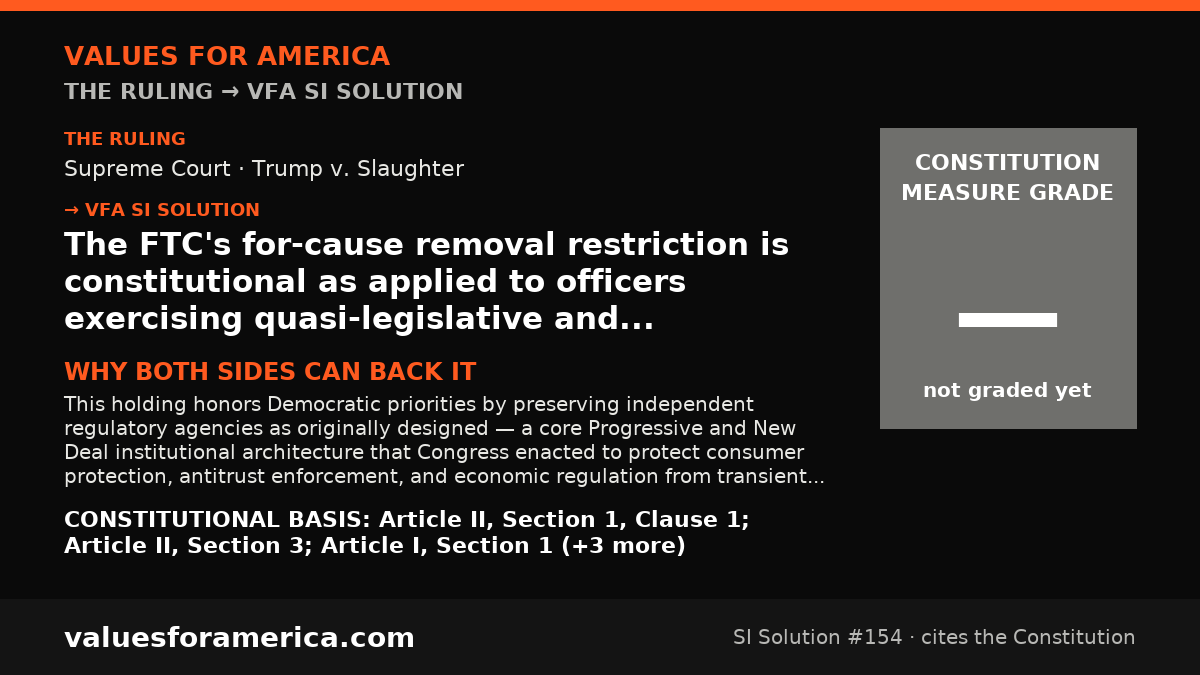
The FTC's for-cause removal restriction is constitutional as applied to officers exercising quasi-legislative and quasi-judicial powers; the President may remove FTC members only for cause.
Archived SI output (machine-generated) · No editorial review recorded
This historical SI draft was machine-generated by software and has no editorial review time on record. Verify its factual and legal claims against the original source before relying on it.
Trump v. Slaughter
John G. Roberts
The FTC's for-cause removal restriction is constitutional as applied to officers exercising quasi-legislative and quasi-judicial powers; the President may remove FTC members only for cause.
Does the Constitution permit Congress to restrict the President's removal of Federal Trade Commission members to 'for inefficiency, neglect of duty, or malfeasance in office'?
Constitutional concerns with the original
- The majority opinion relies primarily on post-1789 practice (the 'Decision of 1789') and the structural inference from unitary executive theory, rather than on the original public meaning of Article II's text.
- The majority treats 'executive Power' (Art. II, §1, cl. 1) as necessarily encompassing an unlimited removal power, but the text does not mention removal at all — original meaning may distinguish between 'executing' the laws and the administrative personnel management of multi-member commissions exercising quasi-legislative and quasi-judicial functions.
- The majority ignores the fact that the FTC exercises powers that are not purely executive: it adjudicates disputes (judicial) and issues prospective rules (legislative). The Constitution vests 'legislative Powers' in Congress (Art. I, §1) and 'judicial Power' in courts (Art. III, §1). Congress may attach conditions to the appointment and tenure of officers who exercise those non-executive powers.
- The majority's reading of Humphrey's Executor as an exception that swallowed the rule is reversed: Humphrey's correct reading is that for-cause removal is permitted when the officer exercises 'quasi-legislative' or 'quasi-judicial' duties — a view grounded in the nondelégation doctrine and the idea that Congress may create independent agencies as 'arms of Congress' to carry out legislative policy without direct presidential control.
Solution text
Operative provisions
Bipartisan rationale
This holding honors Democratic priorities by preserving independent regulatory agencies as originally designed — a core Progressive and New Deal institutional architecture that Congress enacted to protect consumer protection, antitrust enforcement, and economic regulation from transient political control. It honors Republican (originalist / textualist) priorities by demanding a careful separation-of-powers analysis rooted in the original meaning of Article I, Article II, and Article III, rather than 20th-century functional balancing. It rejects the unitary executive theory as inconsistent with the original understanding that Congress may vest non-executive power in officers who are not subject to presidential control. Both parties' constitutional traditions — Democratic institutionalist and Republican originalist — converge on the conclusion that the Constitution's text does not require at-will presidential removal of officers exercising legislative and judicial power.
Constitutional citations
- → Article II, Section 1, Clause 1
- → Article II, Section 3
- → Article I, Section 1
- → Article III, Section 1
- → Article I, Section 8, Clause 18 (Necessary and Proper Clause)
- → Tenth Amendment
- → Federalist No. 47 (Madison)
- → Federalist No. 48 (Madison)
- → Federalist No. 78 (Hamilton)
Article II, Section 1, Clause 1 Article II, Section 3 Article I, Section 1 Article III, Section 1 Article I, Section 8, Clause 18 Amendment X
Report an error in this Solution

Citizen Consensus
“Do you support this VFA SI Solution?”
One vote per verified account; you can change it any time. Only verified accounts count, results publish once 30 verified people have voted, and state and district results count only people who attested a home ZIP code. How this works.
Email verification is not switched on yet, so no vote counts toward results yet. Votes cast now are saved and count once the voter verifies their email address.
Sign in or create a free account to vote.
Add a short reason (optional)
/280 · no links or contact details · reasons are reviewed before anyone sees them, and many never are shown.
Your vote is saved but held out of published results by an automated integrity check (for example, several accounts voting from one browser).
Your vote is saved. It will count once you verify your email address. Verify on your account page.
Your vote counts nationally. Add your home ZIP code to count in your state and district too.
Your vote counts nationally and in .
Reason saved privately; it is shown only if it passes review.
Verified participants nationwide · n =
Self-selected participants, not a random sample; ± is the 95% sampling margin.
Not enough verified votes yet. Results publish at verified votes.
A sudden surge of votes on this item was flagged and is under review; votes from new accounts in that surge are held out until it is resolved.
Generated by VFA SI Solutions · 2026.06.30 06:02 UTC · ← Back to the Republic