Executive Order 14419 explained · Executive Order · No disposition noted
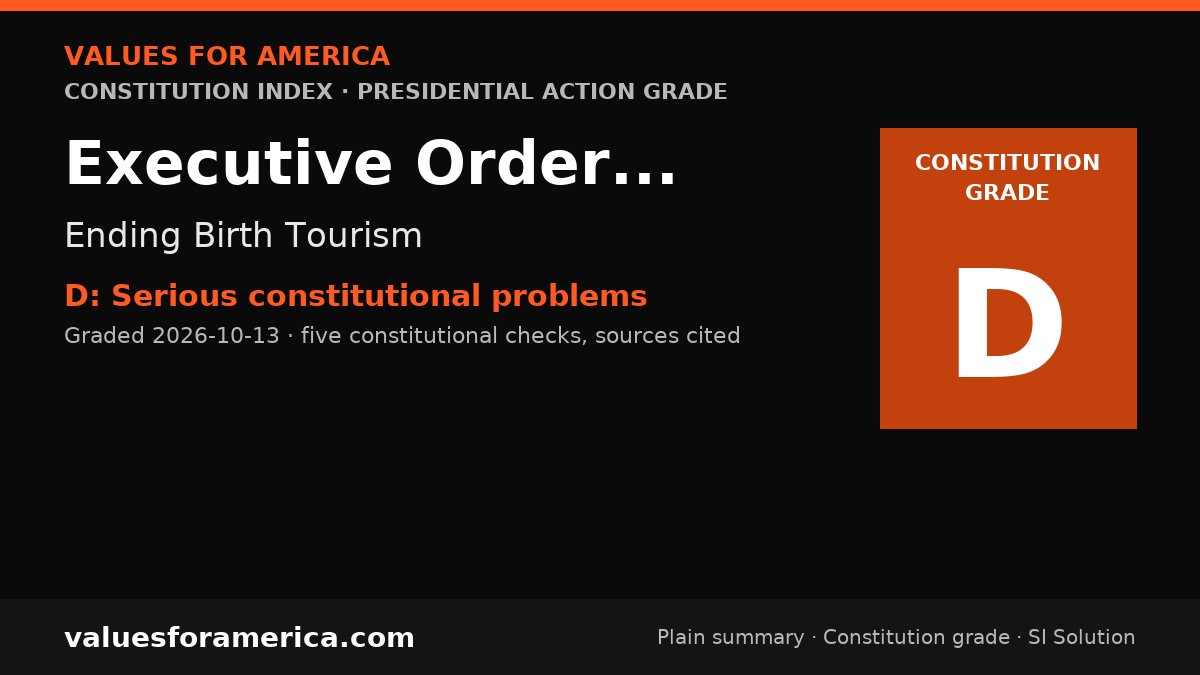
Ending Birth Tourism
Signed: 2026-08-06 Published: 2026-08-11 Federal Register document: 2026-16404
Agencies: Executive Office of the President
What Executive Order 14419 says
Federal Register, Volume 91 Issue 153 (Tuesday, August 11, 2026) [Federal Register Volume 91, Number 153 (Tuesday, August 11, 2026)] [Presidential Documents] [Pages 51993-51995] From the Federal Register Online via the Government Publishing Office [www.gpo.gov] [FR Doc No: 2026-16404] Presidential Documents Federal Register / Vol. 91 , No. 153 / Tuesday, August 11, 2026 / Presidential Documents [[Page 51993]] Executive Order 14419 of August 6, 2026 Ending Birth Tourism By the authority vested in me as President by the Constitution and the laws of the United States of America, it is hereby ordered: Section 1. Purpose. United States citizenship is among the greatest inheritances the Nation can bestow. It embodies a sacred bond between the American people and the Nation in which they live, and carries profound rights, privileges, and responsibilities reflective of the enduring allegiance of citizens to the United States and our Constitution. Citizenship is not a commodity to be acquired through calculated exploitation and evasion of the immigration laws, such as by entering the United States on a nonimmigrant visa for the purpose of giving birth within the Nation's borders. Birth tourism operators use deceptive advertisements and inducements to entice foreign nationals to travel to the United States for the purpose of giving birth on American soil. They promise citizenship...
Opening of the official text; read it in full in the Federal Register.
Constitution Index
“VFA Constitution grade”
Serious constitutional problems
Graded 2026-10-13
SI-generated grade · five published checks · not individually reviewed by a person · methodology
Executive Order 14419 oversteps executive authority by attempting to redefine the scope of birthright citizenship, which is established by the Fourteenth Amendment and federal statute. While the order's focus on visa integrity is within executive power, its provisions to deny entry, revoke visas, and bar aliens based on the purpose of giving birth conflict with the constitutional guarantee of citizenship to all persons born in the United States and subject to its jurisdiction. The order also raises due process concerns by authorizing removal and permanent bars without individualized hearings. The decentralization check fails because immigration and citizenship are inherently federal matters, but the order consolidates excessive discretionary power in the executive branch.
-
✗ Concern · Enumerated powers
The President's authority over immigration and visa issuance derives from Article II and congressional delegation, particularly the Immigration and Nationality Act (8 U.S.C. 1185(a)). However, the order's attempt to deny citizenship-related benefits to U.S.-born children conflicts with the Fourteenth Amendment, which is a constitutional mandate that the executive cannot override. The enumerated po… -
✗ Concern · Bill of Rights
The order implicates the Fourteenth Amendment's Citizenship Clause, which guarantees citizenship to all persons born in the United States and subject to its jurisdiction. By targeting children born to nonimmigrant visa holders, the order effectively denies these children the full rights of citizenship, including the privileges and immunities protected by the Fourteenth Amendment. Additionally, the… -
✗ Concern · Individual sovereignty
The order restricts the fundamental right of parents to make decisions about where to give birth and the right of children to claim citizenship based on birth in the United States. The government's interest in enforcing immigration laws is compelling, but the means chosen—denying citizenship to U.S.-born children—is not narrowly tailored and imposes a severe burden on individual sovereignty. The o… -
✗ Concern · Decentralization
Immigration and citizenship are inherently federal matters, so the first three questions are answered 'no'—individuals, localities, and states cannot handle these issues. However, the order consolidates decision-making in the executive branch, bypassing Congress's legislative role in defining citizenship and immigration policy. This upward consolidation of power violates the separation of powers a… -
✗ Concern · Due process and takings
The order authorizes visa revocation, permanent bars, and removal of aliens based on the purpose of giving birth, but does not provide for individualized hearings or meaningful review. This raises serious procedural due process concerns under the Fifth Amendment. The order also effectively takes the property interest of a visa or immigration status without just compensation or adequate process. Th…
Report an error in this grade
What should happen instead
“VFA SI Solution”
Birth Tourism Deterrence and Visa Integrity Act of 2026
Deter foreign nationals from traveling to the United States for the primary purpose of giving birth so that their child acquires automatic U.S. citizenship (birth tourism).
Bipartisan rationale: This Act honors Republican priorities of immigration enforcement and deterring abuse of the visa system, while affirming Democratic priorities of protecting birthright citizenship as a constitutional right. By legislating rather than acting unilaterally, Congress respects the separation of powers and avoids the constitutional crisis of an executive order overriding the 14th Amendment. Both parties prefer this approach because it provides clear, judicially reviewable standards and terminates after five years, forcing Congress to reassess. It also avoids the protracted litigation that would accompany an unconstitutional executive order.
Article I, Section 8, Clause 3 Article I, Section 8, Clause 4 Amendment XIV, Section 1 Amendment V
Report an error in this Solution

For journalists and bloggers
“Embed this grade”
Free to use with the link back. The badge and card update when the grade changes. Embed terms →
