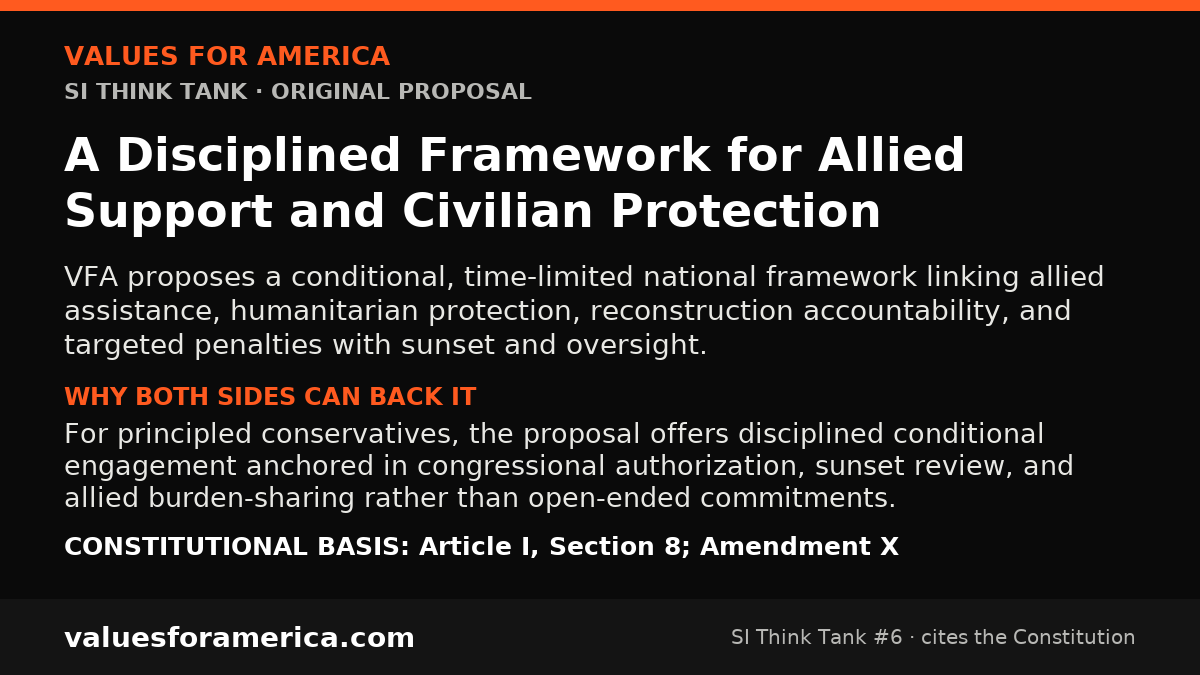
A Disciplined Framework for Allied Support and Civilian Protection
Conditional support, civilian protection, and targeted accountability under congressional control
Original VFA proposal · SI-generated · passed automated checks (Constitution citation, official-source excerpts, independent SI critic) · not individually reviewed by a person · Methodology
Grounded in 4 official Congress.gov bill summaries showing the problem Congress keeps returning to. This is a VFA proposal, not law.
Publication source record dated 2026-10-08 UTC. The source links preserve the versions used for this proposal.
Official source versions match · Last verified 2026-10-19 10:00 UTC. This check does not establish whether an executive action remains legally in force.
Article I, Section 8 Article II Amendment X
TL;DR
VFA proposes a conditional, time-limited national framework linking allied assistance, humanitarian protection, reconstruction accountability, and targeted penalties with sunset and oversight.
The problem
The summaries describe related failures in American response to foreign conflict and coercion. One bill would address war by providing assistance and establishing penalties for responsible foreign persons. Another resolution addresses an ongoing conflict in Sudan and calls for humanitarian access and an end to external material support. A further resolution addresses forced assimilation and urges monitoring and support for affected communities, while a defense sales bill seeks multinational procurement coordination. The shared problem is ad hoc engagement without a disciplined national framework linking conditional support, civilian protection, allied burden-sharing, and targeted accountability.
The proposal
Article I, Section 8 grants Congress power over national defense, foreign commerce, and the purse, while Article II makes the President the executor of foreign policy. That division governs this VFA proposal: Congress would set purposes, conditions, limits, and sunsets, and the executive would act within them. The Tenth Amendment reserves the remaining domestic authority to states and the people, so the design stays narrowly federal and avoids creating open-ended domestic mandates.
The thesis is direct. America should help allies defend themselves, protect civilians, and rebuild after war, but only through conditional commitments that voters can see and end. The VFA proposal would authorize defensive cooperation, humanitarian access, reconstruction support, and coordinated procurement with allies, while directing targeted penalties at aggressors, external enablers of war, and officials responsible for forced assimilation. Assistance would require lawful use, civilian-harm safeguards, allied contributions, and public audits. Penalties would require findings, include humanitarian exceptions, and lift when aggression ends or verified reforms occur.
The strongest objection is that conditionality and sunsets signal weakness and invite adversaries to wait America out. The answer is that discipline is strength. Automatic or indefinite commitments encourage dependence, waste, and mission creep; defined purposes, allied burden-sharing, and renewal votes compel strategy, measure results, and preserve American leverage for negotiation and peace. A framework Congress must defend and renew is more credible than promises no Congress controls.
Why both sides can back it (VFA's assessment)
For principled conservatives, the proposal offers disciplined conditional engagement anchored in congressional authorization, sunset review, and allied burden-sharing rather than open-ended commitments. For good-faith progressives, it offers sustained civilian protection, humanitarian access, and support for communities facing aggression and forced assimilation, with transparent reporting and transitional justice planning.
Operative provisions
Mechanism. VFA proposes Congress would authorize conditional assistance and targeted accountability under defined findings, with allied coordination and periodic congressional review
Cost basis. subject to appropriations; no cost estimate exists yet
Limits. purposes limited to defensive support, civilian protection, humanitarian access, and reconstruction; no permanent commitment; humanitarian exceptions and protections for lawful activity required
Sunset. authorities would expire after a fixed period unless Congress reauthorizes following review of effectiveness and civilian impact
Oversight. periodic public reports to Congress, independent audit of funds and transfers, and review of findings supporting penalties
Enforcement. agency findings and certifications, public compliance reports, suspension or termination of assistance for misuse, and civil enforcement of sanctions subject to judicial review
Foundation
“First principles”
Foreign affairs and national defense are enumerated federal responsibilities, but all federal action remains limited by enumerated powers and individual rights.
Federalism and fiscal restraint favor conditional, temporary, and transparent commitments over permanent or open-ended programs.
Separation of powers requires Congress to define purposes, limits, and review while the President executes foreign policy within those bounds.
Coercive measures must respect due process and liberty, targeting responsible actors while protecting civilians and humanitarian activity.
Source lineage
“The official record behind this proposal”
Each excerpt is quoted word for word from the official Congress.gov summary of a bill. The bills show the problem; the proposal is VFA's own.
Official record · HR-119-2913
Ukraine Support Act
Official source excerpt
requiring the U.S. International Development Finance Corporation to prioritize support for Ukraine
Official record · HRES-119-1179
Condemning attacks on civilians in Sudan and calling for an end to external support to the warring parties and for efforts to promote a negotiated settlement of the war.
Official source excerpt
Since 2023, there has been an ongoing conflict in Sudan between the Sudanese Armed Forces and the paramilitary Rapid Support Forces.
Official record · HRES-119-1400
Condemning the People's Republic of China's Law on the Promotion of Ethnic Unity and Progress and the Chinese Communist Party's campaign of forced assimilation against ethnic and religious minorities.
Official source excerpt
The resolution further urges the Department of State to collaborate with allies to monitor implementation of the law and prioritize programs that support affected communities.
Official record · HR-119-8665
Allied Defense Sales Act
Official source excerpt
directs the Department of State to implement a strategy to encourage foreign entities to participate in a multinational military procurement process
Operative structure
“Core components”
Conditional allied support and protection
Congress would authorize time-limited security cooperation and civilian protection assistance, conditioned on lawful use, civilian harm mitigation, humanitarian access, and allied cost-sharing. The framework would prioritize defensive capacity, border security, intelligence support, and multinational procurement coordination where appropriate.
Accountable reconstruction compact
A reconstruction and recovery trust mechanism would support post-conflict rebuilding, humanitarian relief, and transitional justice planning. Funds would flow only through appropriations with public accounting, independent audit, and benchmarks for civilian benefit and local participation.
Targeted accountability with off-ramps
Penalties would target officials and entities responsible for aggression, material support to warring parties, or forced assimilation policies. Measures would require findings, allow humanitarian exceptions, and include review, waiver, and termination tied to negotiations, peace agreements, or verified behavioral change.
Honest risk surface
“Caveats & mitigations”
3 identified risks, each paired with a concrete mitigation. Judge the idea with these fully visible.
Security assistance and multinational transfers could expand beyond intended recipients or purposes.
Mitigation
Limit authority to enumerated purposes, require written findings, and prohibit transfers outside qualifying recipients with periodic reports to Congress.
Broad sanctions could harm civilians or impede humanitarian access.
Mitigation
Restrict penalties to named categories of responsible officials and entities, require evidence-based findings, and provide delisting and waiver procedures with congressional notice.
Reconstruction and capacity programs could continue without demonstrated results.
Mitigation
Keep the fund subject to appropriations, publish obligations and outcomes, and terminate programs automatically unless Congress reauthorizes them.
Operational rollout
“Implementation phases”
Authorization and standards
Congress would define eligible purposes, recipients, findings, humanitarian safeguards, and reporting rules. Agencies would publish strategy, compliance standards, and audit procedures before funds or transfers begin.
Conditional operation
Assistance, multinational procurement coordination, and targeted penalties would operate under findings and safeguards. Reports would track delivery, allied contributions, civilian protection, and humanitarian access.
Review and renewal decision
Congress would review results, civilian impact, negotiation progress, and compliance before deciding whether to renew, narrow, or terminate authorities and penalties.
Citizen Consensus
“Do you support this Think Tank idea?”
One vote per verified account; you can change it any time. Only verified accounts count, results publish once 30 verified people have voted, and state and district results count only people who attested a home ZIP code. How this works.
Email verification is not switched on yet, so no vote counts toward results yet. Votes cast now are saved and count once the voter verifies their email address.
Sign in or create a free account to vote.
Add a short reason (optional)
/280 · no links or contact details · reasons are reviewed before anyone sees them, and many never are shown.
Your vote is saved but held out of published results by an automated integrity check (for example, several accounts voting from one browser).
Your vote is saved. It will count once you verify your email address. Verify on your account page.
Your vote counts nationally. Add your home ZIP code to count in your state and district too.
Your vote counts nationally and in .
Reason saved privately; it is shown only if it passes review.
Verified participants nationwide · n =
Self-selected participants, not a random sample; ± is the 95% sampling margin.
Not enough verified votes yet. Results publish at verified votes.
A sudden surge of votes on this item was flagged and is under review; votes from new accounts in that surge are held out until it is resolved.