H.R. 8665 explained · 119th Congress · Pending in Congress
Allied Defense Sales Act
Cosponsors: 8 (1 D, 7 R) · per Congress.gov, 2026-10-14
Introduced: 2026-05-04
Latest action (2026-06-09): Received in the Senate and Read twice and referred to the Committee on Foreign Relations.
What H.R. 8665 does, in plain terms
Allied Defense Sales Act This bill directs the Department of State to implement a strategy to encourage foreign entities to participate in a multinational military procurement process. The State Department must also periodically report on the strategy and its implementation. Under the bill, this process involves the sale by the United States to a lead foreign nation of defense articles or services which are subsequently transferred to other qualifying countries. The strategy must incorporate existing efforts by the State Department to, for example, survey interest, identify countries and partners who could serve as lead purchase coordinators, review pathways for participation for countries that are ineligible for foreign military financing loans, identify challenges and solutions regarding compliance with the Arms Export Control Act, and identify opportunities to develop and promote exportable defense articles and services (including for purposes of supporting the trilateral security partnership between Australia, the United Kingdom, and the United States).
Official summary by the Congressional Research Service, via Congress.gov.
Constitution Index
“VFA Constitution grade”
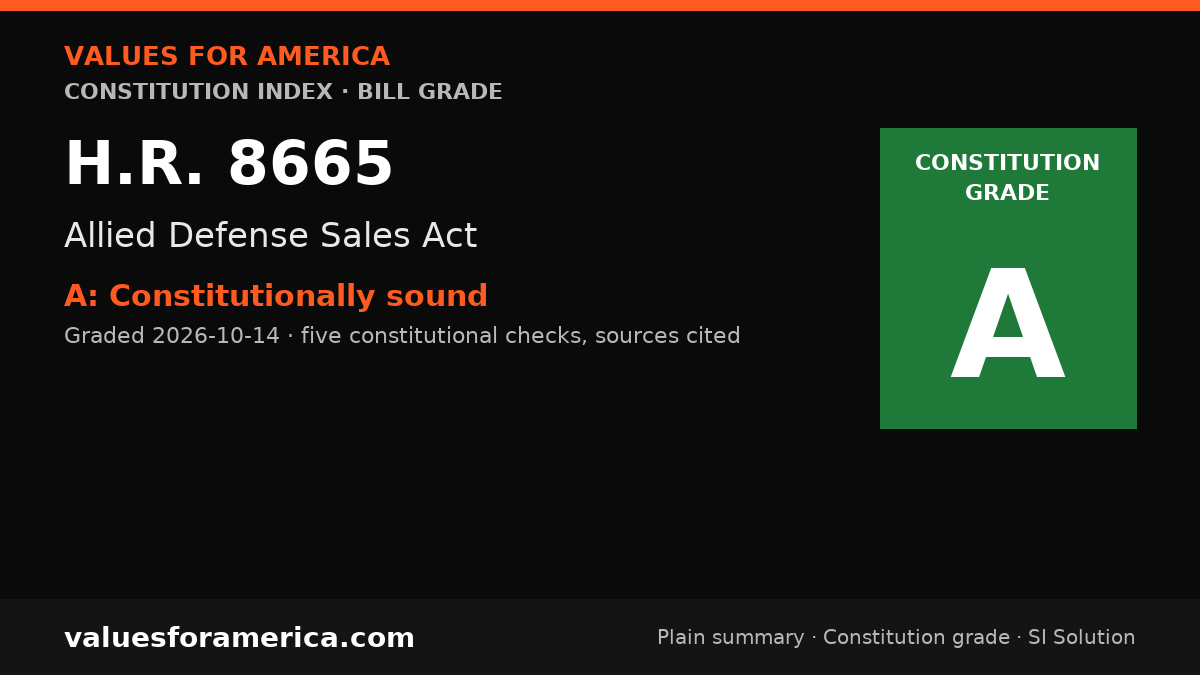
Constitutionally sound
Graded 2026-10-14
SI-generated grade · five published checks · not individually reviewed by a person · methodology
The bill directs the Department of State to implement a strategy for encouraging foreign participation in multinational military procurement, which falls squarely within the federal government's enumerated foreign affairs and defense powers. It does not infringe on any individual rights, does not restrict individual sovereignty, and does not involve domestic decentralization concerns. The bill also does not implicate due process or takings issues.
-
✓ Passes · Enumerated powers
The federal government has explicit constitutional authority over foreign affairs and the military. Article I, Section 8, Clause 11 grants Congress the power to declare war, and Clause 12 grants the power to raise and support armies. Additionally, the President's role as Commander-in-Chief (Article II, Section 2) and the federal government's exclusive authority over foreign commerce (Article I, Se… -
✓ Passes · Bill of Rights
The bill does not implicate any of the first ten amendments. It does not restrict speech, religion, assembly, press, or petition (First Amendment), nor does it affect the right to bear arms (Second Amendment), quartering of soldiers (Third Amendment), search and seizure (Fourth Amendment), self-incrimination or due process (Fifth Amendment), trial rights (Sixth and Seventh Amendments), cruel and u… -
✓ Passes · Individual sovereignty
The bill does not restrict the actions of individuals. It directs the State Department to encourage foreign entities to participate in a procurement process, which is a government-to-government activity. No individual's person, property, speech, labor, or belief is restricted. The burden on government to justify restrictions is not triggered because there is no restriction. -
✓ Passes · Decentralization
The four-question test is not applicable to foreign affairs, which are inherently federal. The Constitution assigns foreign relations and military matters to the federal government exclusively (e.g., Article I, Section 8, Clauses 1, 3, 11-16; Article II, Section 2). An individual, local community, or state cannot handle foreign military sales. The action does not consolidate domestic decision-maki… -
✓ Passes · Due process and takings
The bill does not deprive any person of life, liberty, or property, nor does it take private property for public use. It does not involve any adjudicative or administrative proceedings that would trigger procedural due process. The bill is a directive to the State Department to develop a strategy and report to Congress, which does not affect individual rights.
Sources: Congress.gov: HR 8665 summary
Report an error in this grade
The Framers
“Founders’ Verdict”
Confidence 1.00
Archived SI output (machine-generated)No editorial review recorded. This historical SI verdict was machine-generated by software and predates the review desk; check it against the official bill text.
Synthesis
Unanimous approval: The Allied Defense Sales Act is constitutional under Congress's enumerated powers to regulate commerce with foreign nations (Article I, Section 8, Clause 3) and provide for the common defense (Article I, Section 8, Clause 1), with legislative oversight ensuring balance of powers.
The Allied Defense Sales Act, by its title and referral to the Committee on Foreign Affairs, pertains to the regulation of military sales to allied nations, a measure within the express powers of Congress to provide for the common defense and to regulate commerce with foreign nations. Such authority is indispensable to the Union's security, enabling the national government to strengthen alliances against foreign perils through commercial intercourse in defensive armaments, without encroaching upon the executive's conduct of foreign relations. As I argued, the want of a general authority over f…
The Congress possesses enumerated powers to regulate Commerce with foreign Nations and to provide for the common Defence. Authorizing sales of defense articles to allied nations falls within the regulation of foreign commerce, as such transactions constitute trade in goods produced or held under federal authority for military purposes. This does not exceed delegated powers, for the federal government may dispose of its property and regulate exports to secure the general welfare without usurping reserved powers of the States or the people. Strict construction confines this to appropriations lim…
The proposed legislation, titled Allied Defense Sales Act, pertains to the regulation of defense-related commerce with foreign nations, a matter within the enumerated powers of Congress. The Constitution grants Congress authority to regulate commerce with foreign nations and to provide for the common defense through military establishments. Such sales, when authorized by law, align with the careful balance of powers, ensuring legislative oversight over executive conduct in foreign affairs, while avoiding undue entanglement without declaration of war or treaty. This supports the Union's strengt…
The Allied Defense Sales Act, pertaining to sales of defense articles to allied nations, falls within the enumerated powers of Congress to regulate commerce with foreign nations and to provide for the common defense. Such legislation is a means reasonably adapted to execute these powers, as it facilitates the national security and intercourse with foreign powers through regulated commercial transactions in military materiel. The Constitution vests in Congress the authority to exercise these powers, and judicial review upholds acts of Congress that are plainly within the scope of its constituti…
Report an error in this Founders' Verdict
What should pass
“VFA SI Solution”
Archived SI output (machine-generated) · No editorial review recorded
This historical draft has no editorial review time on record. Check its claims against the original bill and current law.
Allied Defense Sales Streamlining Act of 2025
Generated by VFA SI Solutions
The bill seeks to streamline and expedite U.S. defense equipment sales to allied nations to strengthen collective security and U.S. national defense posture.
Bipartisan rationale: Honors Democratic priorities of alliance strengthening, human rights certifications, and robust congressional oversight; honors Republican priorities of boosting U.S. defense industry jobs, fiscal cost caps, and executive efficiency in national security without new spending.
Article I, Section 8, Clause 1 Article I, Section 8, Clause 3 Article I, Section 8, Clause 11 Article I, Section 9, Clause 7
Report an error in this Solution
Citizen Consensus
“Do you support this VFA SI Solution?”
One vote per verified account; you can change it any time. Only verified accounts count, results publish once 30 verified people have voted, and state and district results count only people who attested a home ZIP code. How this works.
Email verification is not switched on yet, so no vote counts toward results yet. Votes cast now are saved and count once the voter verifies their email address.
Sign in or create a free account to vote.
Add a short reason (optional)
/280 · no links or contact details · reasons are reviewed before anyone sees them, and many never are shown.
Your vote is saved but held out of published results by an automated integrity check (for example, several accounts voting from one browser).
Your vote is saved. It will count once you verify your email address. Verify on your account page.
Your vote counts nationally. Add your home ZIP code to count in your state and district too.
Your vote counts nationally and in .
Reason saved privately; it is shown only if it passes review.
Verified participants nationwide · n =
Self-selected participants, not a random sample; ± is the 95% sampling margin.
Not enough verified votes yet. Results publish at verified votes.
A sudden surge of votes on this item was flagged and is under review; votes from new accounts in that surge are held out until it is resolved.
Related on VFA

For journalists and bloggers
“Embed this grade”
Free to use with the link back. The badge and card update when the grade changes. Embed terms →
