SI-generated Constitutional Solution
International Education Grant Reform and Sunset Act
SI-generated · passed automated checks (Constitution citation, source verification, independent SI critic) · not individually reviewed by a person · Report an error: hello@valuesforamerica.com
Brief for congressional offices →
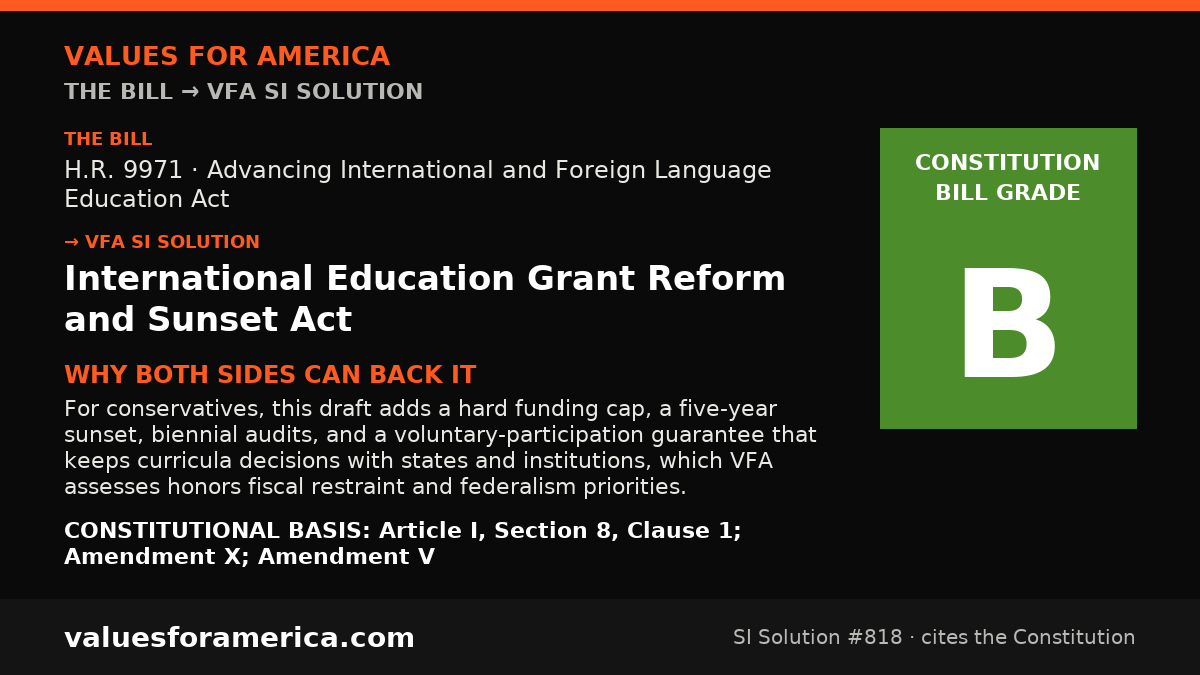
Advancing International and Foreign Language Education Act
International Education Grant Reform and Sunset Act
The bill would reauthorize and revise federal grant programs that support international and foreign language education at institutions of higher education, including language centers, fellowships, and international business education, through fiscal year 2032.
Constitutional concerns with the original
- The bill rests on the spending power in Article I, Section 8, Clause 1. Congress may attach conditions to federal grants, and education grants can serve the general welfare, so the underlying approach is constitutionally sound.
- The strongest objection is that federal grants can erode state control over education. The answer is that grants to institutions remain voluntary: an institution may decline the funds, and Congress can draft conditions so the federal government funds instruction without dictating curricula. The Tenth Amendment reserves to the states or the people any power the Constitution does not delegate to the United States, and the Constitution lists no general federal power over education, so conditions must stay genuinely optional rather than coercive.
- Perpetual reauthorizations without an end date weaken fiscal discipline under the spending power, because grants become a standing obligation rather than a periodically reviewed program.
- The official summary does not show the full bill text, so whether the original conditions leave institutions real flexibility cannot be verified from the record; this proposal adds an explicit flexibility guarantee rather than assuming one exists.
Solution text
Operative provisions
Source basis and limits
Basis: The Congress.gov summary of H.R. 9971 (119th Congress) states that the bill reauthorizes and revises international education programs through FY2032, lists the eight programs above, permits graduate stipends under the Foreign Language and Area Studies Fellowships program, modifies the Technological Innovation and Cooperation for Foreign Information Access program including a possible national database, and renames the Business and International Education program. The record shows the bill was introduced July 27, 2026, and referred to the House Committee on Education and Workforce. The program list, reauthorization window, and fellowship change come directly from that summary. The sunset, funding cap, flexibility guarantee, oversight, and enforcement provisions are new proposals in this draft and are not in the official summary.
Check before relying on this: The full bill text, current-law provisions, eligibility rules, appeal rights, and fiscal effects are not covered by the official summary. The new name for the Business and International Education program is not stated in the summary. Whether the original bill already contains flexibility protections cannot be verified without the full text, so this draft states the guarantee as a new provision. Readers should verify details at the Congress.gov bill page for H.R. 9971.
Bipartisan rationale
For conservatives, this draft adds a hard funding cap, a five-year sunset, biennial audits, and a voluntary-participation guarantee that keeps curricula decisions with states and institutions, which VFA assesses honors fiscal restraint and federalism priorities. For progressives, it continues federal support for language centers, fellowships, overseas research, and international business education, expanding graduate stipends for language study at every proficiency level, which VFA assesses honors priorities of global competitiveness, language access, and educational opportunity.
Constitutional citations
- → Article I, Section 8, Clause 1 (spending power for the general welfare)
- → Tenth Amendment (powers not delegated to the United States are reserved to the states or the people)
- → Fifth Amendment Due Process (notice and an opportunity to respond before debarment)
Article I, Section 8, Clause 1 Amendment X Amendment V
Possible legislative path
In VFA's assessment, members who favor targeted federal grants with spending limits and sunset review, and members who value international language and business education, could each find reasons to support this structure in both chambers, while members opposed to any federal role in education or opposed to a hard funding cap may resist; the bill remains at the House Committee on Education and Workforce, so no floor action has occurred.
Report an error in this Solution

Citizen Consensus
“Do you support this VFA SI Solution?”
One vote per verified account; you can change it any time. Only verified accounts count, results publish once 30 verified people have voted, and state and district results count only people who attested a home ZIP code. How this works.
Email verification is not switched on yet, so no vote counts toward results yet. Votes cast now are saved and count once the voter verifies their email address.
Sign in or create a free account to vote.
Add a short reason (optional)
/280 · no links or contact details · reasons are reviewed before anyone sees them, and many never are shown.
Your vote is saved but held out of published results by an automated integrity check (for example, several accounts voting from one browser).
Your vote is saved. It will count once you verify your email address. Verify on your account page.
Your vote counts nationally. Add your home ZIP code to count in your state and district too.
Your vote counts nationally and in .
Reason saved privately; it is shown only if it passes review.
Verified participants nationwide · n =
Self-selected participants, not a random sample; ± is the 95% sampling margin.
Not enough verified votes yet. Results publish at verified votes.
A sudden surge of votes on this item was flagged and is under review; votes from new accounts in that surge are held out until it is resolved.
Related on VFA
Generated by VFA SI Solutions · 2026.11.14 16:02 UTC · ← Back to the Republic