SI-generated Constitutional Solution
Farmworker Coordination Accountability and Sunset Proposal
SI-generated · passed automated checks (Constitution citation, source verification, independent SI critic) · not individually reviewed by a person · Report an error: hello@valuesforamerica.com
Brief for congressional offices →
Voice for Farm Workers Act
Farmworker Coordination Accountability and Sunset Proposal
The bill aims to keep a USDA Farmworker Coordinator in place and expand the coordinator's duties, so that federal farmworker outreach, coordination, and program measurement are handled by one accountable office. The mechanism is reauthorization through FY2031 plus new duties and staff.
Constitutional concerns with the original
- The official summary does not address funding, so any spending effect of the bill cannot be assessed from this record; a reader should verify funding language in the full bill text.
- An open-ended coordination and staffing mandate, standing without periodic review, risks drifting into roles that states and local governments already perform, a concern under the Tenth Amendment.
- Without a required outcome review, Congress cannot judge whether the coordinator's expanded duties stay within the Spending Clause's grant of spending for the general Welfare.
Solution text
Operative provisions
Source basis and limits
Basis: The Congress.gov summary of S. 5301, 119th Congress, states that the bill reauthorizes the Farmworker Coordinator, part of USDA's Office of Partnerships and Public Engagement, through FY2031; that the coordinator identifies farmworker challenges and coordinates with USDA programs and other federal agencies; that the coordinator must carry out the four listed duties, serve as a liaison to institutions of higher education and local educational agencies, consult with community-based nonprofit organizations on technical skills and job training, and hire necessary staff. The record states the bill was introduced August 6, 2026, and referred to the Senate Committee on Agriculture, Nutrition, and Forestry.
Check before relying on this: The full bill text and current law are not covered by the official summary. Funding levels, appropriations language, existing coordinator authority, eligibility rules, and appeal rights are unverified and should be checked at the Congress.gov bill page. The sunset, spending cap, audit cycle, withholding rule, and no-preemption clause are new proposals from this analysis, not parts of S. 5301 as summarized. The stored latest action may lag the official record, so readers should confirm current status at the Congress.gov page.
Bipartisan rationale
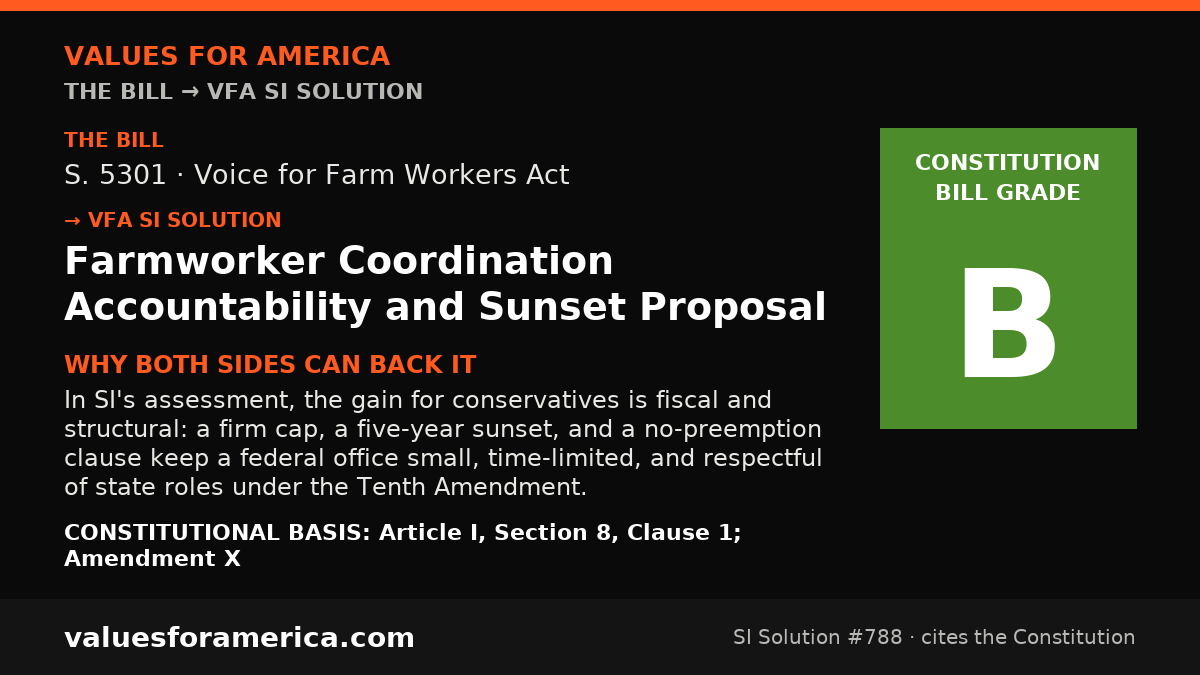
In SI's assessment, the gain for conservatives is fiscal and structural: a firm cap, a five-year sunset, and a no-preemption clause keep a federal office small, time-limited, and respectful of state roles under the Tenth Amendment. The gain for progressives is substantive: the coordinator's full duties survive, including outreach coordination, outcome measurement, liaison work with educational institutions, and consultation with community-based nonprofits, which the official summary presents as serving the farmworker community's needs. Both sides get a record they can audit: the Inspector General reports would tell Congress whether the office works before any reauthorization vote.
Constitutional citations
- → Article I, Section 8, Clause 1 (Spending Clause: Congress may spend for the general Welfare, which authorizes funding the coordinator's duties within USDA's existing programs)
- → Tenth Amendment (powers not delegated to the United States are reserved to the states; the no-preemption clause and liaison-only role guard this line)
Article I, Section 8, Clause 1 Amendment X
Possible legislative path
In the Senate, interests favoring farmworker services and better-run USDA programs could support the proposal, while interests opposed to new federal staffing or any coordinator office could oppose it; in the House, similar arguments for fiscal guardrails and against federal involvement would frame the debate. No official roll-call or vote analysis is available for this draft, and this statement makes no vote forecast.
Report an error in this Solution

Citizen Consensus
“Do you support this VFA SI Solution?”
One vote per verified account; you can change it any time. Only verified accounts count, results publish once 30 verified people have voted, and state and district results count only people who attested a home ZIP code. How this works.
Email verification is not switched on yet, so no vote counts toward results yet. Votes cast now are saved and count once the voter verifies their email address.
Sign in or create a free account to vote.
Add a short reason (optional)
/280 · no links or contact details · reasons are reviewed before anyone sees them, and many never are shown.
Your vote is saved but held out of published results by an automated integrity check (for example, several accounts voting from one browser).
Your vote is saved. It will count once you verify your email address. Verify on your account page.
Your vote counts nationally. Add your home ZIP code to count in your state and district too.
Your vote counts nationally and in .
Reason saved privately; it is shown only if it passes review.
Verified participants nationwide · n =
Self-selected participants, not a random sample; ± is the 95% sampling margin.
Not enough verified votes yet. Results publish at verified votes.
A sudden surge of votes on this item was flagged and is under review; votes from new accounts in that surge are held out until it is resolved.
Related on VFA
Generated by VFA SI Solutions · 2026.11.12 16:03 UTC · ← Back to the Republic