S. 5301 explained · 119th Congress · Pending in Congress
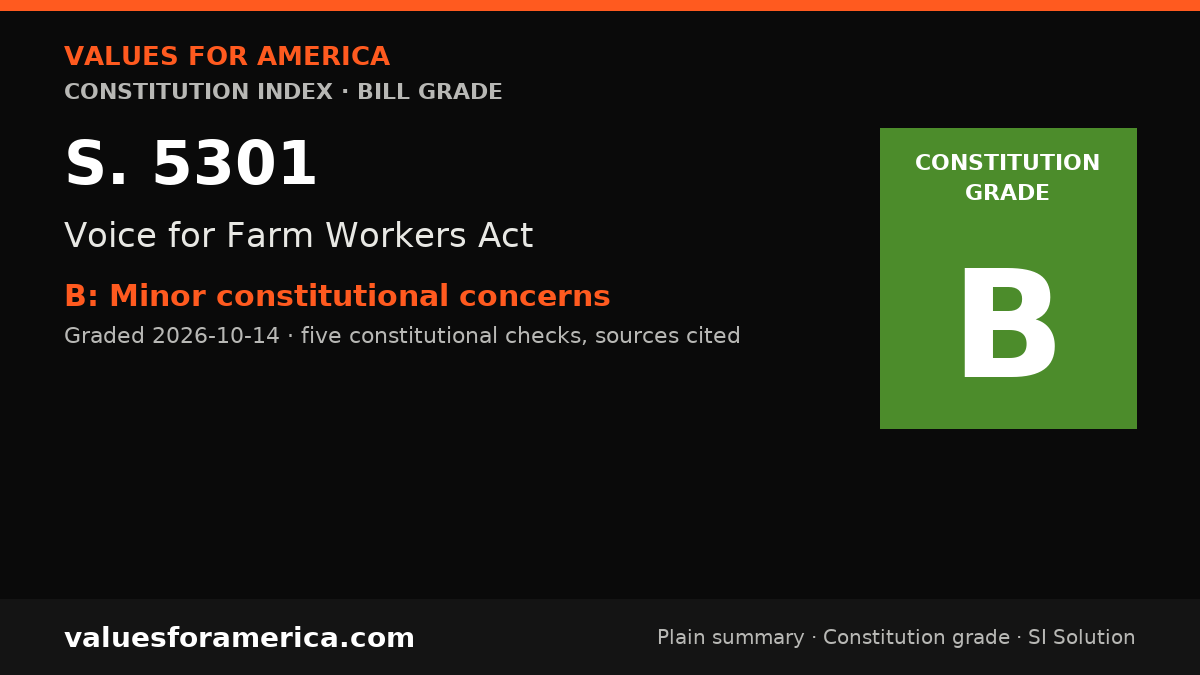
Voice for Farm Workers Act
Cosponsors: 7 (7 D, 0 R) · per Congress.gov, 2026-10-14
Introduced: 2026-08-06
Latest action (2026-08-06): Read twice and referred to the Committee on Agriculture, Nutrition, and Forestry. (Sponsor introductory remarks on measure: CR S4519)
What S. 5301 does, in plain terms
Voice for Farm Workers Act This bill reauthorizes and expands the duties of the Farmworker Coordinator at the Department of Agriculture (USDA). (Part of the Office of Partnerships and Public Engagement, the coordinator identifies challenges faced by farmworkers and coordinates with USDA programs and other federal agencies to address the community’s needs.) The bill reauthorizes the position of Farmworker Coordinator through FY2031. Among other things, the bill also requires the coordinator to develop and implement a plan to coordinate USDA farmworker outreach activities and services, collaborate with USDA's agencies and offices on farmworker-related programmatic and policy decisions, communicate to employers of farmworkers information about federal programs for which their employees may be eligible, and measure and analyze the outcomes of USDA farmworker programs and activities. Further, the bill expands the coordinator's existing duties to include (1) serving as a liaison to institutions of higher education and local educational agencies, and (2) consulting with community-based nonprofit organizations on areas such as technical skills and job training programs. The bill also directs the coordinator to hire the staff who are necessary to carry out the coordinator's activities.
Official summary by the Congressional Research Service, via Congress.gov.
Constitution Index
“VFA Constitution grade”
Minor constitutional concerns
Graded 2026-10-14
SI-generated grade · five published checks · not individually reviewed by a person · methodology
The bill operates within the federal government's enumerated powers over agriculture and interstate commerce, and it does not infringe on individual rights. However, it consolidates farmworker outreach and coordination at the federal level, which could be handled more locally, raising minor decentralization concerns. The bill is otherwise sound and does not violate due process or takings principles.
-
✓ Passes · Enumerated powers
The bill authorizes activities within the Department of Agriculture, which falls under the federal government's enumerated powers to regulate interstate and foreign commerce (Article I, Section 8, Clause 3) and to provide for the general welfare (Article I, Section 8, Clause 1). Farmworker outreach and coordination directly relate to agricultural labor markets, which are part of interstate commerc… -
✓ Passes · Bill of Rights
The bill does not restrict speech, religion, assembly, press, petition, arms, quartering, search and seizure, self-incrimination, due process, takings, fair trial, jury, cruel and unusual punishment, or unenumerated rights. It merely establishes a federal coordinator to facilitate outreach and communication, which does not infringe on any enumerated rights. -
✓ Passes · Individual sovereignty
The bill does not restrict individual liberty. It imposes no mandates on individuals, employers, or farmworkers. Instead, it creates a federal office to coordinate services and information, which is a permissible government function. The burden of justification for any restriction is not triggered because no restriction exists. -
✗ Concern · Decentralization
The bill fails the decentralization test because it consolidates farmworker outreach and coordination at the federal level, whereas states and local communities could handle these activities more effectively. While the federal government has a role in interstate agricultural commerce, the specific duties—such as liaising with local educational agencies and community-based nonprofits—are inherently… -
✓ Passes · Due process and takings
The bill does not deprive any person of life, liberty, or property without due process of law. It does not impose penalties, take property, or affect legal rights. The Fifth Amendment's Takings Clause is not implicated because no property is taken. The bill's provisions are administrative and do not bypass procedural or substantive due process.
Sources: Congress.gov: S 5301 summary
Report an error in this grade
What should pass
“VFA SI Solution”
No solution yet
A sourced SI draft appears here once it passes automated checks (Constitution citation, source verification, independent SI critic). How publication works.
Related on VFA

For journalists and bloggers
“Embed this grade”
Free to use with the link back. The badge and card update when the grade changes. Embed terms →
