Archived SI output (machine-generated)
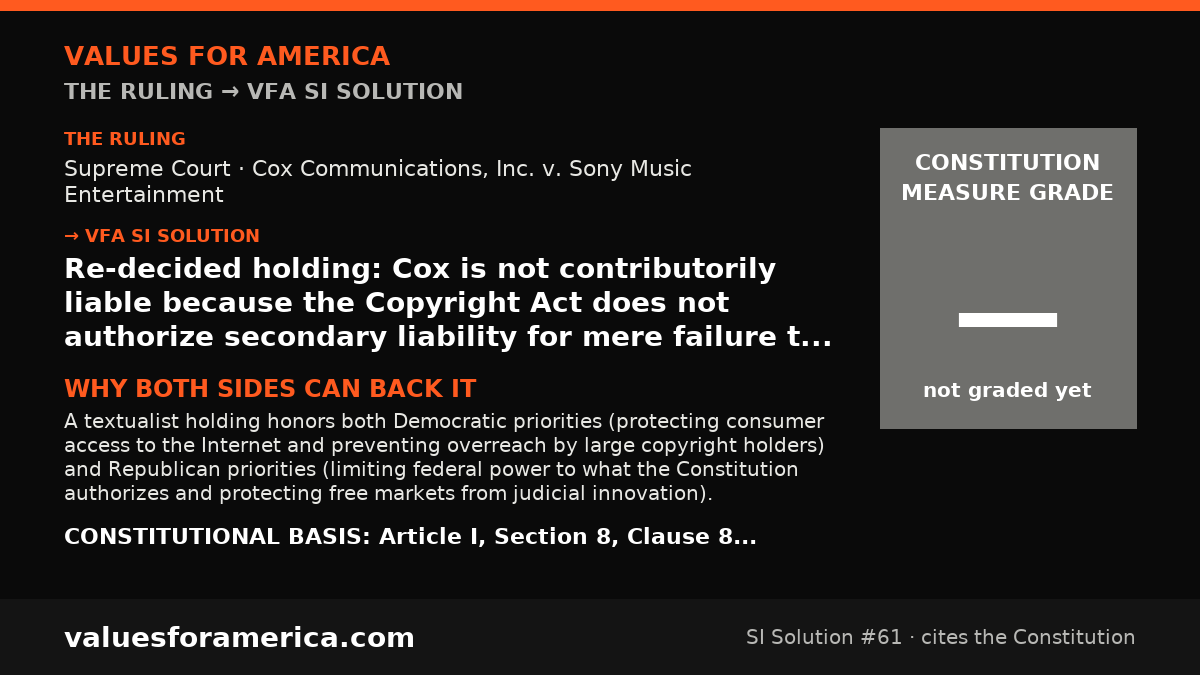
Re-decided holding: Cox is not contributorily liable because the Copyright Act does not authorize secondary liability for mere failure to terminate service, and any such liability must be created by Congress under Article I, Section 8, Clause 8, with clear statutory language.
Archived SI output (machine-generated) · No editorial review recorded
This historical SI draft was machine-generated by software and has no editorial review time on record. Verify its factual and legal claims against the original source before relying on it.
Cox Communications, Inc. v. Sony Music Entertainment
Clarence Thomas
Re-decided holding: Cox is not contributorily liable because the Copyright Act does not authorize secondary liability for mere failure to terminate service, and any such liability must be created by Congress under Article I, Section 8, Clause 8, with clear statutory language.
Whether an Internet service provider can be held contributorily liable for copyright infringement by its subscribers solely because it continued to provide service after receiving notices of infringement, without having induced the infringement or provided a service tailored to infringement.
Constitutional concerns with the original
- The majority opinion relies on post-1900 judicial precedents (Grokster, Sony, Kalem) to define contributory liability, rather than deriving the standard from the text of the Copyright Act or the original meaning of Article I, Section 8, Clause 8.
- The opinion creates a judge-made rule for secondary liability that is not found in the statutory text, which only defines direct infringement (17 U.S.C. §501(a)). This exceeds the judicial role by effectively legislating a new cause of action.
- The holding restricts states' traditional police powers over tort and contract remedies, as the Tenth Amendment reserves to states the authority to define and remedy harms like contributory infringement, absent clear congressional authorization.
Solution text
Operative provisions
Bipartisan rationale
A textualist holding honors both Democratic priorities (protecting consumer access to the Internet and preventing overreach by large copyright holders) and Republican priorities (limiting federal power to what the Constitution authorizes and protecting free markets from judicial innovation). Both parties can agree that Congress, not the courts, should decide whether to impose new liability on ISPs, and that the Tenth Amendment reserves this area to state law unless Congress acts clearly.
Constitutional citations
- → Article I, Section 8, Clause 8
- → Tenth Amendment
- → Federalist No. 43 (Madison on copyright and limited federal power)
Report an error in this Solution

Citizen Consensus
“Do you support this VFA SI Solution?”
One vote per verified account; you can change it any time. Only verified accounts count, results publish once 30 verified people have voted, and state and district results count only people who attested a home ZIP code. How this works.
Email verification is not switched on yet, so no vote counts toward results yet. Votes cast now are saved and count once the voter verifies their email address.
Sign in or create a free account to vote.
Add a short reason (optional)
/280 · no links or contact details · reasons are reviewed before anyone sees them, and many never are shown.
Your vote is saved but held out of published results by an automated integrity check (for example, several accounts voting from one browser).
Your vote is saved. It will count once you verify your email address. Verify on your account page.
Your vote counts nationally. Add your home ZIP code to count in your state and district too.
Your vote counts nationally and in .
Reason saved privately; it is shown only if it passes review.
Verified participants nationwide · n =
Self-selected participants, not a random sample; ± is the 95% sampling margin.
Not enough verified votes yet. Results publish at verified votes.
A sudden surge of votes on this item was flagged and is under review; votes from new accounts in that surge are held out until it is resolved.
Generated by VFA SI Solutions · 2026.05.24 06:00 UTC · ← Back to the Republic