SI-generated Constitutional Solution
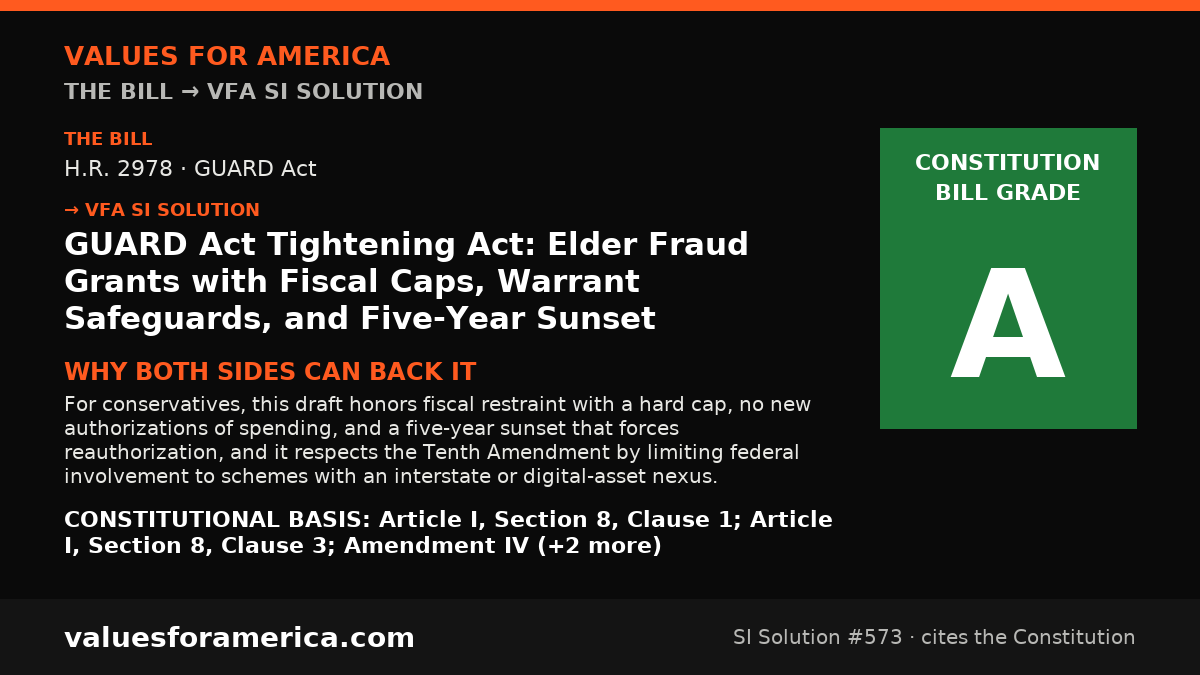
GUARD Act Tightening Act: Elder Fraud Grants with Fiscal Caps, Warrant Safeguards, and Five-Year Sunset
SI-generated · passed automated checks (Constitution citation, source verification, independent SI critic) · not individually reviewed by a person · Report an error: hello@valuesforamerica.com
Brief for congressional offices →
GUARD Act
GUARD Act Tightening Act: Elder Fraud Grants with Fiscal Caps, Warrant Safeguards, and Five-Year Sunset
The bill aims to help state, local, and tribal police fight financial scams that target older Americans, including a cryptocurrency confidence fraud known as pig butchering, by letting certain grant funds be used for those investigations, letting federal agencies help with blockchain tracing, and requiring FinCEN reports on the problem.
Constitutional concerns with the original
- The grant redirection may rely on the Spending Clause power without clear limits, so the SI draft adds a defined ceiling and reporting so spending stays an exercise of Article I, Section 8, Clause 1 rather than open-ended direction of state police functions.
- Federal assistance with blockchain tracing tools, if unguided, could drift into searches of financial records without warrants; the SI draft adds new warrant and consent safeguards grounded in the Fourth Amendment.
- A broad definition of 'general financial fraud' could pull purely local crimes into federally funded activity; scope should be tied to schemes with an interstate or digital-asset nexus under Article I, Section 8, Clause 3.
- FinCEN reporting duties are a proper enumerated-power exercise but should be time-limited so Congress must renew them rather than let mandates continue by default.
Solution text
Operative provisions
Source basis and limits
Basis: The Congress.gov summary of the GUARD Act (H.R. 2978, 119th Congress) supports the facts that the bill would allow state, local, and tribal law enforcement agencies and grantees of certain law enforcement grant programs to use funds for general financial fraud, elder financial fraud, and pig butchering investigations; that federal agencies could assist those agencies and fusion centers with blockchain tracing tools; and that FinCEN would produce two reports, one on combating these frauds with legislative recommendations and one on trends in these crimes. The summary also states the bill defines pig butchering and that the latest recorded action is placement on the Senate Legislative Calendar under General Orders, Calendar No. 627.
Check before relying on this: The official summary does not supply the full bill text, the specific grant programs covered, existing eligibility rules, current penalties, fiscal cost estimates, or statutory conflicts, so readers should verify those details at the Congress.gov bill page. The funding cap, interstate nexus limit, warrant safeguard, quarterly reports, sunset, Inspector General audits, and clawback are new proposals in this draft, not provisions in the original bill. This draft does not authorize new appropriations, but the fiscal effects of the original bill are not stated in the official summary. The bill's current status, whether it has passed either chamber, and any eligibility or appeal rights are not stated in the summary and should be confirmed at the official source.
Bipartisan rationale
For conservatives, this draft honors fiscal restraint with a hard cap, no new authorizations of spending, and a five-year sunset that forces reauthorization, and it respects the Tenth Amendment by limiting federal involvement to schemes with an interstate or digital-asset nexus. For progressives, it honors protection of older Americans and scam victims, keeps resources flowing to elder fraud enforcement, and adds new privacy safeguards requiring warrants or consent before tracing tools target an identified person, reinforcing the Fourth Amendment. In SI's assessment, each side gains its core priority without surrendering the other's.
Constitutional citations
- → Article I, Section 8, Clause 1
- → Article I, Section 8, Clause 3
- → Amendment IV
- → Amendment V
- → Amendment X
Article I, Section 8, Clause 1 Article I, Section 8, Clause 3 Amendment IV Amendment V Amendment X
Possible legislative path
In the House, members focused on elder protection and consumer safety would likely support it, while members wary of any federal role in local policing or concerned about tracing tools might oppose unless the warrant safeguards are emphasized; in the Senate, fraud and judiciary-focused members of both parties would likely find the sunset, cap, and FinCEN reporting a workable compromise, with the strongest objection expected from those who want either unlimited grant flexibility or no tracing assistance at all.
Report an error in this Solution

Citizen Consensus
“Do you support this VFA SI Solution?”
One vote per verified account; you can change it any time. Only verified accounts count, results publish once 30 verified people have voted, and state and district results count only people who attested a home ZIP code. How this works.
Email verification is not switched on yet, so no vote counts toward results yet. Votes cast now are saved and count once the voter verifies their email address.
Sign in or create a free account to vote.
Add a short reason (optional)
/280 · no links or contact details · reasons are reviewed before anyone sees them, and many never are shown.
Your vote is saved but held out of published results by an automated integrity check (for example, several accounts voting from one browser).
Your vote is saved. It will count once you verify your email address. Verify on your account page.
Your vote counts nationally. Add your home ZIP code to count in your state and district too.
Your vote counts nationally and in .
Reason saved privately; it is shown only if it passes review.
Verified participants nationwide · n =
Self-selected participants, not a random sample; ± is the 95% sampling margin.
Not enough verified votes yet. Results publish at verified votes.
A sudden surge of votes on this item was flagged and is under review; votes from new accounts in that surge are held out until it is resolved.
Related on VFA
Generated by VFA SI Solutions · 2026.10.27 15:14 UTC · ← Back to the Republic