H.R. 2978 explained · 119th Congress · Pending in Congress
GUARD Act
Cosponsors: 54 (24 D, 30 R) · per Congress.gov, 2026-10-14
Introduced: 2025-04-21
Latest action (2026-09-16): Received in the Senate. Read twice. Placed on Senate Legislative Calendar under General Orders. Calendar No. 627.
What H.R. 2978 does, in plain terms
Guarding Unprotected Aging Retirees from Deception Act of 2026 or the GUARD Act of 2026 This bill allows state, local, and tribal law enforcement agencies and grantees that receive funds from certain law enforcement grant programs to use the funds to investigate general financial fraud, elder financial fraud, and pig butchering. Pig butchering refers to a confidence and investment fraud in which a victim is gradually lured into transferring increasing amounts of money, generally in the form of cryptocurrency, into a fake virtual investment. The bill allows federal law enforcement agencies to assist state, local, and tribal law enforcement agencies and fusion centers in the use of tracing tools for blockchain and related technology tools. Finally, the bill requires the Financial Crimes Enforcement Network (FinCEN) to report on efforts to combat general financial fraud, elder financial fraud, pig butchering, and scams, including an evaluation of any legislative recommendations to improve the efforts. The bill also requires FinCEN to report on the state of general financial fraud, elder financial fraud, pig butchering, and scams in the United States, including trends in the crimes.
Official summary by the Congressional Research Service, via Congress.gov.
Constitution Index
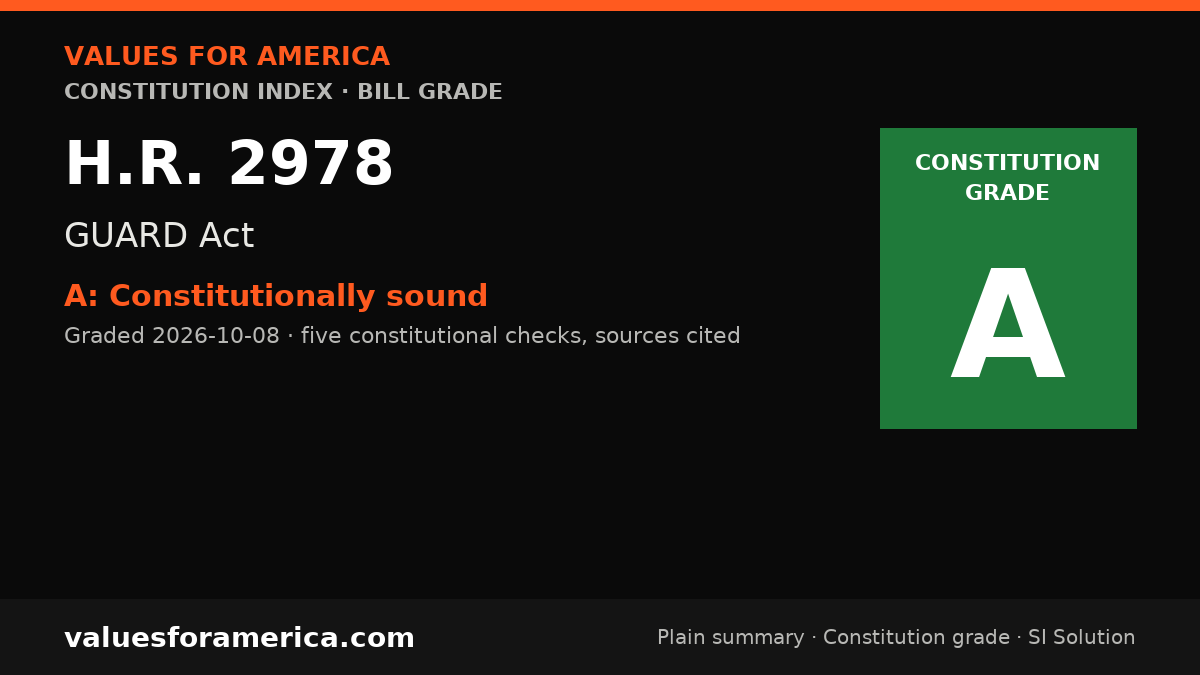
“VFA Constitution grade”
Constitutionally sound
Graded 2026-10-08
SI-generated grade · five published checks · not individually reviewed by a person · methodology
The GUARD Act is constitutionally sound. It uses existing spending authority to let state, local, and tribal agencies investigate financial and elder fraud, offers voluntary federal blockchain-tracing assistance, and requires FinCEN reports. It creates no new crime, mandate, search authority, or taking, and it decentralizes enforcement rather than concentrating federal power.
-
✓ Passes · Enumerated powers
Congress has authority to appropriate funds and to condition federal law-enforcement grants under Article I, Section 8, Clause 1 (Spending Clause, general Welfare) and to carry related measures into execution under Article I, Section 8, Clause 18 (Necessary and Proper Clause). Regulation of interstate fraud and cryptocurrency-based investment schemes is further supported by Article I, Section 8, C… -
✓ Passes · Bill of Rights
The bill creates no restriction on speech, religion, press, assembly, or petition under the First Amendment, no arms regulation under the Second Amendment, and no search, seizure, or surveillance mandate under the Fourth Amendment. It merely permits existing grantees to use funds for fraud investigation and permits federal technical assistance. It does not authorize warrantless searches, compelled… -
✓ Passes · Individual sovereignty
The bill restricts no personal conduct, property use, speech, labor, or belief. It does not criminalize victim behavior, possession of cryptocurrency, or private investment decisions. It targets perpetrators of deception and supports victims of elder fraud. The burden test is satisfied because no liberty is curtailed and no justification is therefore required beyond the legitimate protection of pe… -
✓ Passes · Decentralization
(1) Individual/family cannot handle organized interstate elder fraud and blockchain tracing alone, so federal or state investigative support is appropriate. (2) Local and county agencies can investigate fraud, and the bill empowers them to do so. (3) States can handle fraud enforcement, and the bill preserves that role. (4) The bill does not consolidate decision-making upward: it leaves use of fun… -
✓ Passes · Due process and takings
The bill authorizes investigation and reporting only. It creates no criminal penalty, civil forfeiture, arrest authority, or property seizure, and therefore triggers no procedural due process, presumption-of-innocence, or Fifth Amendment Takings Clause issue. Any future prosecution arising from investigations would remain subject to the Fifth Amendment Due Process Clause and Sixth Amendment fair-t…
Sources: Congress.gov: HR 2978 summary
Report an error in this grade
What should pass
“VFA SI Solution”
No solution yet
A sourced SI draft appears here once it passes automated checks (Constitution citation, source verification, independent SI critic). How publication works.
Related on VFA

For journalists and bloggers
“Embed this grade”
Free to use with the link back. The badge and card update when the grade changes. Embed terms →
