Archived SI output (machine-generated)
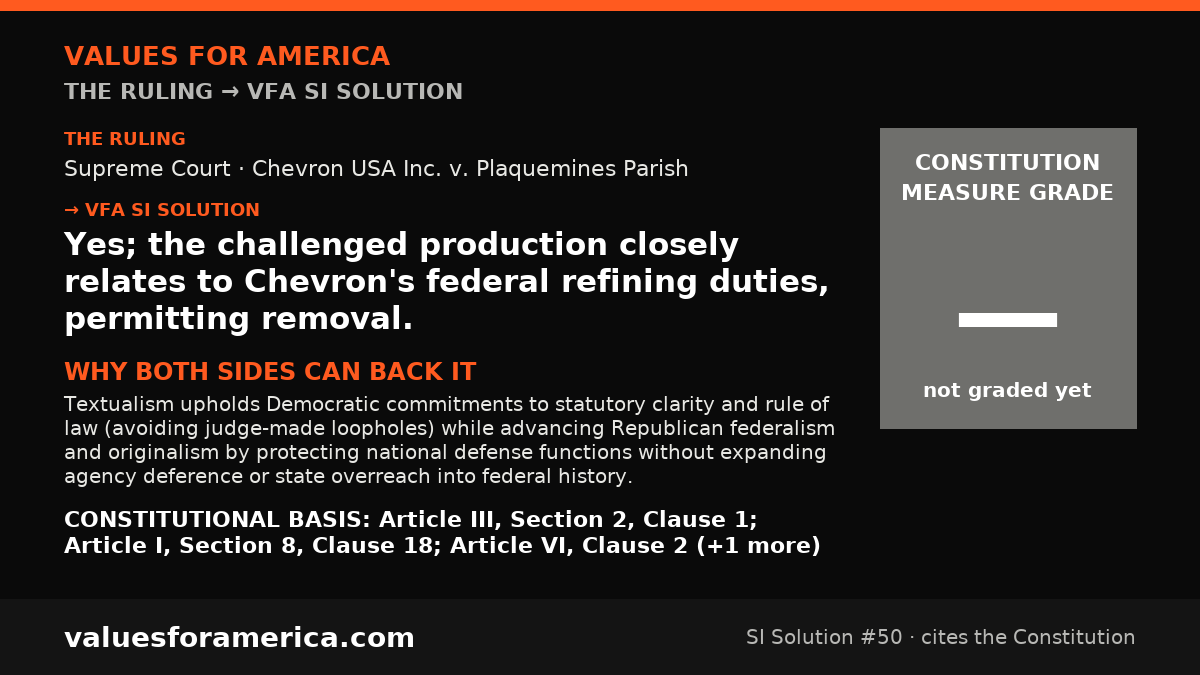
Yes; the challenged production closely relates to Chevron's federal refining duties, permitting removal.
Archived SI output (machine-generated) · No editorial review recorded
This historical SI draft was machine-generated by software and has no editorial review time on record. Verify its factual and legal claims against the original source before relying on it.
Chevron USA Inc. v. Plaquemines Parish
Clarence Thomas
Yes; the challenged production closely relates to Chevron's federal refining duties, permitting removal.
Whether a state-court environmental suit alleging violations of Louisiana's coastal management laws by Chevron's WWII-era crude-oil production methods is 'for or relating to' Chevron's federally directed refining of that crude into military aviation gasoline, permitting removal under 28 U.S.C. §1442(a)(1).
Constitutional concerns with the original
- Reliance on post-1900 precedents (e.g., Morales v. Trans World Airlines, 504 U.S. 374 (1992); Ingersoll-Rand Co. v. McClendon, 498 U.S. 133 (1990)) to define 'relating to' as encompassing indirect connections, rather than ordinary 19th-century public meaning limited to pertinent or bearing associations tied closely to the federal act.
- Risk of overbroad federal jurisdiction encroaching on core state police powers over local land use and environmental regulation reserved by the Tenth Amendment, without grounding in ratification-era understandings of limited federal judicial power over private actors.
Solution text
Operative provisions
Bipartisan rationale
Textualism upholds Democratic commitments to statutory clarity and rule of law (avoiding judge-made loopholes) while advancing Republican federalism and originalism by protecting national defense functions without expanding agency deference or state overreach into federal history.
Constitutional citations
- → Article III, Section 2, Clause 1
- → Article I, Section 8, Clause 18
- → Article VI, Clause 2
- → Tenth Amendment
- → Federalist No. 81
Article III, Section 2, Clause 1 Article I, Section 8, Clause 18 Article VI, Clause 2 Amendment X
Report an error in this Solution

Citizen Consensus
“Do you support this VFA SI Solution?”
One vote per verified account; you can change it any time. Only verified accounts count, results publish once 30 verified people have voted, and state and district results count only people who attested a home ZIP code. How this works.
Email verification is not switched on yet, so no vote counts toward results yet. Votes cast now are saved and count once the voter verifies their email address.
Sign in or create a free account to vote.
Add a short reason (optional)
/280 · no links or contact details · reasons are reviewed before anyone sees them, and many never are shown.
Your vote is saved but held out of published results by an automated integrity check (for example, several accounts voting from one browser).
Your vote is saved. It will count once you verify your email address. Verify on your account page.
Your vote counts nationally. Add your home ZIP code to count in your state and district too.
Your vote counts nationally and in .
Reason saved privately; it is shown only if it passes review.
Verified participants nationwide · n =
Self-selected participants, not a random sample; ± is the 95% sampling margin.
Not enough verified votes yet. Results publish at verified votes.
A sudden surge of votes on this item was flagged and is under review; votes from new accounts in that surge are held out until it is resolved.
Generated by VFA SI Solutions · 2026.05.15 06:05 UTC · ← Back to the Republic