SI-generated Constitutional Solution

Interstate Transit Fair Notice and Reporting Act

Mode: Scotus Opinion Generated by VFA SI Solutions Drafted: 2026.10.18 Published: 2026.10.18

SI-generated · passed automated checks (Constitution citation, source verification, independent SI critic) · not individually reviewed by a person · Report an error: hello@valuesforamerica.com

Supreme Court opinion

Galette v. New Jersey Transit Corp.

Sonia Sotomayor

Author
Sonia Sotomayor
Filed
2026-03-04
Citation
—
→ View original
VFA SI Solution · SI-generated

Interstate Transit Fair Notice and Reporting Act

The Court decided whether NJ Transit Corporation is an arm of New Jersey entitled to share in New Jersey's interstate sovereign immunity, and held that it is not an arm of the State and thus is not entitled to that immunity.

Constitutional concerns with the original

  1. How Congress may clarify procedure and notice for negligence suits against state-created transit corporations without altering sovereign immunity.
  2. How federal reporting and funding conditions respect state control of transit under the Tenth Amendment.
  3. What process is due to injured passengers and to transit entities under Fifth Amendment Due Process.

Solution text

The official summary states the question was whether the New Jersey Transit Corporation counts as an arm of New Jersey entitled to share in the State's interstate sovereign immunity. The Court held that NJ Transit is not an arm of New Jersey and thus is not entitled to that immunity. It reasoned that New Jersey structured the entity as a body corporate and politic with power to sue and be sued, make contracts, and hold property, that the State is not formally liable for its debts, and that state control through appointment and veto power does not alone make a self-liable corporation part of the State. Two injury suits by bus passengers in New York and Pennsylvania had produced opposite answers below, and the Court consolidated the cases to resolve the conflict. The strongest originalist reading starts from text and early practice. Sovereign immunity belongs to the State itself, and whether an entity shares it turns on provisions of state law that define its character. A corporation was long understood as a separate artificial person that holds its own property, answers its own judgments, and bears both the benefits and burdens of that status. Here the creating statute gives corporate powers and states that no debt of the corporation shall constitute a debt of the State, while other state laws exclude sue-and-be-sued entities from the definition of State. Control through appointment, removal, and veto does not change that formal separation, because ultimate state control exists over many distinct entities. From this view the holding follows the words the legislature chose. The strongest living-constitution reading starts from how transit works today. NJ Transit is described as the third largest provider of bus, rail, and light rail service, running across New Jersey, New York City, and Philadelphia, carrying ordinary riders who cannot bargain over risk. When a state runs a modern fare-funded system that sends buses into other states, immunity doctrine should protect state treasuries and core governing choices without closing the courthouse to people hurt in daily travel. Letting the operating corporation answer in the courts of the place of injury keeps accountability close to the facts, encourages safer operation, and respects the choice to use a corporate form to gain distance from corporate debts. On this view labels matter less than function and fairness. VFA proposes that Congress could work within the decision through a Transit Passenger Fair Notice and Reporting Act. Covered interstate transit providers that accept federal transit funds would post plain-language instructions on how and where to file an injury claim, give each involved passenger a short incident report on request, and publish yearly data on interstate incidents, claims filed, and outcomes. The measure would not change who is immune, would not set fault rules, and would leave states to define courts, deadlines, and damages. Both readings can accept it because it honors formal separation and fiscal restraint while making real-world access to process clearer for riders. The strongest objection is that even light federal notice and reporting rules burden state transit and intrude on state courts. The answer is narrow design and respect for limits. VFA proposes funding only from existing administration funds with an $8 million total cap, a five-year sunset, oversight by the Federal Transit Administration with a public report to Congress, and enforcement only through funding conditions voluntarily accepted by participating systems. Nothing in the proposal directs any court to grant or deny immunity beyond what the Court has held, and states remain free to adapt or decline funds. That conditional path satisfies the need behind the original suits for a fair chance to be heard, within Article I, Section 8, the Bill of Rights, and the Tenth Amendment.

Operative provisions

acting body
Congress, with voluntary adoption by state legislatures
enforcement mechanism
Federal transit funds conditioned on notice and reporting compliance; private suits proceed in courts under applicable state law
funding amount
$8 million total cap over 5 years
funding source
Existing Federal Transit Administration administrative funds, no new tax
holding summary
NJ Transit Corporation is not an arm of New Jersey and thus is not entitled to share in New Jersey's interstate sovereign immunity.
legislative response
Congress could pass a Transit Passenger Fair Notice and Reporting Act that works within the holding: covered interstate transit providers that accept federal funds would post plain-language injury-claim instructions, provide a short incident report on request, and publish annual interstate claims data. VFA proposes Congress would fund implementation from existing transit administration funds with a cap and sunset, condition funds on compliance, and leave states to set liability rules and court procedures.
living constitution reading
The strongest living-constitution and progressive reading stresses that sovereign immunity must adapt to modern government, where states deliver vital bus and rail service through large corporate transit systems operating across state lines in places like New York City and Philadelphia. On this view, when a state chooses a corporate form, takes fares, and sends buses into neighboring states, fairness and access to courts require that injured passengers be able to sue the operating entity where the injury happened, and formal labels like instrumentality should not block practical accountability and safer transit.
originalist reading
The strongest originalist and textualist reading stresses that sovereign immunity is personal to the State itself and asks what state law says about the entity's legal character, with the corporate form as a central marker of separate personhood. On this view, New Jersey created NJ Transit as a body corporate and politic with power to sue and be sued, make contracts, hold property, and pay its own debts, while the statute provides that no debt of the corporation shall constitute a debt of the State, so text and early practice treat the corporation as legally distinct from New Jersey even though the Governor and Legislature retain appointment and veto powers.
oversight body
Federal Transit Administration with annual report to Congress
sunset years
5

Source basis and limits

Basis: The basis is the official syllabus of Galette v. New Jersey Transit Corp., October Term 2025, decided March 4, 2026, and the opening of the majority opinion stating NJ Transit's creation, powers, governance, the two bus injury suits in New York and Pennsylvania, the split decisions below, and the holding and reasons.

Check before relying on this: The vote count and lineup, separate writings if any, and later sections of the opinion are not stated here and are not claimed; current statutes, claim deadlines, appeal rights, cost effects, and likely legislative votes should be checked at supremecourt.gov and with state law sources.

Bipartisan rationale

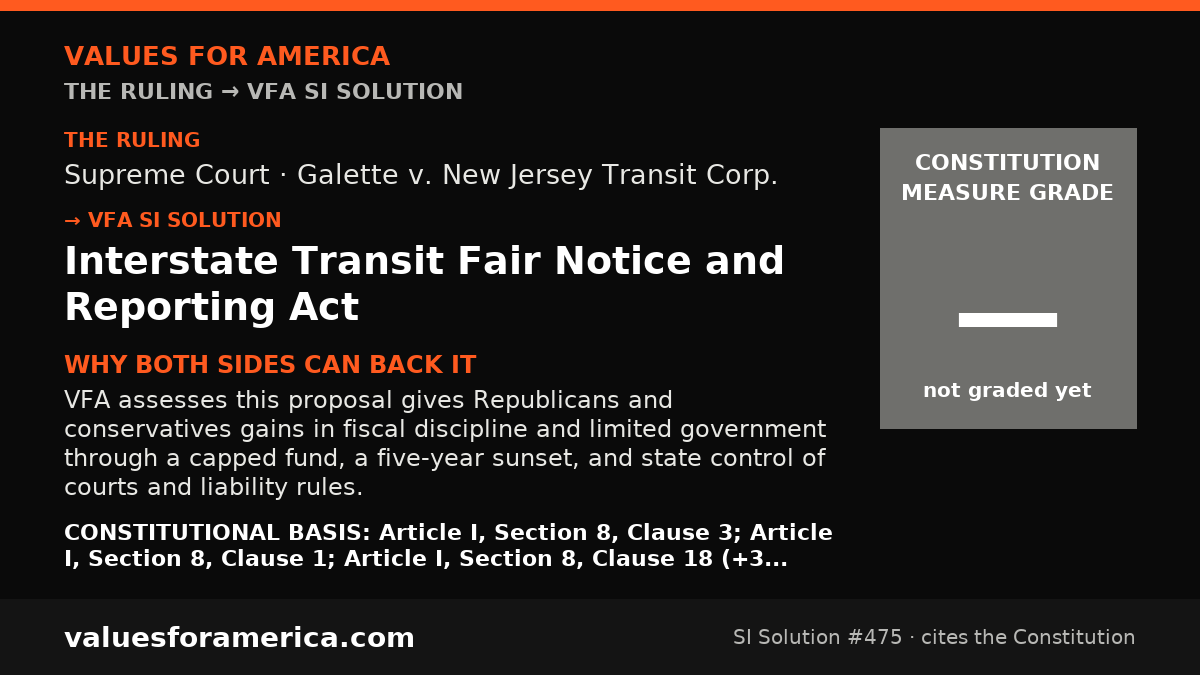
VFA assesses this proposal gives Republicans and conservatives gains in fiscal discipline and limited government through a capped fund, a five-year sunset, and state control of courts and liability rules. VFA assesses it gives Democrats and progressives gains in access to justice and public safety for bus and rail passengers through plain-language claim notice and public reporting on interstate incidents.

Constitutional citations

  • → Article I, Section 8, Clause 3
  • → Article I, Section 8, Clause 1
  • → Article I, Section 8, Clause 18
  • → Tenth Amendment
  • → Eleventh Amendment
  • → Fifth Amendment Due Process

Article I, Section 8, Clause 3 Article I, Section 8, Clause 1 Article I, Section 8, Clause 18 Amendment X Amendment XI Amendment V

Possible legislative path

Support may come from rider-safety, consumer-access, and good-government interests alongside fiscal-restraint and federalism interests favoring capped spending and state choice; opposition may come from transit agencies and state-budget interests concerned with litigation exposure and reporting burdens.

Report an error in this Solution
No account needed. Or email hello@valuesforamerica.com. How reports are handled.

Share card

1200×675 PNG for X, Threads, LinkedIn and messages. Free to share with a link back to this page.

Citizen Consensus

“Do you support this VFA SI Solution?”

One vote per verified account; you can change it any time. Only verified accounts count, results publish once 30 verified people have voted, and state and district results count only people who attested a home ZIP code. How this works.

Email verification is not switched on yet, so no vote counts toward results yet. Votes cast now are saved and count once the voter verifies their email address.

Add a short reason (optional)

/280 · no links or contact details · reasons are reviewed before anyone sees them, and many never are shown.

Your vote is saved but held out of published results by an automated integrity check (for example, several accounts voting from one browser).

Your vote is saved. It will count once you verify your email address. Verify on your account page.

Your vote counts nationally. Add your home ZIP code to count in your state and district too.

Your vote counts nationally and in .

Reason saved privately; it is shown only if it passes review.

A sudden surge of votes on this item was flagged and is under review; votes from new accounts in that surge are held out until it is resolved.

National, state and district results →

Generated by VFA SI Solutions · 2026.10.18 15:08 UTC · ← Back to the Republic