SI-generated Constitutional Solution
Arts Learning Opportunity and Accountability Act
SI-generated · passed automated checks (Constitution citation, source verification, independent SI critic) · not individually reviewed by a person · Report an error: hello@valuesforamerica.com
Brief for congressional offices →
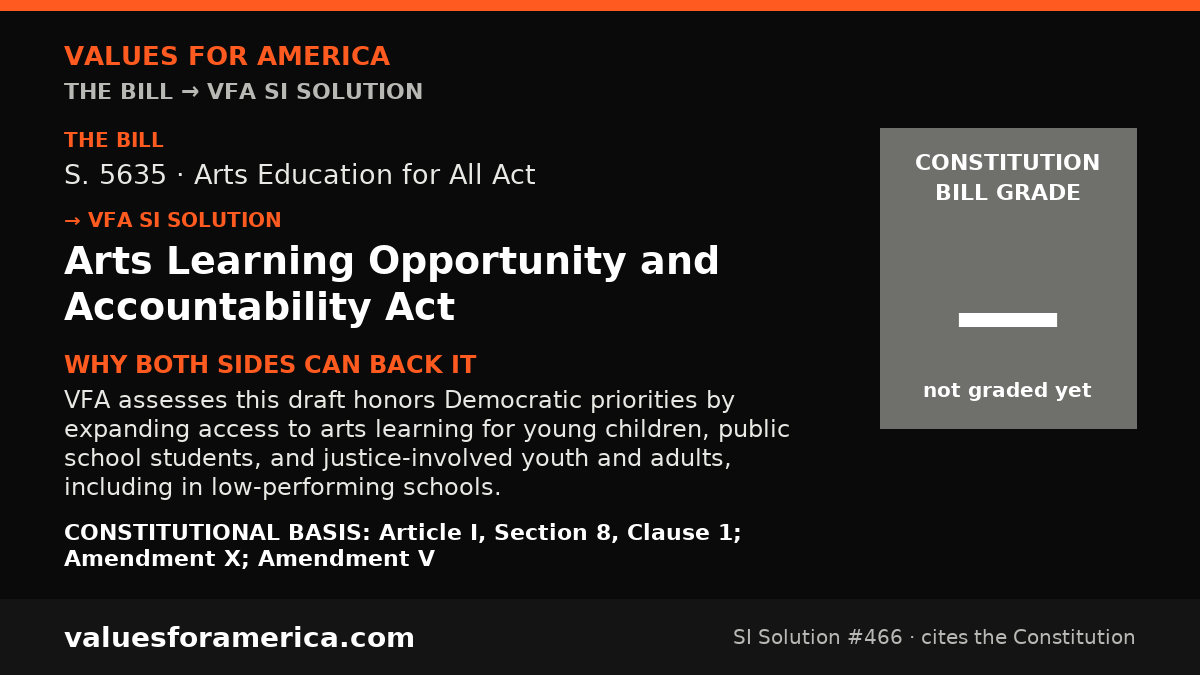
Arts Education for All Act
Arts Learning Opportunity and Accountability Act
Expand access to arts education and arts programming for young children, K-12 students, and juveniles and adults in the criminal justice system.
Constitutional concerns with the original
- Federal direction of state education plans, report cards, and teacher staffing goals raises Tenth Amendment and federalism concerns if read as a mandate rather than a condition on voluntary federal funds.
- Requirements tied to state juvenile justice plans raise federalism concerns unless states retain discretion and participation remains tied to voluntary grants.
Solution text
Operative provisions
Source basis and limits
Basis: The official Congress.gov summary of S. 119-5635, Arts Education for All Act, supports the goal, target groups, listed education and justice provisions, research duties, and committee referral stage.
Check before relying on this: The official summary does not supply full bill text, current law, eligibility rules, existing appeal rights, fiscal effects, or statutory conflicts; readers should verify those points and program details at the Congress.gov bill page before relying on this draft.
Bipartisan rationale
VFA assesses this draft honors Democratic priorities by expanding access to arts learning for young children, public school students, and justice-involved youth and adults, including in low-performing schools. VFA assesses it honors Republican and conservative priorities by making participation voluntary, preserving state and local control over curriculum, hiring, and staffing, capping federal spending with no new tax, and sunsetting the authority so Congress must review results before renewal.
Constitutional citations
- → Article I, Section 8, Clause 1
- → Tenth Amendment
- → Fifth Amendment Due Process
Article I, Section 8, Clause 1 Amendment X Amendment V
Possible legislative path
In each chamber, support may come from members focused on education opportunity and rehabilitation, while opposition may come from members concerned about federal influence over schools, spending levels, or justice-program priorities.
Report an error in this Solution

Citizen Consensus
“Do you support this VFA SI Solution?”
One vote per verified account; you can change it any time. Only verified accounts count, results publish once 30 verified people have voted, and state and district results count only people who attested a home ZIP code. How this works.
Email verification is not switched on yet, so no vote counts toward results yet. Votes cast now are saved and count once the voter verifies their email address.
Sign in or create a free account to vote.
Add a short reason (optional)
/280 · no links or contact details · reasons are reviewed before anyone sees them, and many never are shown.
Your vote is saved but held out of published results by an automated integrity check (for example, several accounts voting from one browser).
Your vote is saved. It will count once you verify your email address. Verify on your account page.
Your vote counts nationally. Add your home ZIP code to count in your state and district too.
Your vote counts nationally and in .
Reason saved privately; it is shown only if it passes review.
Verified participants nationwide · n =
Self-selected participants, not a random sample; ± is the 95% sampling margin.
Not enough verified votes yet. Results publish at verified votes.
A sudden surge of votes on this item was flagged and is under review; votes from new accounts in that surge are held out until it is resolved.
Related on VFA
Generated by VFA SI Solutions · 2026.10.18 15:05 UTC · ← Back to the Republic