SI-generated Constitutional Solution
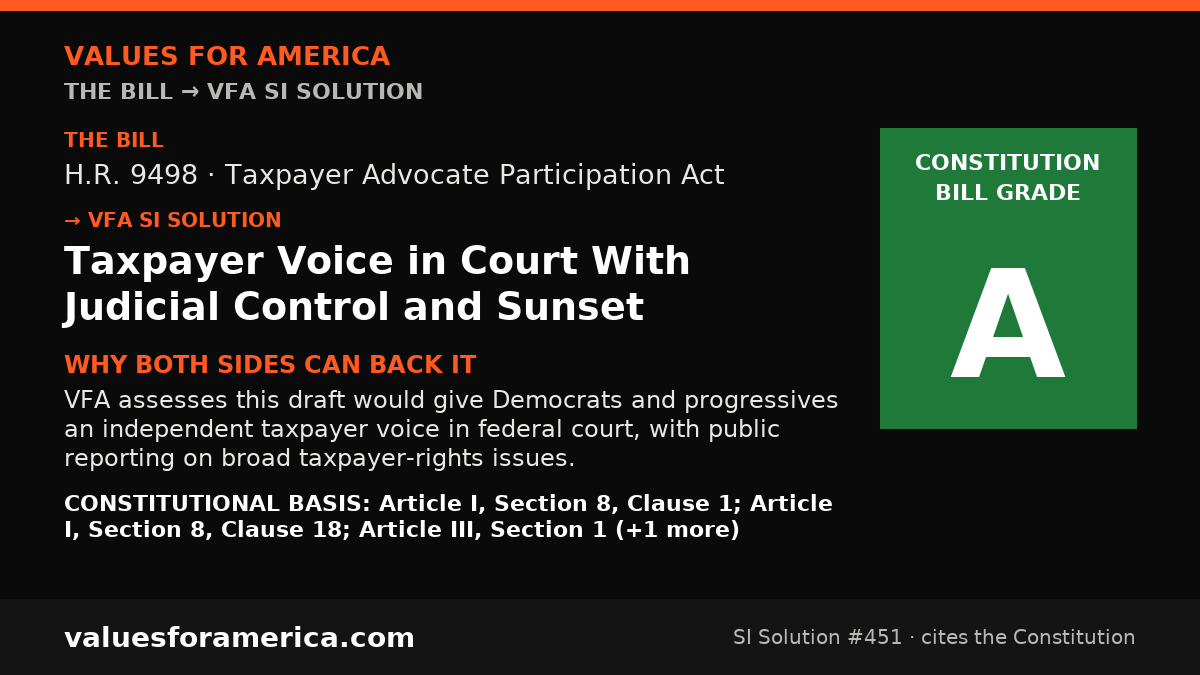
Taxpayer Voice in Court With Judicial Control and Sunset
SI-generated · passed automated checks (Constitution citation, source verification, independent SI critic) · not individually reviewed by a person · Report an error: hello@valuesforamerica.com
Brief for congressional offices →
Taxpayer Advocate Participation Act
Taxpayer Voice in Court With Judicial Control and Sunset
Help protect broad taxpayer rights in federal court by letting the National Taxpayer Advocate share an independent taxpayer perspective in cases involving federal tax law.
Constitutional concerns with the original
- Mandatory language requiring federal courts to permit appearances raises separation of powers concerns under Article III, Section 1, because Congress should authorize requests to file rather than order courts to accept them.
- Due process and fairness require that the Advocate disclose its government role and file only on broad taxpayer-rights issues, so no party gains a hidden advantage.
Solution text
Operative provisions
Source basis and limits
Basis: The official Congress.gov summary of H.R. 9498 in the 119th Congress states the bill would authorize the National Taxpayer Advocate to appear as amicus curiae in federal tax cases on issues broadly affecting taxpayer rights, and notes the latest action as received in the Senate and referred to Finance.
Check before relying on this: The full bill text, current law details, eligibility rules, court procedures, fiscal effects, and conflicts with existing statutes are not stated in the official summary and should be verified in the full bill text at Congress.gov before action.
Bipartisan rationale
VFA assesses this draft would give Democrats and progressives an independent taxpayer voice in federal court, with public reporting on broad taxpayer-rights issues. VFA assesses it would give Republicans and conservatives a limited reform that preserves court control, bars party intervention, caps spending with no new funds, and ends after five years unless Congress extends it.
Constitutional citations
- → Article I, Section 8, Clause 1
- → Article I, Section 8, Clause 18
- → Article III, Section 1
- → Fifth Amendment Due Process
Article I, Section 8, Clause 1 Article I, Section 8, Clause 18 Article III, Section 1 Amendment V
Possible legislative path
In the House and Senate, taxpayer fairness and court efficiency interests may support the measure while judges and fiscal restraint interests may seek to preserve court discretion and enforce the cap and sunset.
Report an error in this Solution

Citizen Consensus
“Do you support this VFA SI Solution?”
One vote per verified account; you can change it any time. Only verified accounts count, results publish once 30 verified people have voted, and state and district results count only people who attested a home ZIP code. How this works.
Email verification is not switched on yet, so no vote counts toward results yet. Votes cast now are saved and count once the voter verifies their email address.
Sign in or create a free account to vote.
Add a short reason (optional)
/280 · no links or contact details · reasons are reviewed before anyone sees them, and many never are shown.
Your vote is saved but held out of published results by an automated integrity check (for example, several accounts voting from one browser).
Your vote is saved. It will count once you verify your email address. Verify on your account page.
Your vote counts nationally. Add your home ZIP code to count in your state and district too.
Your vote counts nationally and in .
Reason saved privately; it is shown only if it passes review.
Verified participants nationwide · n =
Self-selected participants, not a random sample; ± is the 95% sampling margin.
Not enough verified votes yet. Results publish at verified votes.
A sudden surge of votes on this item was flagged and is under review; votes from new accounts in that surge are held out until it is resolved.
Related on VFA
Generated by VFA SI Solutions · 2026.10.17 15:05 UTC · ← Back to the Republic