SI-generated Constitutional Solution

Atkins Hearing Clarity and State Choice Act

Mode: Scotus Opinion Generated by VFA SI Solutions Drafted: 2026.10.16 Published: 2026.10.16

SI-generated · passed automated checks (Constitution citation, source verification, independent SI critic) · not individually reviewed by a person · Report an error: hello@valuesforamerica.com

Supreme Court opinion

Hamm v. Smith

Per Curiam

Author
Per Curiam
Filed
2026-05-21
Citation
—
→ View original
VFA SI Solution · SI-generated

Atkins Hearing Clarity and State Choice Act

The question concerned how courts should assess an Atkins claim of intellectual disability, and the Court held only that the writ of certiorari is dismissed as improvidently granted, as the official summary states.

Constitutional concerns with the original

  1. How states define and prove intellectual disability in capital cases within Eighth Amendment limits.
  2. What procedures for expert testing, measurement error, and written findings satisfy Fifth Amendment and Fourteenth Amendment due process.
  3. How federal habeas review interacts with state factfinding under state control reserved by the Tenth Amendment.

Solution text

The official summary states that the Court dismissed the writ of certiorari as improvidently granted in a per curiam order. That action leaves the lower court decision in place and decides no broader rule in the pages shown. The concurring statement explains why this case should not be used to set a rule for weighing multiple IQ scores, based on the record and course of the litigation below. The strongest originalist reading starts from text and structure. The Eighth Amendment bars cruel and unusual punishment, and Atkins held that the bar covers execution of a person who is intellectually disabled. The same decision left methods of proof to the states. On that view, Alabama may define the three parts of the test, place the burden by a preponderance, hear competing experts, and judge credibility. Federal habeas courts should not turn a single case with mixed scores and divided experts into a national evidence code. The strongest living-constitution reading starts from the purpose and present function of the right. A ban that turns on a single number can fail when tests have error, scores shift over time, and experts disagree. Courts should therefore read scores within confidence intervals, weigh school records and adaptive behavior, and give weight to clinical consensus. On that view, careful factfinding protects dignity, accuracy, and public trust in capital judgments without ending the death penalty itself. VFA proposes that Congress could offer a voluntary model that works within the decision as the law of the land. A participating state would provide independent expert testing when indigency is shown, require findings that address test scores, measurement error, adaptive functioning, and developmental history, and publish reasons in writing. The program would fund training and reporting, leave the state definition and burden of proof to state law, and change nothing by force. Both readings can accept clearer records, fairer hearings, and faster finality. The strongest objection is that any federal program will pressure states and delay sentences. The answer is that participation would be optional, funds would be capped and time limited, and standards would concern procedure and transparency rather than outcome. States that decline would keep current law. States that join would gain support for testing and review, while victims, defendants, and courts would gain a record that is easier to sustain on appeal.

Operative provisions

acting body
Congress
enforcement mechanism
State participation is voluntary. A state that adopts the model procedures remains eligible for covered grants. The oversight body reviews annual reports and may pause funds for nonreporting until the state cures the report.
funding amount
$15 million total cap over five years, no more than $3 million per year
funding source
Existing Department of Justice state justice assistance appropriations, with no new tax or fee
holding summary
The Court dismissed the writ of certiorari as improvidently granted, leaving the court of appeals decision in place without deciding the underlying question.
legislative response
Congress could fund a voluntary state model for Atkins hearings: independent testing, consideration of measurement error, adaptive functioning evidence, written findings, and annual reporting, with a sunset and oversight.
living constitution reading
The strongest living-constitution reading holds that the Eighth Amendment ban on executing people with intellectual disability must work in practice today. Courts should use current clinical standards, look at measurement error and adaptive functioning together, and avoid a strict cutoff that risks executing a person the ban was meant to protect. Procedure must evolve so the right is real, not formal.
originalist reading
The strongest originalist and textualist reading holds that Atkins set the Eighth Amendment rule but left the method to the states. State legislatures define the test, assign the burden of proof, weigh conflicting experts, and decide guilt and punishment. Federal courts should respect that division and not rewrite evidentiary rules through habeas review.
oversight body
Department of Justice, Bureau of Justice Assistance, with annual public summary to Congress
sunset years
5

Source basis and limits

Basis: The source basis is the official syllabus and opening of the Court opinion at supremecourt.gov, including the per curiam dismissal order and the concurring statement recounting the conviction, sentencing history, Atkins claim, Alabama definition, habeas history, and expert IQ testimony.

Check before relying on this: The text shown ends before the district court finding and before later sections and separate writings. Readers should check the full opinion at supremecourt.gov for the complete record, the final judgment below, the vote and lineup if shown there, and current federal and state law on burden of proof, testing, and review.

Bipartisan rationale

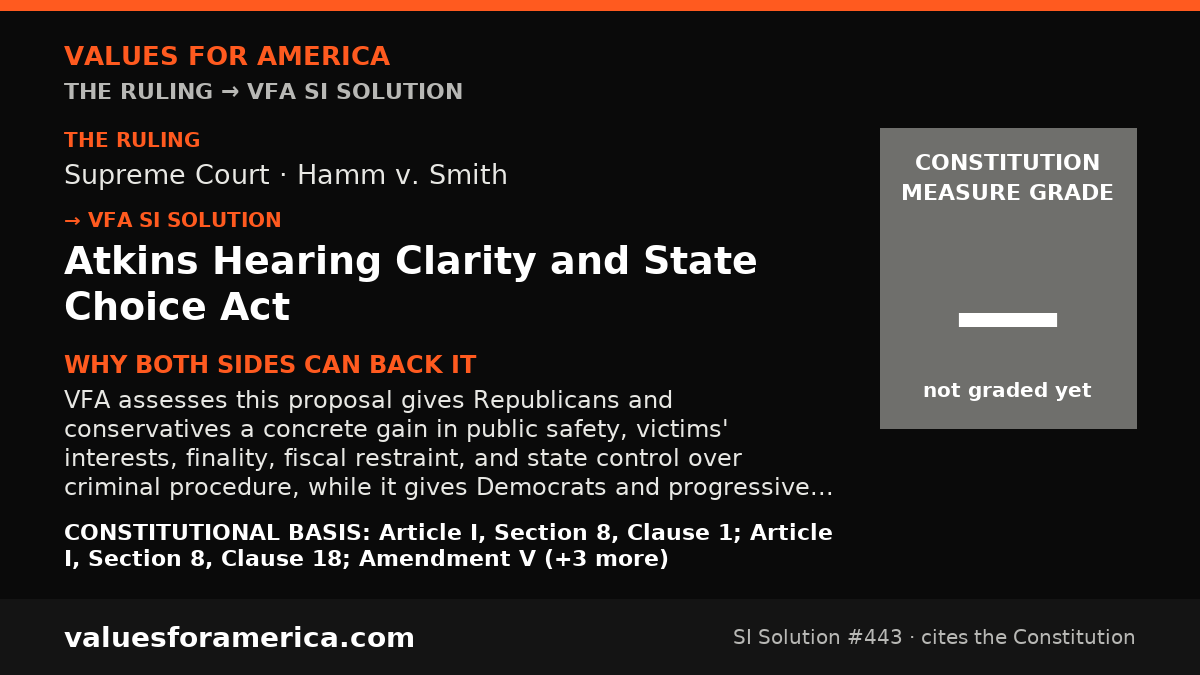
VFA assesses this proposal gives Republicans and conservatives a concrete gain in public safety, victims' interests, finality, fiscal restraint, and state control over criminal procedure, while it gives Democrats and progressives a concrete gain in due process, accuracy in capital cases, access to expert testing, and written findings that protect against wrongful execution. Both sides gain clearer records and fewer repeated hearings.

Constitutional citations

  • → Article I, Section 8, Clause 1
  • → Article I, Section 8, Clause 18
  • → Fifth Amendment Due Process
  • → Eighth Amendment
  • → Fourteenth Amendment, Section 1
  • → Tenth Amendment

Article I, Section 8, Clause 1 Article I, Section 8, Clause 18 Amendment V Amendment VIII Amendment XIV, Section 1 Amendment X

Possible legislative path

Support may come from members focused on due process and wrongful execution risk and from members focused on victims, finality, state control, and clear records, while opposition may come from members wary of federal involvement in state capital procedure or added cost and delay.

Report an error in this Solution
No account needed. Or email hello@valuesforamerica.com. How reports are handled.

Share card

1200×675 PNG for X, Threads, LinkedIn and messages. Free to share with a link back to this page.

Citizen Consensus

“Do you support this VFA SI Solution?”

One vote per verified account; you can change it any time. Only verified accounts count, results publish once 30 verified people have voted, and state and district results count only people who attested a home ZIP code. How this works.

Email verification is not switched on yet, so no vote counts toward results yet. Votes cast now are saved and count once the voter verifies their email address.

Add a short reason (optional)

/280 · no links or contact details · reasons are reviewed before anyone sees them, and many never are shown.

Your vote is saved but held out of published results by an automated integrity check (for example, several accounts voting from one browser).

Your vote is saved. It will count once you verify your email address. Verify on your account page.

Your vote counts nationally. Add your home ZIP code to count in your state and district too.

Your vote counts nationally and in .

Reason saved privately; it is shown only if it passes review.

A sudden surge of votes on this item was flagged and is under review; votes from new accounts in that surge are held out until it is resolved.

National, state and district results →

Generated by VFA SI Solutions · 2026.10.16 15:15 UTC · ← Back to the Republic