SI-generated Constitutional Solution

Neutral Notice and Consent for Youth Counseling

Mode: Scotus Opinion Generated by VFA SI Solutions Drafted: 2026.10.16 Published: 2026.10.16

SI-generated · passed automated checks (Constitution citation, source verification, independent SI critic) · not individually reviewed by a person · Report an error: hello@valuesforamerica.com

Supreme Court opinion

Chiles v. Salazar Revisions: 3/31/26

Neil Gorsuch

Author
Neil Gorsuch
Filed
2026-03-31
Citation
—
→ View original
VFA SI Solution · SI-generated

Neutral Notice and Consent for Youth Counseling

The Court was asked how the First Amendment applies to Colorado conversion-therapy law when used against talk therapy. The official summary states the law controls talk based on viewpoint and lower courts were wrong not to use demanding First Amendment review.

Constitutional concerns with the original

  1. How Congress and the states may add procedure, notice, consent, and reporting around talk therapy while respecting viewpoint neutrality under the First Amendment.
  2. How federal funding and state licensing can protect minors and preserve client self-determination consistent with Fourteenth Amendment liberty and Fifth Amendment Due Process.
  3. How to divide federal and state roles under Article I, Section 8 and the Tenth Amendment in regulating licensed counseling.

Solution text

The official summary states Kaley Chiles is a licensed Colorado counselor who uses only talk and seeks to help clients, including young people, reach their own goals. Colorado law bars licensed counselors from any practice that attempts to change sexual orientation or gender identity, while it permits acceptance and support for identity work and help for gender transition. The official summary states that as used against Ms. Chiles the law controls the content of talk and picks favored and disfavored views, and that calling talk conduct or treatment does not remove First Amendment review. The lower courts were wrong to treat the law as a mere conduct rule under lenient review. The strongest originalist reading starts from text and early practice: speech means speech, and government may not punish words by relabeling them. On this view, the law lets one message through and bars the opposite message in the same counseling room, which is viewpoint control at its core. Licensed work does not waive the right to speak, since licensing long tested training and fitness rather than fixed opinion. Historic limits are few and old, such as fraud and defamation, and a broad new zone for substandard talk has no firm roots. Strict review thus applies, and the state must show a tight fit to a truly pressing need. The strongest living-constitution reading starts from changed knowledge and the modern duty to protect young people in licensed care. On this view, a therapy room mixes words with professional power, and states acting on current clinical consensus should have room to set safe practice bounds. Lawmakers learned over time which methods help and which risk lasting harm, and a democratic public should be able to act on that learning through licensing, consent, and malpractice rules. Free talk stays broad in public debate, while licensed youth practice faces closer control. Courts still guard against true censorship, but health and safety weigh heavily. VFA proposes that Congress pass a viewpoint-neutral Youth Counseling Clarity plan that takes the ruling as law and leaves method choices to clients, families, and states. Licensed counselors serving minors would give plain written notice of methods, risks, voluntary choice, and the right to stop. They would obtain written consent from a parent or guardian plus assent of the minor, keep brief session records, and report de-identified outcomes and complaints each year. Grants would fund neutral options, second opinions, and family support, open to all lawful approaches. Both readings can accept this path because it honors free talk and client direction while it builds safety, records, and public reports. The strongest objection holds that notice and reporting still burden talk and invite pressure on disfavored views. The answer is neutrality by design: the same short notice, consent, record, and report rules would apply to every licensed youth counselor whatever view is voiced, with no ban on any viewpoint, no compelled script favoring one outcome, funds open on equal terms, state board review, court review of any penalty, and a five-year sunset with public data before any renewal.

Operative provisions

acting body
Congress working with state legislatures
enforcement mechanism
State licensing boards would enforce notice, consent, and record rules through fines, probation, or license action; federal funds would pause for nonreporting programs, with judicial review in federal court.
funding amount
$45 million over five years, capped at $9 million per year
funding source
General revenues appropriated under Article I, Section 8, Clause 1, with grants to states that adopt the notice, consent, and reporting rules
holding summary
The official summary states Colorado law as used against Ms. Chiles controls talk based on viewpoint, and lower courts were wrong not to use demanding First Amendment review.
legislative response
Congress could set viewpoint-neutral rules for licensed youth counseling: written notice, informed consent, session records, outcome and complaint reporting, and grants for neutral counseling options. States could adopt the same rules through licensing law.
living constitution reading
The strongest living-constitution reading sees the First Amendment as a living guard for democratic self-rule that must leave room for modern public-health regulation. On this view, states learned through experience that certain counseling methods risk harm to young people, and a legislature acting on current medical consensus should be able to set standards for licensed care. Speech and conduct blur in a therapy room, and the freedom to speak does not carry a freedom to practice a licensed trade without limits. Government keeps broad power to protect children while courts still check laws that truly silence dissent.
originalist reading
The strongest originalist reading holds that talk is speech, and labels such as conduct, treatment, or standard of care cannot turn words into regulable acts. The official summary states the First Amendment guards the right of each person to decide how best to speak, and laws that pick allowed and barred views on sexual orientation and gender identity strike at that core. Licensed status does not lower that shield, and history shows licensing long tested fitness rather than fixed a point of view. Only narrow historic limits like fraud or defamation escape strict review, and this law fits none of them.
oversight body
State counseling licensing boards, with annual reports to the Department of Health and Human Services
sunset years
5

Source basis and limits

Basis: The basis is the Court official syllabus and opening opinion in Chiles v. Salazar, No. 24-539, decided March 31, 2026, read at supremecourt.gov. The official summary states facts about Ms. Chiles, Colorado Rev. Stat. sections 12-245-202 and 12-245-224, the Tenth Circuit path, and the holding on viewpoint regulation of talk therapy.

Check before relying on this: The text read ends early and later sections plus any separate writings were not read; readers should check the full opinion at supremecourt.gov. The vote count, lineup of Justices, remedy on remand, current state eligibility and discipline rules, appeal rights, cost effects, and likely legislative votes are not shown in the text read and remain to be checked.

Bipartisan rationale

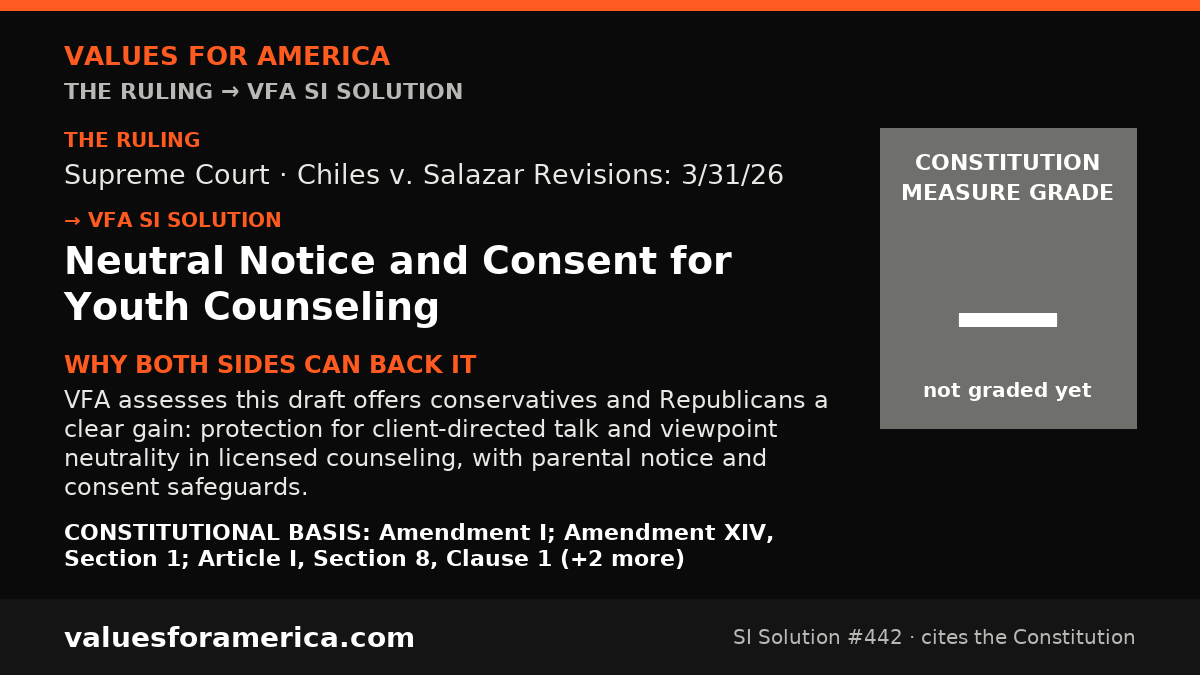
VFA assesses this draft offers conservatives and Republicans a clear gain: protection for client-directed talk and viewpoint neutrality in licensed counseling, with parental notice and consent safeguards. It offers progressives and Democrats a clear gain: funding for evidence-based youth mental health care, strong harm reporting, and licensing oversight that keeps states in the lead on safety. Neither side is asked to concede its view of the underlying care debate.

Constitutional citations

  • → First Amendment
  • → Fourteenth Amendment, Section 1
  • → Article I, Section 8, Clause 1
  • → Tenth Amendment
  • → Fifth Amendment Due Process

Amendment I Amendment XIV, Section 1 Article I, Section 8, Clause 1 Amendment X Amendment V

Possible legislative path

Support could come from lawmakers focused on free talk and parental rights together with lawmakers focused on youth safety and care quality, while opposition could come from those who want bans or mandates rather than neutral procedure and reporting.

Report an error in this Solution
No account needed. Or email hello@valuesforamerica.com. How reports are handled.

Share card

1200×675 PNG for X, Threads, LinkedIn and messages. Free to share with a link back to this page.

Citizen Consensus

“Do you support this VFA SI Solution?”

One vote per verified account; you can change it any time. Only verified accounts count, results publish once 30 verified people have voted, and state and district results count only people who attested a home ZIP code. How this works.

Email verification is not switched on yet, so no vote counts toward results yet. Votes cast now are saved and count once the voter verifies their email address.

Add a short reason (optional)

/280 · no links or contact details · reasons are reviewed before anyone sees them, and many never are shown.

Your vote is saved but held out of published results by an automated integrity check (for example, several accounts voting from one browser).

Your vote is saved. It will count once you verify your email address. Verify on your account page.

Your vote counts nationally. Add your home ZIP code to count in your state and district too.

Your vote counts nationally and in .

Reason saved privately; it is shown only if it passes review.

A sudden surge of votes on this item was flagged and is under review; votes from new accounts in that surge are held out until it is resolved.

National, state and district results →

Generated by VFA SI Solutions · 2026.10.16 15:14 UTC · ← Back to the Republic