SI-generated Constitutional Solution
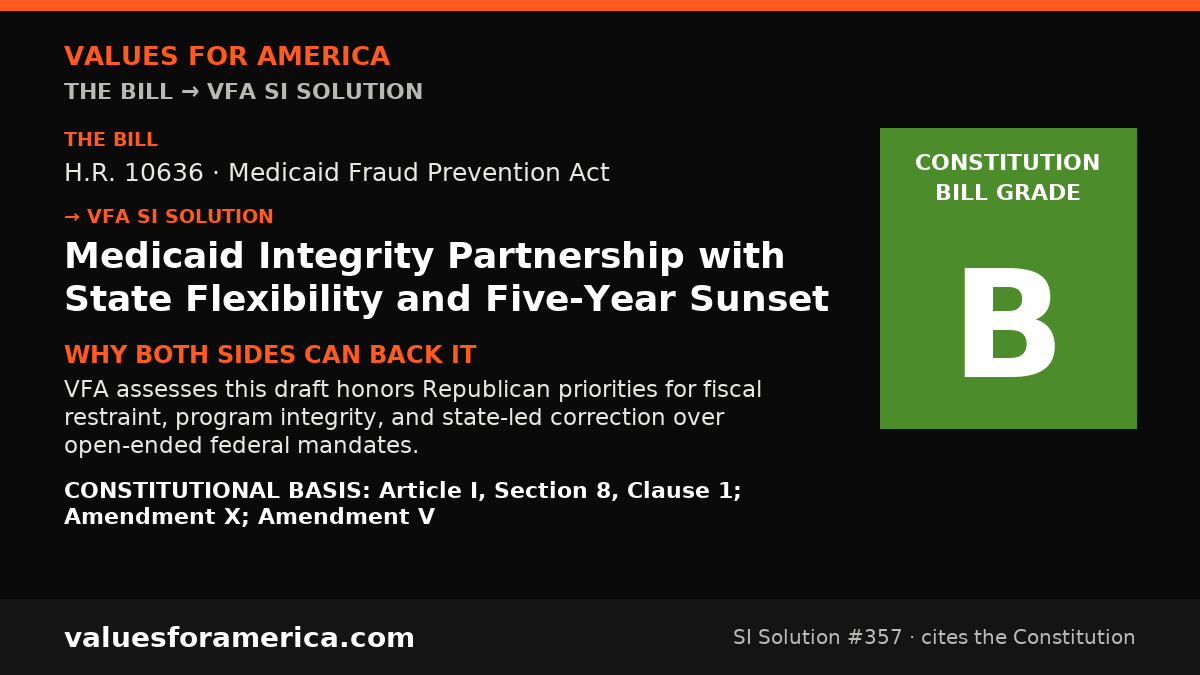
Medicaid Integrity Partnership with State Flexibility and Five-Year Sunset
SI-generated · passed automated checks (Constitution citation, source verification, independent SI critic) · not individually reviewed by a person · Report an error: hello@valuesforamerica.com
Brief for congressional offices →
Medicaid Fraud Prevention Act
Medicaid Integrity Partnership with State Flexibility and Five-Year Sunset
Reduce fraud and payment errors in state Medicaid programs while keeping coverage working for eligible people. The bill would pursue that goal through regular state risk reviews and reports to federal overseers.
Constitutional concerns with the original
- If open-ended reporting or corrective mandates displace state administration of Medicaid, that may raise Tenth Amendment and conditional-spending concerns.
- If fraud findings lead to payment holds or enrollment changes without notice and review, that may raise Fifth Amendment Due Process concerns.
Solution text
Operative provisions
Source basis and limits
Basis: This draft is based only on the supplied official summary excerpt for H.R. 10636 stating annual state fraud risk assessments, corrective action plans, reports to CMS, CMS guidelines and annual report to Congress, and referral to House Energy and Commerce on 2026-09-28.
Check before relying on this: The full bill text, current Medicaid law, eligibility and enrollment rules, appeal rights, managed care contract terms, data system limits, fiscal effects, and likely votes were not supplied and remain unverified; readers should verify the official bill text at the congress.gov page before relying on scope, cost, or rights described here.
Bipartisan rationale
VFA assesses this draft honors Republican priorities for fiscal restraint, program integrity, and state-led correction over open-ended federal mandates. VFA assesses it honors Democratic priorities for protecting Medicaid access for eligible people and using oversight to preserve funding for care rather than cutting benefits.
Constitutional citations
- → Article I, Section 8, Clause 1
- → Tenth Amendment
- → Fifth Amendment Due Process
Article I, Section 8, Clause 1 Amendment X Amendment V
Possible legislative path
In the House and Senate, support may come from members focused on fiscal oversight and program integrity and from members focused on protecting access to care, while opposition may come from those wary of reporting burdens on states or of stronger federal enforcement.
Report an error in this Solution

Citizen Consensus
“Do you support this VFA SI Solution?”
One vote per verified account; you can change it any time. Only verified accounts count, results publish once 30 verified people have voted, and state and district results count only people who attested a home ZIP code. How this works.
Email verification is not switched on yet, so no vote counts toward results yet. Votes cast now are saved and count once the voter verifies their email address.
Sign in or create a free account to vote.
Add a short reason (optional)
/280 · no links or contact details · reasons are reviewed before anyone sees them, and many never are shown.
Your vote is saved but held out of published results by an automated integrity check (for example, several accounts voting from one browser).
Your vote is saved. It will count once you verify your email address. Verify on your account page.
Your vote counts nationally. Add your home ZIP code to count in your state and district too.
Your vote counts nationally and in .
Reason saved privately; it is shown only if it passes review.
Verified participants nationwide · n =
Self-selected participants, not a random sample; ± is the 95% sampling margin.
Not enough verified votes yet. Results publish at verified votes.
A sudden surge of votes on this item was flagged and is under review; votes from new accounts in that surge are held out until it is resolved.
Related on VFA
Generated by VFA SI Solutions · 2026.10.08 15:05 UTC · ← Back to the Republic