H.R. 10636 explained · 119th Congress · Pending in Congress
Medicaid Fraud Prevention Act
Cosponsors: 6 (0 D, 6 R) · per Congress.gov, 2026-10-14
Introduced: 2026-09-28
Latest action (2026-09-28): Referred to the House Committee on Energy and Commerce.
What H.R. 10636 does, in plain terms
Medicaid Fraud Prevention Act This bill requires state Medicaid programs to regularly assess their programs for fraud and take corrective actions. Specifically, states must complete a fraud risk assessment on at least an annual basis, implement a corrective action plan to address any identified vulnerabilities, and report on the results to the Centers for Medicare & Medicaid Services (CMS). The CMS must analyze this information and annually report the information to Congress. The fraud risk assessments must include a comprehensive assessment of the risks of fraud across the entirety of a state's Medicaid program, including with respect to managed care entities and eligibility and enrollment systems. The assessments must, to the extent practicable, utilize data from specified existing program integrity systems (e.g., Medicaid fraud control units). The CMS must issue guidelines on how states may identify areas that are at the highest risk of fraud.
Official summary by the Congressional Research Service, via Congress.gov.
Constitution Index
“VFA Constitution grade”
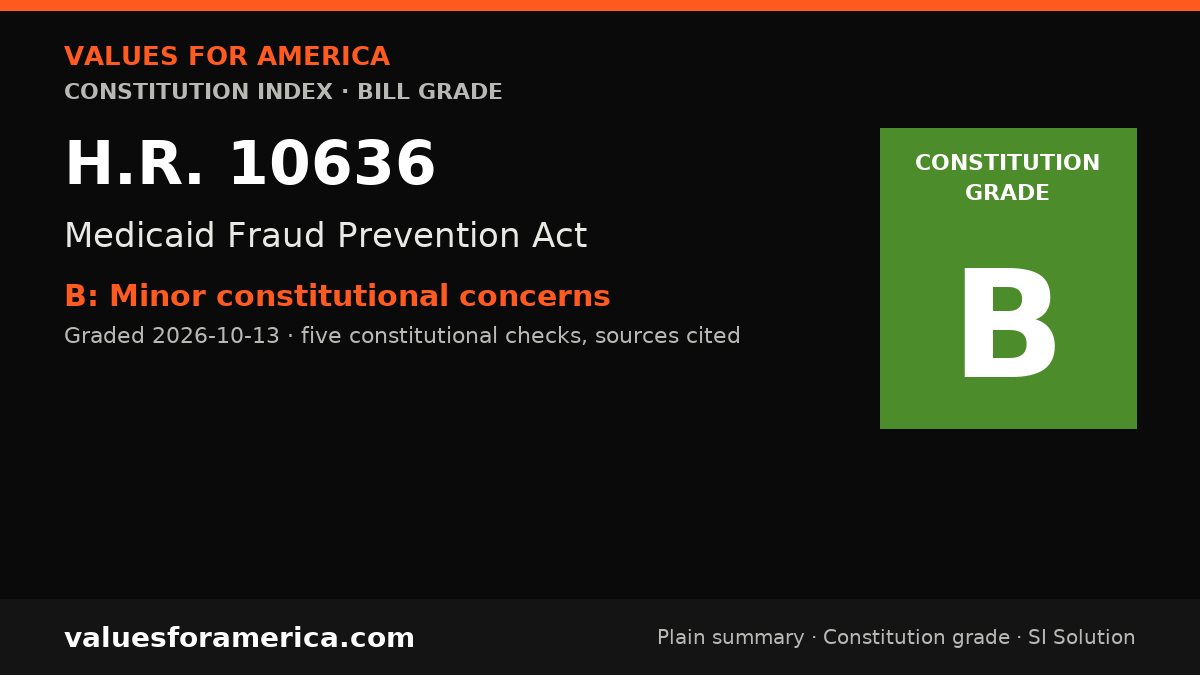
Minor constitutional concerns
Graded 2026-10-13
SI-generated grade · five published checks · not individually reviewed by a person · methodology
The bill is a conditional spending measure that imposes administrative requirements on states participating in Medicaid. It does not directly infringe on individual rights, but it does raise federalism concerns by directing state program administration and requiring state reporting to the federal government. The conditions are reasonably related to the legitimate federal interest in preventing fraud in a jointly funded program, and the burden on states is not disproportionate. However, the bill's prescriptive requirements on state Medicaid agencies may exceed the minimal necessary federal involvement, warranting a 'B' grade.
-
✓ Passes · Enumerated powers
The federal government has authority under the Spending Clause (Article I, Section 8, Clause 1) to attach conditions to funds disbursed to states for the Medicaid program. The bill's requirements are conditions on state receipt of Medicaid funds, and they are reasonably related to the federal interest in ensuring the integrity of the program. The Supreme Court has upheld such conditions in cases l… -
✓ Passes · Bill of Rights
The bill does not implicate any of the first ten amendments. It imposes administrative and reporting requirements on state governments, not on individuals. It does not restrict speech, religion, assembly, press, petition, arms, quartering, search and seizure, self-incrimination, due process, takings, trial rights, or cruel and unusual punishment. The requirements are directed at state agencies and… -
✓ Passes · Individual sovereignty
The bill does not restrict the actions of individuals. It imposes obligations on state governments to conduct fraud risk assessments and implement corrective action plans. While these requirements may indirectly affect Medicaid beneficiaries by potentially altering program administration, they do not directly restrict personal liberty, property, speech, labor, or belief. The government's interest … -
✗ Concern · Decentralization
The bill fails the decentralization test because it consolidates decision-making at the federal level by requiring states to follow federal guidelines and report to CMS, which then reports to Congress. While states retain flexibility in how they conduct assessments, the federal government dictates the frequency, content, and reporting requirements. This is more than the minimum necessary federal i… -
✓ Passes · Due process and takings
The bill does not deprive any person of life, liberty, or property without due process. It does not impose penalties or take property. It requires states to report to CMS, but this is an administrative requirement, not a judicial or quasi-judicial action. There is no deprivation of rights, and the bill does not implicate the Takings Clause of the Fifth Amendment.
Sources: Congress.gov: HR 10636 summary
Report an error in this grade
What should pass
“VFA SI Solution”
SI-generated · passed automated checks (Constitution citation, source verification, independent SI critic) · not individually reviewed by a person · Report an error: hello@valuesforamerica.com
Medicaid Integrity Partnership with State Flexibility and Five-Year Sunset
Generated by VFA SI Solutions
Reduce fraud and payment errors in state Medicaid programs while keeping coverage working for eligible people. The bill would pursue that goal through regular state risk reviews and reports to federal overseers.
Bipartisan rationale: VFA assesses this draft honors Republican priorities for fiscal restraint, program integrity, and state-led correction over open-ended federal mandates. VFA assesses it honors Democratic priorities for protecting Medicaid access for eligible people and using oversight to preserve funding for care rather than cutting benefits.
Possible legislative path: In the House and Senate, support may come from members focused on fiscal oversight and program integrity and from members focused on protecting access to care, while opposition may come from those wary of reporting burdens on states or of stronger federal enforcement.
Source limits: The full bill text, current Medicaid law, eligibility and enrollment rules, appeal rights, managed care contract terms, data system limits, fiscal effects, and likely votes were not supplied and remain unverified; readers should verify the official bill text at the congress.gov page before relying on scope, cost, or rights described here.
Report an error in this Solution
Citizen Consensus
“Do you support this VFA SI Solution?”
One vote per verified account; you can change it any time. Only verified accounts count, results publish once 30 verified people have voted, and state and district results count only people who attested a home ZIP code. How this works.
Email verification is not switched on yet, so no vote counts toward results yet. Votes cast now are saved and count once the voter verifies their email address.
Sign in or create a free account to vote.
Add a short reason (optional)
/280 · no links or contact details · reasons are reviewed before anyone sees them, and many never are shown.
Your vote is saved but held out of published results by an automated integrity check (for example, several accounts voting from one browser).
Your vote is saved. It will count once you verify your email address. Verify on your account page.
Your vote counts nationally. Add your home ZIP code to count in your state and district too.
Your vote counts nationally and in .
Reason saved privately; it is shown only if it passes review.
Verified participants nationwide · n =
Self-selected participants, not a random sample; ± is the 95% sampling margin.
Not enough verified votes yet. Results publish at verified votes.
A sudden surge of votes on this item was flagged and is under review; votes from new accounts in that surge are held out until it is resolved.
Related on VFA

For journalists and bloggers
“Embed this grade”
Free to use with the link back. The badge and card update when the grade changes. Embed terms →
