Archived SI output (machine-generated)
Synthetic Opioid Control and Interstate Enforcement Act of 2025
Archived SI output (machine-generated) · No editorial review recorded
This historical SI draft was machine-generated by software and has no editorial review time on record. Verify its factual and legal claims against the original source before relying on it.
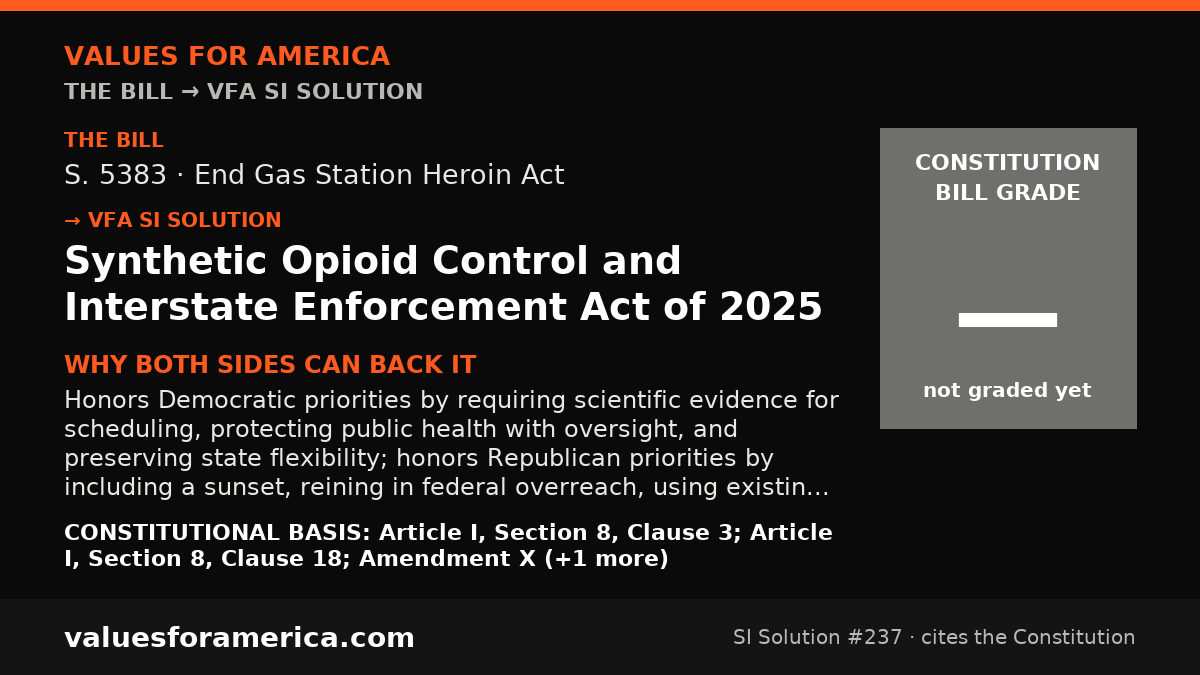
End Gas Station Heroin Act
Synthetic Opioid Control and Interstate Enforcement Act of 2025
Prevent the spread of emerging synthetic opioids (including MGM-15, MGM-16, 7-hydroxymitragynine, and mitragynine pseudoindoxyl) by placing them under Schedule I control and strengthening enforcement against manufacturers and distributors, thereby reducing public health harms from 'gas station heroin.'
Constitutional concerns with the original
- Scheduling substances without clear scientific evidence may exceed the Commerce Clause if applied to purely intrastate activities (see United States v. Lopez, 514 U.S. 549)
- Blanket scheduling of mitragynine derivatives could infringe on state police powers over public health and safety, conflicting with the Tenth Amendment
- Expanding enforcement without clear federal nexus (interstate commerce) risks federal overreach into activities properly regulated by states
Solution text
Operative provisions
Bipartisan rationale
Honors Democratic priorities by requiring scientific evidence for scheduling, protecting public health with oversight, and preserving state flexibility; honors Republican priorities by including a sunset, reining in federal overreach, using existing funding sources, and focusing enforcement on interstate commerce rather than broad federal mandates.
Constitutional citations
- → Article I, Section 8, Clause 3 (Commerce Clause)
- → Article I, Section 8, Clause 18 (Necessary and Proper Clause)
- → Tenth Amendment
- → Fifth Amendment Due Process Clause (procedural safeguards in scheduling)
Article I, Section 8, Clause 3 Article I, Section 8, Clause 18 Amendment X Amendment V
Report an error in this Solution

Citizen Consensus
“Do you support this VFA SI Solution?”
One vote per verified account; you can change it any time. Only verified accounts count, results publish once 30 verified people have voted, and state and district results count only people who attested a home ZIP code. How this works.
Email verification is not switched on yet, so no vote counts toward results yet. Votes cast now are saved and count once the voter verifies their email address.
Sign in or create a free account to vote.
Add a short reason (optional)
/280 · no links or contact details · reasons are reviewed before anyone sees them, and many never are shown.
Your vote is saved but held out of published results by an automated integrity check (for example, several accounts voting from one browser).
Your vote is saved. It will count once you verify your email address. Verify on your account page.
Your vote counts nationally. Add your home ZIP code to count in your state and district too.
Your vote counts nationally and in .
Reason saved privately; it is shown only if it passes review.
Verified participants nationwide · n =
Self-selected participants, not a random sample; ± is the 95% sampling margin.
Not enough verified votes yet. Results publish at verified votes.
A sudden surge of votes on this item was flagged and is under review; votes from new accounts in that surge are held out until it is resolved.
Related on VFA
Generated by VFA SI Solutions · 2026.08.09 06:00 UTC · ← Back to the Republic