Archived SI output (machine-generated)
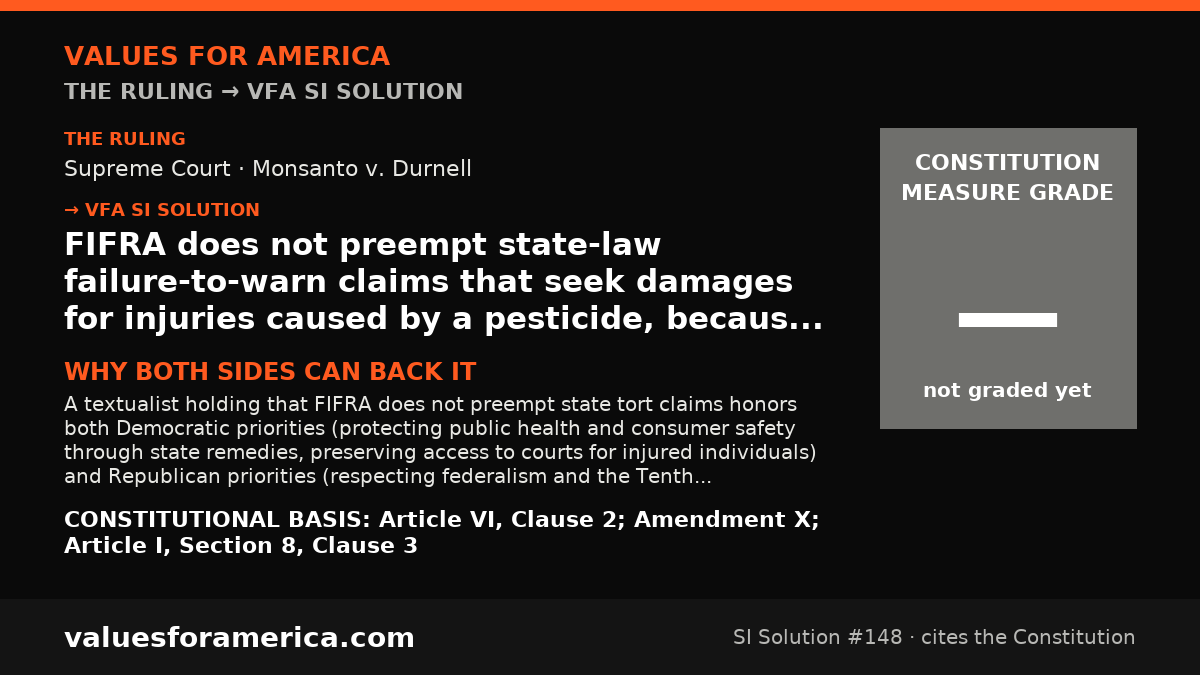
FIFRA does not preempt state-law failure-to-warn claims that seek damages for injuries caused by a pesticide, because such claims are not 'requirements for labeling or packaging' within the meaning of 7 U.S.C. §136v(b), and the Tenth Amendment reserves to the states the power to provide tort remedies for harm to health and safety.
Archived SI output (machine-generated) · No editorial review recorded
This historical SI draft was machine-generated by software and has no editorial review time on record. Verify its factual and legal claims against the original source before relying on it.
Monsanto v. Durnell
Brett Kavanaugh
FIFRA does not preempt state-law failure-to-warn claims that seek damages for injuries caused by a pesticide, because such claims are not 'requirements for labeling or packaging' within the meaning of 7 U.S.C. §136v(b), and the Tenth Amendment reserves to the states the power to provide tort remedies for harm to health and safety.
Does the Federal Insecticide, Fungicide, and Rodenticide Act (FIFRA) expressly preempt a state-law failure-to-warn tort claim that would require a pesticide manufacturer to add a cancer warning to a label that the EPA has already approved without such a warning?
Constitutional concerns with the original
- The majority opinion relies on FIFRA's preemption clause (7 U.S.C. §136v(b)) and the Riegel v. Medtronic precedent to find preemption, but it does not address whether the Tenth Amendment reserves to the states the traditional police power to protect public health and safety through tort law, absent a clear and unmistakable congressional intent to preempt such claims.
- The majority interprets FIFRA's preemption clause broadly, treating EPA's approval of a label as imposing a federal 'requirement' that bars any state law imposing additional or different labeling. This reading departs from the text of §136v(b), which prohibits states from imposing 'requirements for labeling or packaging in addition to or different from those required under this subchapter.' The clause does not explicitly state that it preempts common-law tort duties, which are not 'requirements' imposed by the state but rather remedies for breach of a duty of care. The majority conflates state-imposed requirements with state-law duties that arise from general tort principles.
- The majority's reliance on Riegel is misplaced because the Medical Device Amendments' preemption clause (21 U.S.C. §360k(a)) is not 'nearly identical' to FIFRA's clause. The MDA clause preempts state 'requirements' that are 'different from, or in addition to, any requirement applicable under this chapter,' and the FDA's premarket approval process for medical devices is far more intensive and specific than EPA's registration process for pesticides. FIFRA's registration process does not involve the same level of individualized safety determinations, and the statute itself allows states to regulate pesticide use and sales in certain respects (see §136v(a)). The majority ignores these textual and structural differences.
- The majority fails to consider the original meaning of the Supremacy Clause (Article VI, Clause 2) and the Tenth Amendment. At the founding, state tort law was a core aspect of state police power, and federal preemption of such law required a clear statement from Congress. FIFRA's preemption clause does not contain such a clear statement regarding common-law tort claims, and the majority's interpretation effectively allows an administrative agency's labeling decision to displace state remedies without explicit congressional authorization.
Solution text
Operative provisions
Bipartisan rationale
A textualist holding that FIFRA does not preempt state tort claims honors both Democratic priorities (protecting public health and consumer safety through state remedies, preserving access to courts for injured individuals) and Republican priorities (respecting federalism and the Tenth Amendment, limiting federal agency overreach, requiring clear congressional intent before displacing state law). Both parties' constitutional traditions recognize that the states are laboratories of democracy and that tort law is a traditional state function. This holding avoids the constitutional difficulty of allowing an administrative agency to effectively immunize manufacturers from liability without explicit congressional authorization.
Constitutional citations
- → Article VI, Clause 2 (Supremacy Clause)
- → Tenth Amendment
- → Article I, Section 8, Clause 3 (Commerce Clause, as the basis for FIFRA)
- → Federalist No. 45 (Madison) (on reserved powers of the states)
Article VI, Clause 2 Amendment X Article I, Section 8, Clause 3
Report an error in this Solution

Citizen Consensus
“Do you support this VFA SI Solution?”
One vote per verified account; you can change it any time. Only verified accounts count, results publish once 30 verified people have voted, and state and district results count only people who attested a home ZIP code. How this works.
Email verification is not switched on yet, so no vote counts toward results yet. Votes cast now are saved and count once the voter verifies their email address.
Sign in or create a free account to vote.
Add a short reason (optional)
/280 · no links or contact details · reasons are reviewed before anyone sees them, and many never are shown.
Your vote is saved but held out of published results by an automated integrity check (for example, several accounts voting from one browser).
Your vote is saved. It will count once you verify your email address. Verify on your account page.
Your vote counts nationally. Add your home ZIP code to count in your state and district too.
Your vote counts nationally and in .
Reason saved privately; it is shown only if it passes review.
Verified participants nationwide · n =
Self-selected participants, not a random sample; ± is the 95% sampling margin.
Not enough verified votes yet. Results publish at verified votes.
A sudden surge of votes on this item was flagged and is under review; votes from new accounts in that surge are held out until it is resolved.
Generated by VFA SI Solutions · 2026.06.29 06:03 UTC · ← Back to the Republic