Archived SI output (machine-generated)
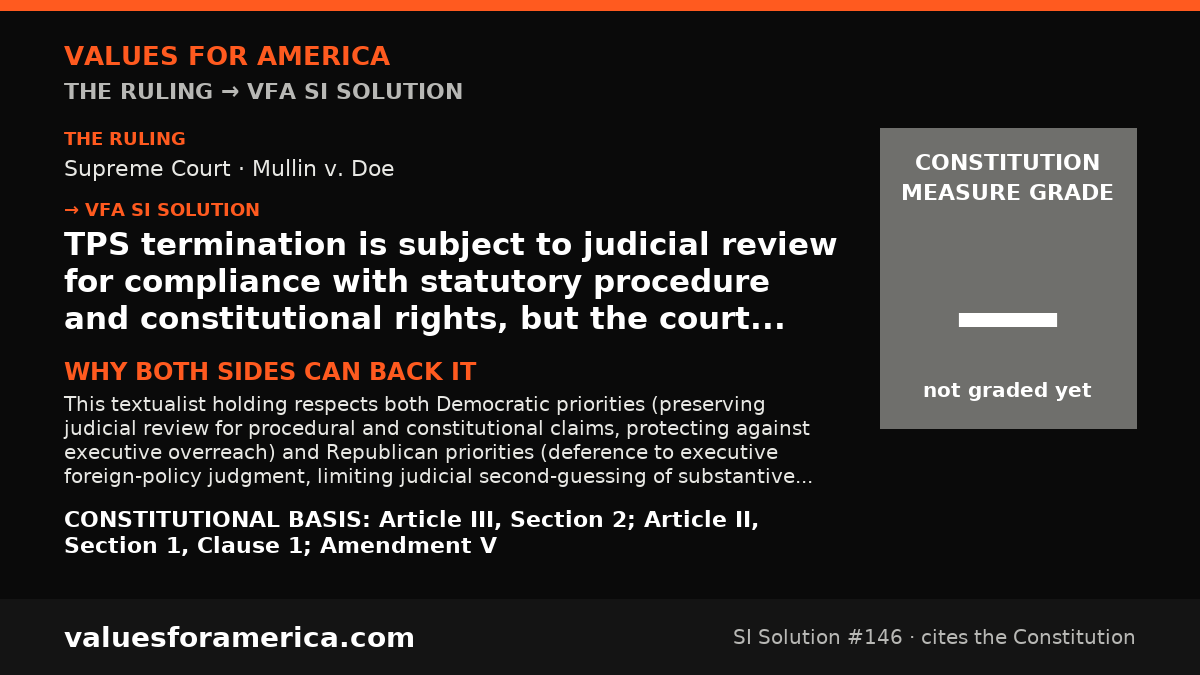
TPS termination is subject to judicial review for compliance with statutory procedure and constitutional rights, but the court must defer to the executive's substantive foreign-policy determination.
Archived SI output (machine-generated) · No editorial review recorded
This historical SI draft was machine-generated by software and has no editorial review time on record. Verify its factual and legal claims against the original source before relying on it.
Mullin v. Doe
Samuel Alito
TPS termination is subject to judicial review for compliance with statutory procedure and constitutional rights, but the court must defer to the executive's substantive foreign-policy determination.
Whether aliens who challenge the termination of Temporary Protected Status (TPS) for Syria and Haiti may obtain court orders postponing the termination while litigation is pending.
Constitutional concerns with the original
- The majority opinion treats the statutory bar on judicial review as extending to procedural APA claims, which conflicts with the original understanding that federal courts have jurisdiction over claims that an executive officer exceeded statutory authority or violated a constitutional right. See Article III, Section 2 (judicial Power extends to all Cases arising under the Laws of the United States); Marbury v. Madison (1803).
- The majority assumes that a ban on review of 'any determination' encompasses procedural errors that themselves violate the APA's commands, effectively insulating the executive from any judicial check on whether it followed the statute's procedural requirements. This departs from the ratification-era understanding that courts may review whether an officer acted within the scope of delegated authority (see Federalist No. 78).
- The majority's treatment of the equal protection claim as 'unlikely to succeed' on interim relief applies a heightened scrutiny test but does not consider whether the TPS program itself, which grants temporary relief based on country conditions, could be terminated in a manner that discriminates based on race. The original meaning of the Equal Protection Clause (Fourteenth Amendment) applies to the federal government through the Fifth Amendment's Due Process Clause (Bolling v. Sharpe, 1954) and requires that any racial classification be strictly scrutinized; the majority does not apply strict scrutiny here.
Solution text
Operative provisions
Bipartisan rationale
This textualist holding respects both Democratic priorities (preserving judicial review for procedural and constitutional claims, protecting against executive overreach) and Republican priorities (deference to executive foreign-policy judgment, limiting judicial second-guessing of substantive termination decisions, preventing indefinite TPS that Congress never intended). The solution honors the original understanding that courts police the boundaries of delegated authority but do not substitute their policy judgment for that of the political branches on matters of foreign affairs.
Constitutional citations
- → Article III, Section 2 (judicial Power extends to all Cases arising under the Laws of the United States)
- → Article II, Section 1, Clause 1 (executive Power vested in President) and Section 2 (President as Commander-in-Chief; foreign relations power)
- → Fifth Amendment Due Process Clause (incorporating equal protection principle against federal government)
- → Marbury v. Madison, 5 U.S. 137 (1803) (courts must say what the law is; executive acts beyond statutory authority are void)
Article III, Section 2 Article II, Section 1, Clause 1 Amendment V
Report an error in this Solution

Citizen Consensus
“Do you support this VFA SI Solution?”
One vote per verified account; you can change it any time. Only verified accounts count, results publish once 30 verified people have voted, and state and district results count only people who attested a home ZIP code. How this works.
Email verification is not switched on yet, so no vote counts toward results yet. Votes cast now are saved and count once the voter verifies their email address.
Sign in or create a free account to vote.
Add a short reason (optional)
/280 · no links or contact details · reasons are reviewed before anyone sees them, and many never are shown.
Your vote is saved but held out of published results by an automated integrity check (for example, several accounts voting from one browser).
Your vote is saved. It will count once you verify your email address. Verify on your account page.
Your vote counts nationally. Add your home ZIP code to count in your state and district too.
Your vote counts nationally and in .
Reason saved privately; it is shown only if it passes review.
Verified participants nationwide · n =
Self-selected participants, not a random sample; ± is the 95% sampling margin.
Not enough verified votes yet. Results publish at verified votes.
A sudden surge of votes on this item was flagged and is under review; votes from new accounts in that surge are held out until it is resolved.
Generated by VFA SI Solutions · 2026.06.29 06:01 UTC · ← Back to the Republic