Executive Order 14431 explained · Executive Order · No disposition noted
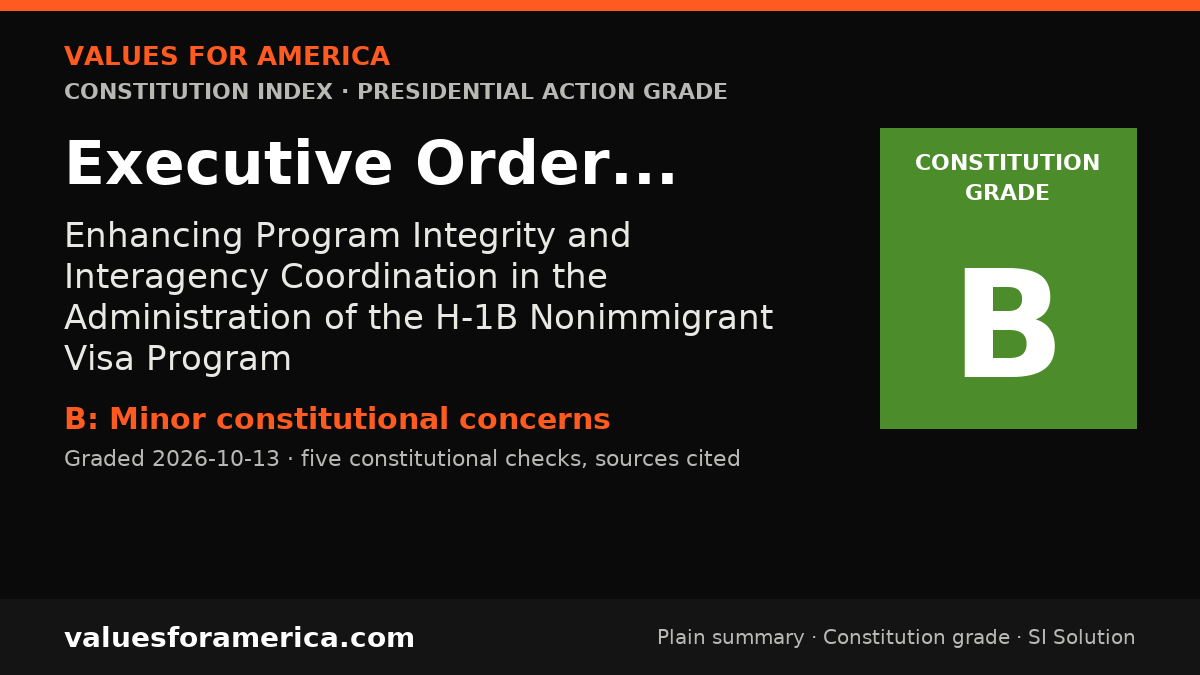
Enhancing Program Integrity and Interagency Coordination in the Administration of the H-1B Nonimmigrant Visa Program
Signed: 2026-09-18 Published: 2026-09-23 Federal Register document: 2026-19555
Agencies: Executive Office of the President
What Executive Order 14431 says
Federal Register, Volume 91 Issue 183 (Wednesday, September 23, 2026) [Federal Register Volume 91, Number 183 (Wednesday, September 23, 2026)] [Presidential Documents] [Pages 60501-60503] From the Federal Register Online via the Government Publishing Office [www.gpo.gov] [FR Doc No: 2026-19555] Presidential Documents Federal Register / Vol. 91, No. 183 / Wednesday, September 23, 2026 / Presidential Documents [[Page 60501]] Executive Order 14431 of September 18, 2026 Enhancing Program Integrity and Interagency Coordination in the Administration of the H-1B Nonimmigrant Visa Program By the authority vested in me as President by the Constitution and the laws of the United States of America, it is hereby ordered: Section 1. Purpose. The H-1B nonimmigrant visa program was created to identify uniquely skilled and highly specialized foreign temporary workers to strategically supplement the United States economy. Instead, the program has been widely abused by certain employers, third-party placement groups, and outsourcing firms to undercut and displace the supply of skilled United States labor. The large-scale, systematic abuse of the H-1B program to obtain non-qualifying foreign labor has undermined the additive purpose of the program and harmed the wages, working conditions, and job opportunities of skilled American workers. The abuse of cheaper H-1B labor places downward pressure...
Opening of the official text; read it in full in the Federal Register.
Constitution Index
“VFA Constitution grade”
Minor constitutional concerns
Graded 2026-10-13
SI-generated grade · five published checks · not individually reviewed by a person · methodology
Executive Order 14431 is a federal action aimed at enforcing existing immigration statutes and addressing program abuse. It operates within the federal government's enumerated powers over immigration and foreign commerce, and it does not infringe on individual rights. The order's main constitutional tension lies in its delegation of authority and the potential for administrative discretion, but it remains largely consistent with the Constitution.
-
✓ Passes · Enumerated powers
The federal government has explicit constitutional authority over immigration and naturalization under Article I, Section 8, Clause 4, and the power to regulate foreign commerce under Article I, Section 8, Clause 3. The H-1B visa program is a matter of immigration and foreign labor, squarely within these enumerated powers. The executive order directs agencies to enforce existing statutory requirem… -
✓ Passes · Bill of Rights
The order does not infringe on any of the first ten amendments. It does not restrict speech, religion, assembly, press, or petition (First Amendment). It does not affect the right to bear arms (Second Amendment), quartering of soldiers (Third Amendment), or search and seizure (Fourth Amendment). It does not implicate self-incrimination, double jeopardy, due process, or takings (Fifth Amendment), n… -
✓ Passes · Individual sovereignty
The order does not restrict the rights of individuals to their person, property, speech, labor, or belief. It imposes additional scrutiny on employers who sponsor H-1B visas, but this is a regulation of a voluntary economic activity (hiring foreign workers) that has been subject to federal regulation since the inception of the visa program. The government has a compelling interest in preventing fr… -
✓ Passes · Decentralization
Immigration policy is inherently a federal matter, as the Constitution grants the federal government exclusive authority over naturalization and foreign affairs. An individual or family cannot handle immigration policy, a local community cannot regulate visas, and a state cannot set federal immigration law. The order does not consolidate decision-making upward; it coordinates existing federal agen… -
✓ Passes · Due process and takings
The order does not bypass due process or take property without just compensation. It directs agencies to consider layoffs and other factors when adjudicating H-1B petitions, but it does not deny any party a hearing or an opportunity to present evidence. The order explicitly states it does not create any enforceable right or benefit, and it must be implemented consistent with applicable law, which …
Report an error in this grade
What should happen instead
“VFA SI Solution”
SI-generated · passed automated checks (Constitution citation, source verification, independent SI critic) · not individually reviewed by a person · Report an error: hello@valuesforamerica.com
H-1B Program Integrity and American Worker Protection Act
Protect American skilled workers and restore the H-1B program to its specialty-occupation purpose by reducing fraud, wage undercutting, displacement, and outsourcing abuse through interagency coordination.
Bipartisan rationale: VFA assesses Democrats would gain wage protection, anti-fraud enforcement, and due process safeguards with notice and hearing before penalties. VFA assesses Republicans and conservatives would gain priority for American workers, interagency accountability, and program integrity without ending lawful skilled immigration. Both sides would gain lasting rules, court-tested procedures, and congressional control of spending compared with unilateral executive action.
Article I, Section 8, Clause 4 Article I, Section 8, Clause 3 Article I, Section 8, Clause 18 Amendment V
Report an error in this Solution

For journalists and bloggers
“Embed this grade”
Free to use with the link back. The badge and card update when the grade changes. Embed terms →
