SI-generated Constitutional Solution
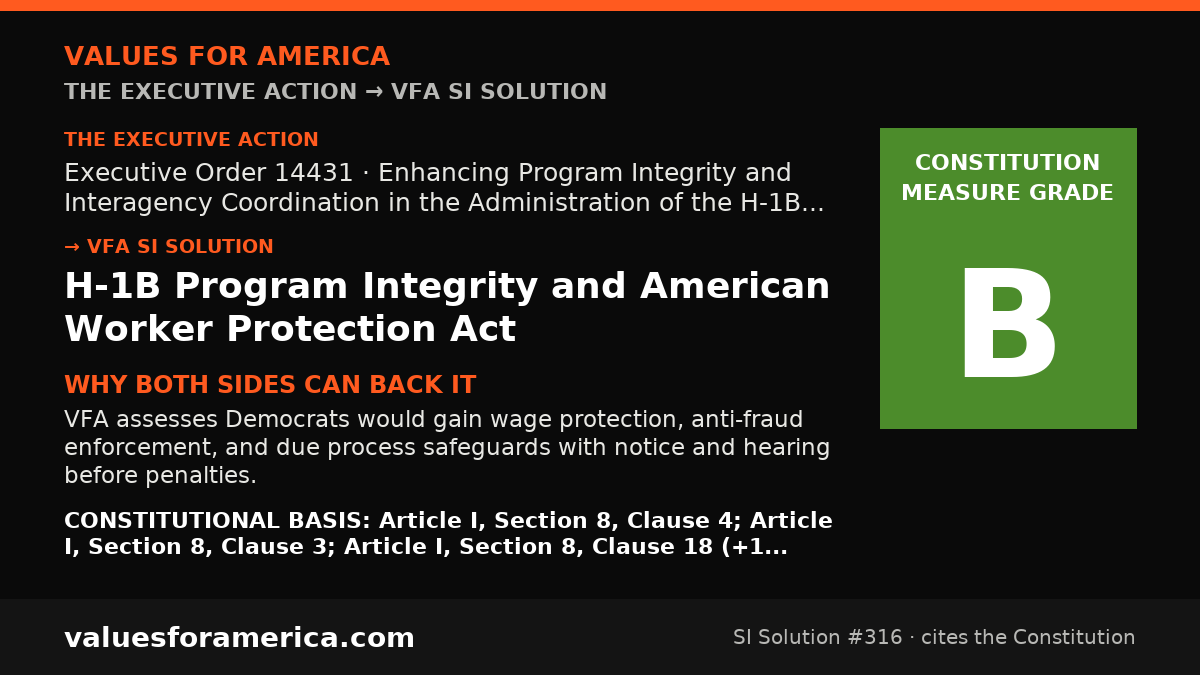
H-1B Program Integrity and American Worker Protection Act
SI-generated · passed automated checks (Constitution citation, source verification, independent SI critic) · not individually reviewed by a person · Report an error: hello@valuesforamerica.com
Enhancing Program Integrity and Interagency Coordination in the Administration of the H-1B Nonimmigrant Visa Program
Executive Order
H-1B Program Integrity and American Worker Protection Act
Protect American skilled workers and restore the H-1B program to its specialty-occupation purpose by reducing fraud, wage undercutting, displacement, and outsourcing abuse through interagency coordination.
Constitutional concerns with the original
- Whether the order creates new layoff-based petition criteria beyond section 101(a)(15)(H)(i)(b), 212(n), 214(i), 215(a), and 274B of the INA
- Whether delegation under 3 U.S.C. 301 and INA section 215(a) can support interagency visa screening rules without new statutory standards
- Whether retroactive review of labor condition applications risks Fifth Amendment Due Process if penalties lack notice and hearing
Solution text
Operative provisions
Source basis and limits
Basis: Basis is Federal Register excerpt for EO 14431, pages 60501-60503, signed 2026-09-18: purpose language on abuse and wage effects, Sections 2-3 on interagency coordination, layoff history, and review of labor condition applications under INA provisions cited above.
Check before relying on this: Full order text beyond 8000 characters, current INA eligibility rules, existing appeal rights, actual wage gaps and layoff figures, cost effects, agency capacity, and likely votes were not supplied and must be checked by the editor before enactment.
Bipartisan rationale
VFA assesses Democrats would gain wage protection, anti-fraud enforcement, and due process safeguards with notice and hearing before penalties. VFA assesses Republicans and conservatives would gain priority for American workers, interagency accountability, and program integrity without ending lawful skilled immigration. Both sides would gain lasting rules, court-tested procedures, and congressional control of spending compared with unilateral executive action.
Constitutional citations
- → Article I, Section 8, Clause 4
- → Article I, Section 8, Clause 3
- → Article I, Section 8, Clause 18
- → Fifth Amendment Due Process
Article I, Section 8, Clause 4 Article I, Section 8, Clause 3 Article I, Section 8, Clause 18 Amendment V
Possible legislative path
A coalition could form around worker protection plus legal immigration: labor-aligned members and worker advocates support wage and anti-displacement rules, business-aligned members support clean fast lanes and small-firm input, and oversight-minded members support sunsets, audits, and court review. Opposition may come from outsourcing-heavy users facing higher compliance costs and from groups wary of added paperwork, addressed through risk-based review and cure periods.
Report an error in this Solution

Citizen Consensus
“Do you support this VFA SI Solution?”
One vote per verified account; you can change it any time. Only verified accounts count, results publish once 30 verified people have voted, and state and district results count only people who attested a home ZIP code. How this works.
Email verification is not switched on yet, so no vote counts toward results yet. Votes cast now are saved and count once the voter verifies their email address.
Sign in or create a free account to vote.
Add a short reason (optional)
/280 · no links or contact details · reasons are reviewed before anyone sees them, and many never are shown.
Your vote is saved but held out of published results by an automated integrity check (for example, several accounts voting from one browser).
Your vote is saved. It will count once you verify your email address. Verify on your account page.
Your vote counts nationally. Add your home ZIP code to count in your state and district too.
Your vote counts nationally and in .
Reason saved privately; it is shown only if it passes review.
Verified participants nationwide · n =
Self-selected participants, not a random sample; ± is the 95% sampling margin.
Not enough verified votes yet. Results publish at verified votes.
A sudden surge of votes on this item was flagged and is under review; votes from new accounts in that surge are held out until it is resolved.
Related on VFA
Generated by VFA SI Solutions · 2026.10.05 15:01 UTC · ← Back to the Republic