Executive Order 14418 explained · Executive Order · No disposition noted
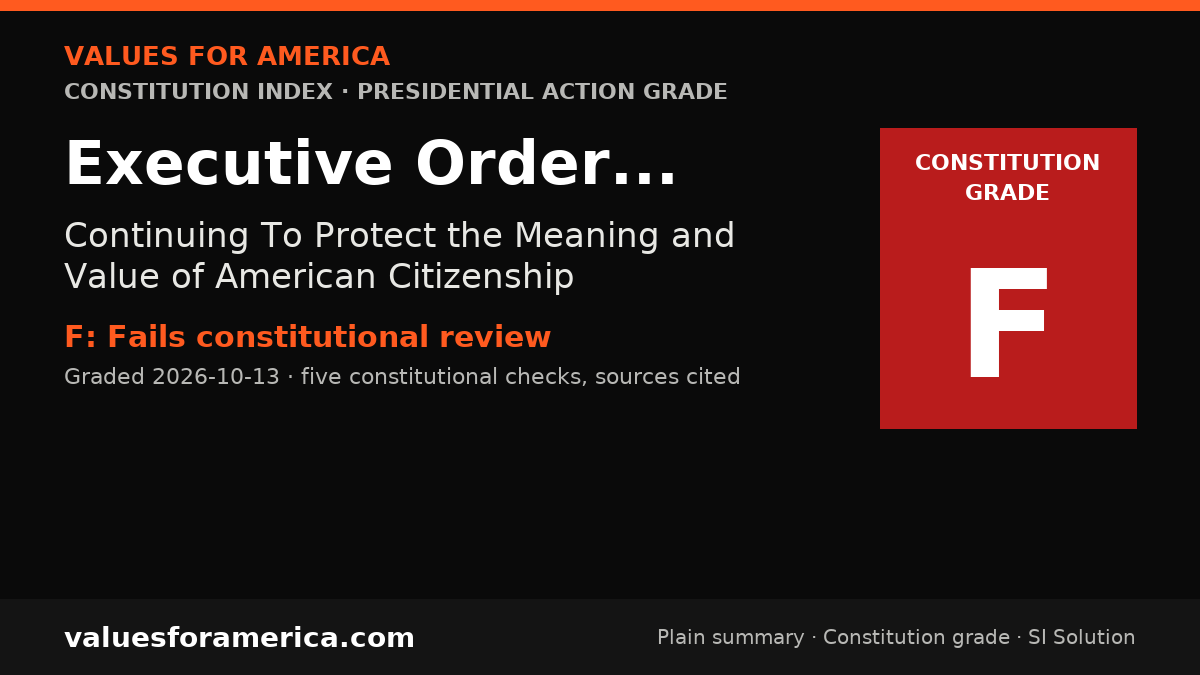
Continuing To Protect the Meaning and Value of American Citizenship
Signed: 2026-08-06 Published: 2026-08-11 Federal Register document: 2026-16403
Agencies: Executive Office of the President
Federal Register notes (as of 2026-10-19): See: EO 13224, September 23, 2001
What Executive Order 14418 says
Federal Register, Volume 91 Issue 153 (Tuesday, August 11, 2026) [Federal Register Volume 91, Number 153 (Tuesday, August 11, 2026)] [Presidential Documents] [Pages 51991-51992] From the Federal Register Online via the Government Publishing Office [www.gpo.gov] [FR Doc No: 2026-16403] Presidential Documents Federal Register / Vol. 91 , No. 153 / Tuesday, August 11, 2026 / Presidential Documents [[Page 51991]] Executive Order 14418 of August 6, 2026 Continuing To Protect the Meaning and Value of American Citizenship By the authority vested in me as President by the Constitution and the laws of the United States of America, it is hereby ordered: Section 1. Purpose. The privilege of United States citizenship remains a priceless and profound gift. Since my first day in office, my Administration has guarded against the risks posed by malign foreign actors who attempt to swindle American citizens by taking advantage of the generosity of our Nation. On June 30, 2026, the Supreme Court decided in Trump v. Barbara, 609 U.S. __, 146 S. Ct. 2438, 2449 (2026), that the Citizenship Clause of the Fourteenth Amendment to the United States Constitution extends the privilege of citizenship to children born to parents in the United States ``for whom no extraterritorial fiction applie[s].'' This order identifies, non-exhaustively, and prescribes action concerning certain categories of children...
Opening of the official text; read it in full in the Federal Register.
Constitution Index
“VFA Constitution grade”
Fails constitutional review
Graded 2026-10-13
SI-generated grade · five published checks · not individually reviewed by a person · methodology
This executive order directly violates the Fourteenth Amendment's Citizenship Clause by attempting to deny citizenship to children born in the United States based on the status or conduct of their parents. The Supreme Court's decision in Trump v. Barbara, as cited in the order, does not authorize the executive to redefine or restrict birthright citizenship beyond the clear text of the Amendment. The order also exceeds the President's enumerated powers, infringes on individual sovereignty, and improperly centralizes authority over citizenship determinations, which are constitutionally vested in Congress and the courts. The order's attempt to strip citizenship from U.S.-born children is a direct violation of the Constitution and fundamental principles of individual rights.
-
✗ Concern · Enumerated powers
The President's authority to issue executive orders derives from Article II of the Constitution, but this order purports to define and restrict citizenship in ways that are not authorized by any enumerated power. The Constitution grants Congress the power to establish a uniform rule of naturalization (Article I, Section 8, Clause 4), and the Fourteenth Amendment defines citizenship. The executive … -
✗ Concern · Bill of Rights
The order violates the Fourteenth Amendment's Citizenship Clause, which is part of the Bill of Rights broadly understood (though technically the Fourteenth Amendment is not one of the first ten amendments, it is a fundamental constitutional protection). The Citizenship Clause states that 'all persons born or naturalized in the United States, and subject to the jurisdiction thereof, are citizens of… -
✗ Concern · Individual sovereignty
The order restricts the fundamental right of citizenship for individuals born on U.S. soil. Citizenship is a foundational aspect of individual sovereignty, and denying it based on the actions or status of one's parents is a severe restriction on the individual's rights. The government has not provided a compelling constitutional justification for such a restriction, as the Citizenship Clause is cl… -
✗ Concern · Decentralization
The order centralizes authority over citizenship determinations in the federal executive branch, overriding state and local recognition of citizenship. This consolidates decision-making at the highest level of government, which is contrary to the principle of decentralization. While citizenship is a federal matter, the order's approach is overly broad and preempts state and local authorities witho… -
✗ Concern · Due process and takings
The order denies citizenship to individuals without providing due process of law. It creates categories of exclusion based on parental status or conduct, without any individualized hearing or opportunity to challenge the determination. This violates the Fifth Amendment's Due Process Clause, which requires fair notice and a fair hearing before depriving a person of life, liberty, or property. Citiz…
Report an error in this grade
What should happen instead
“VFA SI Solution”
American Citizenship Integrity Act of 2026
To protect the meaning and value of American citizenship by ensuring that the legal definition of U.S. citizenship is not diluted by automatic conferral to individuals not fully subject to U.S. jurisdiction, particularly children of parents present in the country unlawfully.
Bipartisan rationale: This solution honors Democratic priorities by explicitly protecting the 14th Amendment's guarantee of birthright citizenship and providing a robust judicial review mechanism. It honors Republican priorities by establishing a bipartisan commission to study the issue and recommend possible legislative changes, addressing legitimate concerns about fraud and legal interpretation without unilateral executive action. Both parties prefer this approach over unilateral executive orders because it preserves institutional integrity, ensures congressional input, and provides a clear legal framework that can withstand judicial scrutiny.
Article I, Section 8, Clause 4 Amendment XIV, Section 1 Amendment V Article II, Section 3
Report an error in this Solution

For journalists and bloggers
“Embed this grade”
Free to use with the link back. The badge and card update when the grade changes. Embed terms →
