Executive Order 14417 explained · Executive Order · No disposition noted
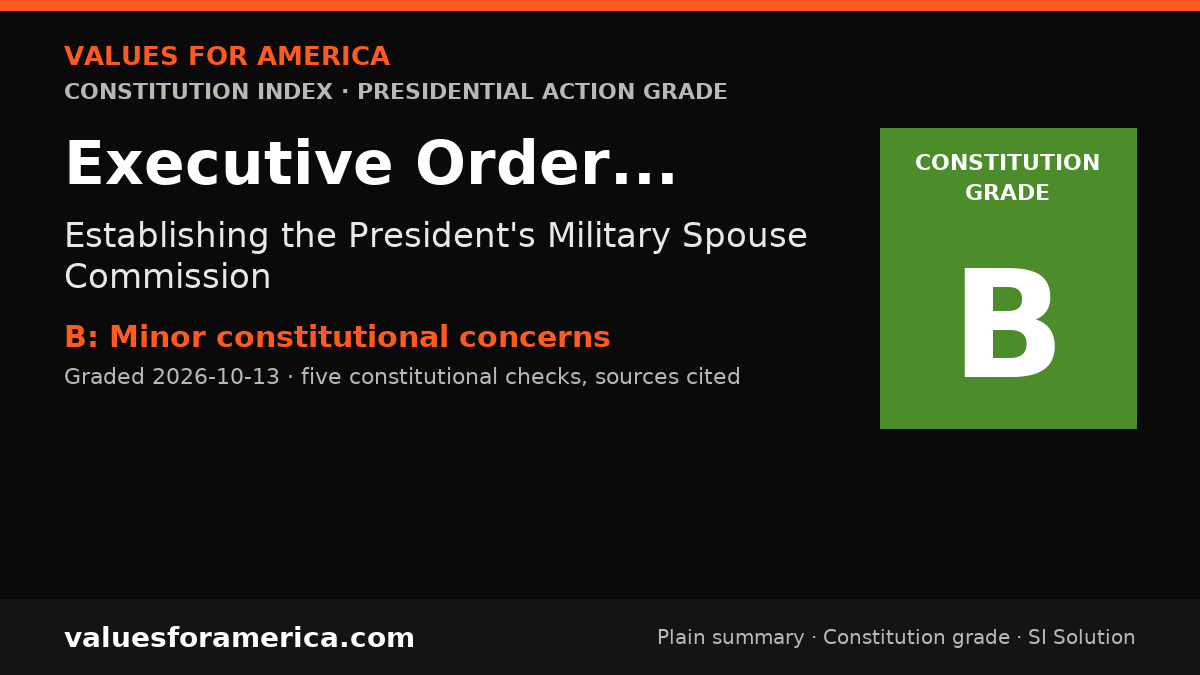
Establishing the President's Military Spouse Commission
Signed: 2026-08-03 Published: 2026-08-06 Federal Register document: 2026-16125
Agencies: Executive Office of the President
What Executive Order 14417 says
Federal Register, Volume 91 Issue 150 (Thursday, August 6, 2026) [Federal Register Volume 91, Number 150 (Thursday, August 6, 2026)] [Presidential Documents] [Pages 51059-51061] From the Federal Register Online via the Government Publishing Office [www.gpo.gov] [FR Doc No: 2026-16125] [[Page 51057]] Vol. 91 Thursday, No. 150 August 6, 2026 Part IV The President ----------------------------------------------------------------------- Executive Order 14417--Establishing the President's Military Spouse Commission Presidential Documents Federal Register / Vol. 91 , No. 150 / Thursday, August 6, 2026 / Presidential Documents ___________________________________________________________________ Title 3-- The President [[Page 51059]] Executive Order 14417 of August 3, 2026 Establishing the President's Military Spouse Commission By the authority vested in me as President by the Constitution and the laws of the United States of America, it is hereby ordered: Section 1. Purpose and Policy. Military spouses are intrinsically linked to the good order, readiness, and retention of our military. Their support and contributions to our Armed Forces are crucial to mission success. Yet the spouses of our Nation's service members face significant challenges due to the nature of military service. Frequent relocations and the long absences of service members--especially when deployed to combat...
Opening of the official text; read it in full in the Federal Register.
Constitution Index
“VFA Constitution grade”
Minor constitutional concerns
Graded 2026-10-13
SI-generated grade · five published checks · not individually reviewed by a person · methodology
Executive Order 14417 establishes an advisory commission to study and recommend policies for military spouses. The order is mostly sound but has minor constitutional tensions: it relies on the President's general executive authority rather than a specific enumerated power, and it creates a commission composed entirely of spouses of senior officials, which raises mild concerns about individual sovereignty and the proper scope of federal advisory bodies. The order does not infringe any rights, bypass due process, or take property, and it does not consolidate power upward in a problematic way. The grade is B because the enumerated powers basis is thin and the composition of the commission could be seen as an unnecessary federal intrusion into family matters, but these issues are fixable.
-
✗ Concern · Enumerated powers
The President cites 'the Constitution and the laws of the United States' but does not point to a specific enumerated power. The order concerns military spouses, which is related to the military, but Article II, Section 2 makes the President Commander in Chief of the Armed Forces, and Article I, Section 8, Clause 12 gives Congress power to raise and support Armies. However, creating a commission to… -
✓ Passes · Bill of Rights
The order does not infringe any of the first ten amendments. It does not restrict speech, religion, assembly, press, petition, arms, quartering, search and seizure, self-incrimination, due process, takings, fair trial, jury, or cruel and unusual punishment. It creates an advisory commission with no coercive or punitive powers. No Bill of Rights violation is present. Severity: none. -
✗ Concern · Individual sovereignty
The order does not restrict individual liberty or property, but it does create a commission that may develop policies affecting military spouses. While the commission is advisory and voluntary, the order assumes that the federal government should involve itself in the personal and family lives of military spouses. This is a mild encroachment on individual sovereignty because it presumes federal ov… -
✓ Passes · Decentralization
The four-question test: (1) Could an individual or family handle this without government involvement? No—military spouse challenges like licensure portability and frequent relocations are systemic issues that individuals cannot solve alone. (2) Could a local community or county handle this without state involvement? No—military families move across state lines, so local solutions are insufficient.… -
✓ Passes · Due process and takings
The order does not deprive anyone of life, liberty, or property, nor does it take private property for public use. It creates no penalties, fines, or obligations. It explicitly states it does not create any enforceable right or benefit. No due process or takings issue arises. Severity: none.
Report an error in this grade
What should happen instead
“VFA SI Solution”
Revised Executive Order: President's Military Spouse Commission
Establish a commission to advise the President on policies to improve employment, education, and well-being of military spouses.
Bipartisan rationale: Both parties share a commitment to supporting military families. This revised EO respects the President's constitutional authority to manage the executive branch while imposing clear sunset, oversight, and funding limits that respond to conservative concerns about executive overreach and liberal concerns about transparency and accountability. The commission is purely advisory, avoiding delegation of legislative power, and its funding is capped to existing appropriations, appealing to fiscal conservatives. Both parties benefit from institutional integrity: a properly structured commission is more durable and credible than one created without such safeguards.
Article II, Section 1 Article II, Section 3 Article I, Section 9, Clause 7
Report an error in this Solution

For journalists and bloggers
“Embed this grade”
Free to use with the link back. The badge and card update when the grade changes. Embed terms →
