Executive Order 14405 explained · Executive Order · No disposition noted
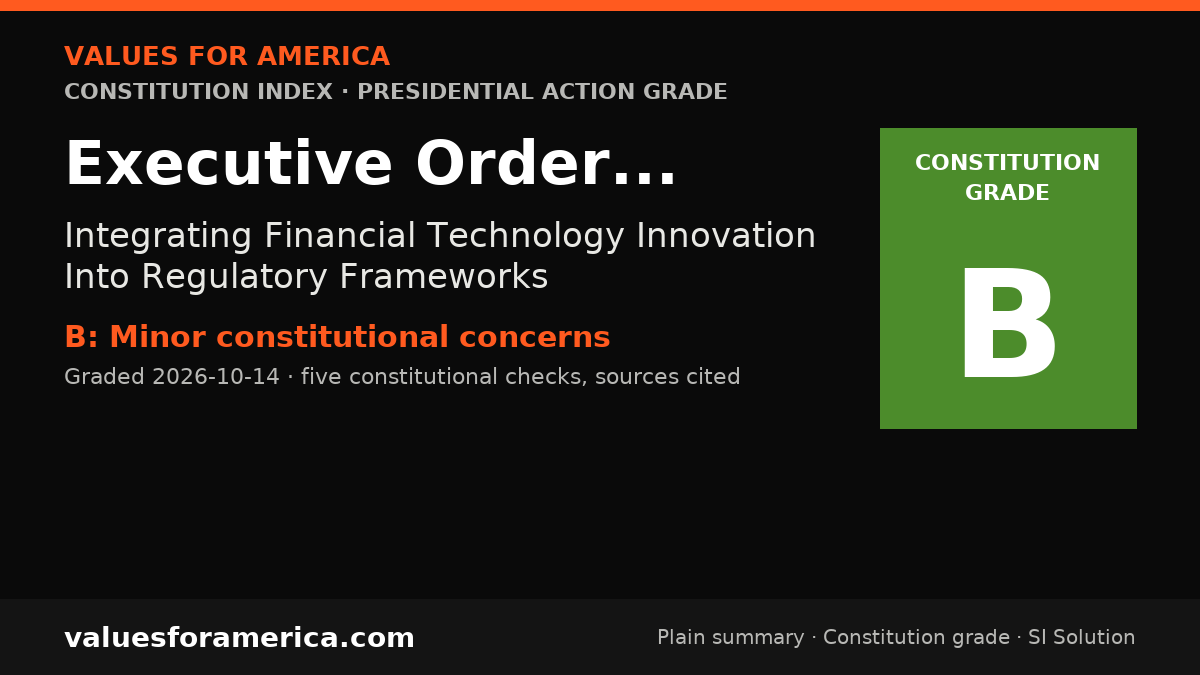
Integrating Financial Technology Innovation Into Regulatory Frameworks
Signed: 2026-05-19 Published: 2026-05-22 Federal Register document: 2026-10399
Agencies: Executive Office of the President
What Executive Order 14405 says
Federal Register, Volume 91 Issue 99 (Friday, May 22, 2026) [Federal Register Volume 91, Number 99 (Friday, May 22, 2026)] [Presidential Documents] [Pages 30475-30477] From the Federal Register Online via the Government Publishing Office [www.gpo.gov] [FR Doc No: 2026-10399] Presidential Documents Federal Register / Vol. 91, No. 99 / Friday, May 22, 2026 / Presidential Documents [[Page 30475]] Executive Order 14405 of May 19, 2026 Integrating Financial Technology Innovation Into Regulatory Frameworks By the authority vested in me as President by the Constitution and the laws of the United States of America, it is hereby ordered: Section 1. Policy. The United States is a global leader in financial innovation, driven in part by the rapid growth of financial technology (fintech) firms. These firms provide innovative services and solutions that enhance access to financial products and services and create economic opportunity for all Americans. To foster this financial innovation, the Federal Government must update regulations to allow integration of digital assets and innovative technology into traditional financial services and payment systems. The Federal Government must also remove overly burdensome and fragmented regulations and supervisory practices that form barriers to entry and primarily benefit incumbent financial services firms. It is therefore the policy of the United...
Opening of the official text; read it in full in the Federal Register.
Constitution Index
“VFA Constitution grade”
Minor constitutional concerns
Graded 2026-10-14
SI-generated grade · five published checks · not individually reviewed by a person · methodology
Executive Order 14405 directs federal financial regulators to review and streamline regulations to facilitate fintech innovation, including potential expansion of Federal Reserve payment services access. The order is largely within executive authority to manage the executive branch and implement existing law, and it does not directly infringe on individual rights. However, it raises minor concerns regarding potential overreach into independent agency authority and the possibility of expanding Federal Reserve services to non-banks, which could have implications for financial stability and the proper scope of federal power. The order also centralizes policy direction at the federal level, but it does not violate the Constitution.
-
✓ Passes · Enumerated powers
The executive order directs federal financial regulators to review and streamline regulations, which falls within the President's constitutional authority to supervise the executive branch and ensure faithful execution of the laws (Article II, Section 3). The order does not create new law or expand statutory authority; it merely directs agencies to exercise their existing authority in a manner con… -
✓ Passes · Bill of Rights
The order does not implicate any of the first ten amendments. It does not restrict speech, religion, assembly, press, petition, arms, quartering, search and seizure, self-incrimination, due process, takings, fair trial, jury, cruel and unusual punishment, or unenumerated rights. It is a regulatory streamlining measure that does not affect individual liberties. -
✓ Passes · Individual sovereignty
The order does not restrict individual freedom; rather, it aims to reduce barriers to entry for fintech firms, which enhances economic liberty. It does not compel individuals to act against their will, nor does it infringe on property, speech, labor, or belief. The order's focus on regulatory reform is consistent with individual sovereignty by promoting voluntary economic activity. -
✗ Concern · Decentralization
The order fails the decentralization test because it consolidates decision-making at the federal level. While the order does not directly preempt state law, it directs federal regulators to streamline processes and potentially expand federal payment services access, which could centralize financial regulation and reduce the role of state-level oversight. The questions: (1) individuals and families… -
✓ Passes · Due process and takings
The order does not bypass due process or take property without just compensation. It directs agencies to review regulations and streamline processes, which does not deprive individuals of life, liberty, or property without due process. The order also does not involve any taking of private property. The requirement for transparent application procedures for Federal Reserve access, if implemented, w…
Report an error in this grade
What should happen instead
“VFA SI Solution”
Executive Order on Encouraging Financial Technology Innovation Within Existing Statutory Authority
To encourage regulatory frameworks that accommodate financial technology innovation while maintaining consumer protection, financial stability, and compliance with existing law.
Bipartisan rationale: This version respects constitutional boundaries by directing agencies only to act within existing statutory authority, preserving Congress's role in setting financial policy. It promotes innovation without deregulation, appealing to Democrats focused on consumer protection and Republicans favoring limited government and market flexibility. Sunset and reporting requirements ensure oversight and accountability, reducing fears of executive overreach.
Article II, Section 1, Clause 1 Article II, Section 3 Article I, Section 8, Clause 3 Article I, Section 8, Clause 5
Report an error in this Solution

For journalists and bloggers
“Embed this grade”
Free to use with the link back. The badge and card update when the grade changes. Embed terms →
