Executive Order 14401 explained · Executive Order · No disposition noted
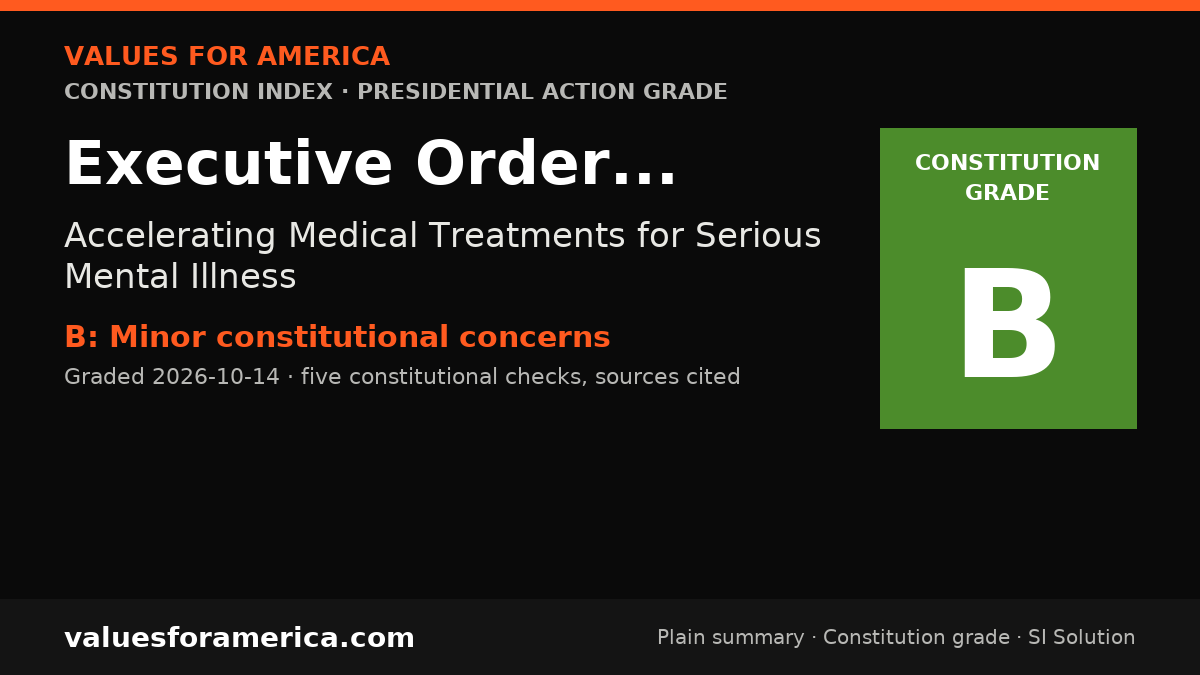
Accelerating Medical Treatments for Serious Mental Illness
Signed: 2026-04-18 Published: 2026-04-22 Federal Register document: 2026-07907
Agencies: Executive Office of the President
What Executive Order 14401 says
Federal Register, Volume 91 Issue 77 (Wednesday, April 22, 2026) [Federal Register Volume 91, Number 77 (Wednesday, April 22, 2026)] [Presidential Documents] [Pages 21709-21711] From the Federal Register Online via the Government Publishing Office [www.gpo.gov] [FR Doc No: 2026-07907] [[Page 21707]] Vol. 91 Wednesday, No. 77 April 22, 2026 Part IV The President ----------------------------------------------------------------------- Executive Order 14401--Accelerating Medical Treatments for Serious Mental Illness Presidential Documents Federal Register / Vol. 91 , No. 77 / Wednesday, April 22, 2026 / Presidential Documents ___________________________________________________________________ Title 3-- The President [[Page 21709]] Executive Order 14401 of April 18, 2026 Accelerating Medical Treatments for Serious Mental Illness By the authority vested in me as President by the Constitution and the laws of the United States of America, it is hereby ordered: Section 1. Purpose and Policy. Policymakers and the medical field have long struggled to address the burden of suicide and serious mental illness rates in America. Today, over 14 million American adults have a serious mental illness, defined as having a diagnosable mental, behavioral, or emotional disorder that substantially interferes with a person's life and ability to function, and about 8 million are on prescription...
Opening of the official text; read it in full in the Federal Register.
Constitution Index
“VFA Constitution grade”
Minor constitutional concerns
Graded 2026-10-14
SI-generated grade · five published checks · not individually reviewed by a person · methodology
Executive Order 14401 is mostly sound but has minor tensions regarding federalism and the Controlled Substances Act. It operates within enumerated federal powers over drug regulation and interstate commerce, does not infringe Bill of Rights protections, and respects individual sovereignty by expanding access to treatment. However, it directs federal funding to states in a way that may incentivize state action beyond traditional federal roles, and the rescheduling directive touches on controlled substances in a manner that could be seen as encroaching on state police powers, though it remains within federal authority under the Commerce Clause.
-
✓ Passes · Enumerated powers
The order relies on federal authority over interstate commerce (Article I, Section 8, Clause 3) and the power to regulate drugs under the Food, Drug, and Cosmetic Act and Controlled Substances Act. The FDA's role in drug approval and the DEA's scheduling authority are well-established federal functions. The order does not exceed these enumerated powers. -
✓ Passes · Bill of Rights
The order does not restrict speech, religion, assembly, press, petition, arms, quartering, search and seizure, self-incrimination, due process, takings, fair trial, jury, cruel and unusual punishment, or unenumerated rights. It expands access to medical treatments, which aligns with individual liberty. No infringement of the first ten amendments is present. -
✓ Passes · Individual sovereignty
The order facilitates individual access to potentially life-saving treatments under the Right to Try Act, respecting personal autonomy in medical decisions. It does not restrict what individuals can do with their person, property, speech, labor, or belief. The burden of justification is met by the compelling interest in reducing suicide and serious mental illness. -
✗ Concern · Decentralization
While the order allows states to develop their own programs and provides federal support, it consolidates decision-making at the federal level by directing FDA prioritization, DEA rescheduling, and federal funding allocation. An individual or family cannot independently access Schedule I psychedelics without federal law changes, and local communities cannot override federal drug scheduling. The st… -
✓ Passes · Due process and takings
The order does not bypass due process or take property without just compensation. It operates within existing statutory frameworks (Right to Try Act, Controlled Substances Act, FDA approval processes) that provide procedural safeguards. The rescheduling review under 21 U.S.C. 811 includes notice and comment, ensuring fair process. No arbitrary government action or deprivation of property is involv…
Report an error in this grade
What should happen instead
“VFA SI Solution”
Serious Mental Illness Treatment Acceleration Act
Accelerate research, clinical trials, FDA review, and patient access to psychedelic drugs including ibogaine for serious mental illness and veteran suicide, using priority vouchers, Right to Try pathways, federal-state funding, data sharing, and timely rescheduling.
Bipartisan rationale: The proposal combines interest in research and treatment access with patient safety, clear spending authority, voluntary state participation, privacy protections, audits, and a sunset. Those design choices offer concrete questions for lawmakers with different priorities; they do not establish party support or a predicted vote.
Article I, Section 8, Clause 1 Article I, Section 9, Clause 7 Article II, Section 3 Amendment V Amendment X
Report an error in this Solution

For journalists and bloggers
“Embed this grade”
Free to use with the link back. The badge and card update when the grade changes. Embed terms →
