Published Constitutional Solution
Serious Mental Illness Treatment Acceleration Act
SI-generated · published by a VFA editor on 2026-10-04 · how publication works · Report an error: hello@valuesforamerica.com
Accelerating Medical Treatments for Serious Mental Illness
Executive Order
Serious Mental Illness Treatment Acceleration Act
Accelerate research, clinical trials, FDA review, and patient access to psychedelic drugs including ibogaine for serious mental illness and veteran suicide, using priority vouchers, Right to Try pathways, federal-state funding, data sharing, and timely rescheduling.
Constitutional concerns with the original
- Article I funding: the Order directs at least $50 million from existing ARPA-H funds; any new multiyear program needs identified lawful appropriation authority and spending within available funds.
- Article II and agency authority: FDA voucher, investigational-access, Schedule I handling, and scheduling actions must fit existing statutes or receive express congressional authorization; the Order itself does not amend those laws.
- Due process and privacy: patient data sharing and licensing decisions need procedures and protections under the laws that apply to each agency and participant.
- Federalism: the Order seeks partnerships with states; a congressional grant program should keep state participation voluntary and its conditions clear.
Solution text
Operative provisions
Source basis and limits
Basis: Checked against the full published text of Executive Order 14401, Federal Register document 2026-07907, published April 22, 2026, sections 1 through 6. The Order directs at least $50 million from existing funds and calls for FDA, DEA, HHS, and VA coordination; the five-year ceiling and safeguards here are new VFA proposals. Additional evidence: FDA Right to Try eligibility and sponsor discretion, https://www.fda.gov/patients/learn-about-expanded-access-and-other-treatment-options/right-try ; primary ibogaine cardiac-safety observations, https://pmc.ncbi.nlm.nih.gov/articles/PMC9292417/ .
Check before relying on this: Current FDA voucher authority and eligibility, Right to Try requirements and product availability, Schedule I licensing or waiver authority, lawful ARPA-H appropriation availability, applicable privacy and review procedures, and clinical safety or efficacy require separate verification before legislation or patient use. Any particular psychiatric diagnosis, product, sponsor, and clinical protocol must separately meet eligibility and safety requirements; this proposal gives no patient-specific access or treatment recommendation.
Bipartisan rationale
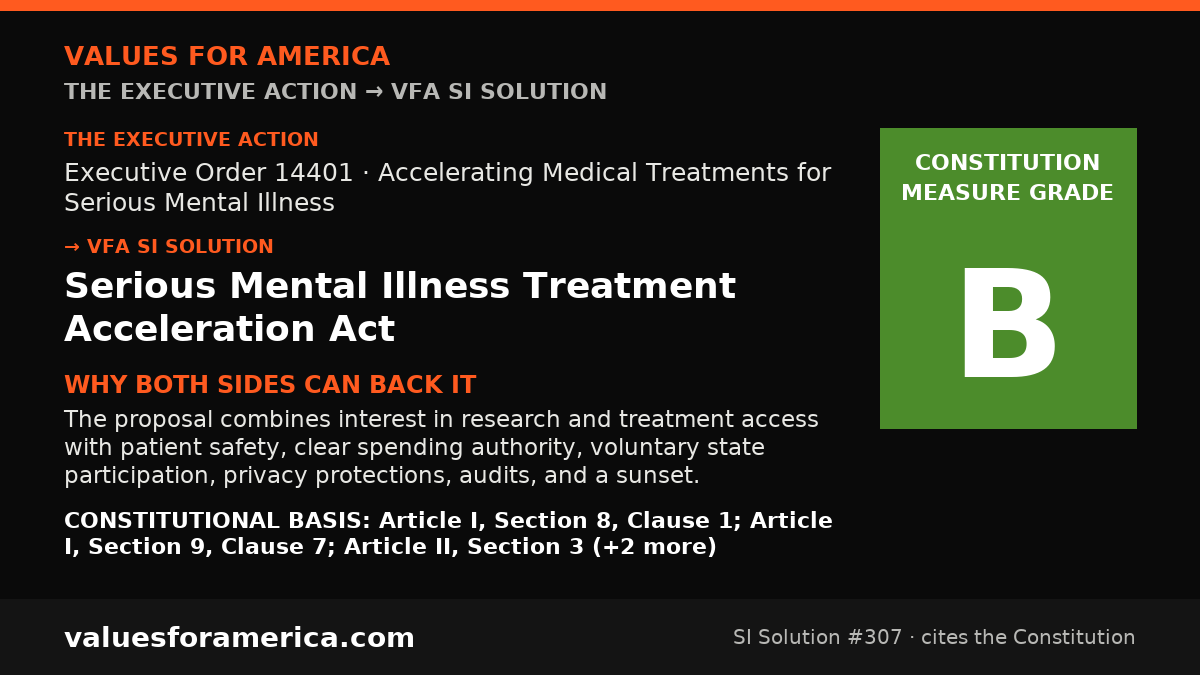
The proposal combines interest in research and treatment access with patient safety, clear spending authority, voluntary state participation, privacy protections, audits, and a sunset. Those design choices offer concrete questions for lawmakers with different priorities; they do not establish party support or a predicted vote.
Constitutional citations
- → Article I, Section 8, Clause 1
- → Article I, Section 9, Clause 7
- → Article II, Section 3
- → Fifth Amendment
- → Tenth Amendment
Article I, Section 8, Clause 1 Article I, Section 9, Clause 7 Article II, Section 3 Amendment V Amendment X
Possible legislative path
Congressional health and judiciary committees would need to examine agency authority, funding, patient safeguards, and state participation against official evidence before any floor vote. This describes a deliberation path, not a forecast of support.
Report an error in this Solution

Citizen Consensus
“Do you support this VFA SI Solution?”
One vote per verified account; you can change it any time. Only verified accounts count, results publish once 30 verified people have voted, and state and district results count only people who attested a home ZIP code. How this works.
Email verification is not switched on yet, so no vote counts toward results yet. Votes cast now are saved and count once the voter verifies their email address.
Sign in or create a free account to vote.
Add a short reason (optional)
/280 · no links or contact details · reasons are reviewed before anyone sees them, and many never are shown.
Your vote is saved but held out of published results by an automated integrity check (for example, several accounts voting from one browser).
Your vote is saved. It will count once you verify your email address. Verify on your account page.
Your vote counts nationally. Add your home ZIP code to count in your state and district too.
Your vote counts nationally and in .
Reason saved privately; it is shown only if it passes review.
Verified participants nationwide · n =
Self-selected participants, not a random sample; ± is the 95% sampling margin.
Not enough verified votes yet. Results publish at verified votes.
A sudden surge of votes on this item was flagged and is under review; votes from new accounts in that surge are held out until it is resolved.
Related on VFA
Generated by VFA SI Solutions · 2026.10.04 03:36 UTC · ← Back to the Republic