Executive Order 14370 explained · Executive Order · No disposition noted
Increasing Medical Marijuana and Cannabidiol Research
Signed: 2025-12-18 Published: 2025-12-23 Federal Register document: 2025-23846
Agencies: Executive Office of the President
What Executive Order 14370 says
Federal Register, Volume 90 Issue 244 (Tuesday, December 23, 2025) [Federal Register Volume 90, Number 244 (Tuesday, December 23, 2025)] [Presidential Documents] [Pages 60541-60543] From the Federal Register Online via the Government Publishing Office [www.gpo.gov] [FR Doc No: 2025-23846] Presidential Documents Federal Register / Vol. 90, No. 244 / Tuesday, December 23, 2025 / Presidential Documents [[Page 60541]] Executive Order 14370 of December 18, 2025 Increasing Medical Marijuana and Cannabidiol Research By the authority vested in me as President by the Constitution and the laws of the United States of America, it is hereby ordered: Section 1. Purpose and Policy. Americans deserve access to the best medical treatments and research infrastructure in the world. In 2023, the Food and Drug Administration (FDA) completed a review of the landscape of medical use of marijuana and found scientific support for its use to treat anorexia related to a medical condition, nausea and vomiting, and pain. Chronic pain affects nearly 1 in 4 United States adults and more than 1 in 3 United States seniors, and 6 in 10 people who use medical marijuana report doing so to manage pain. Forty States plus the District of Columbia have State- or locally-sanctioned, regulated medical marijuana programs. Yet decades of Federal drug control policy have neglected marijuana's medical uses. That...
Opening of the official text; read it in full in the Federal Register.
Constitution Index
“VFA Constitution grade”
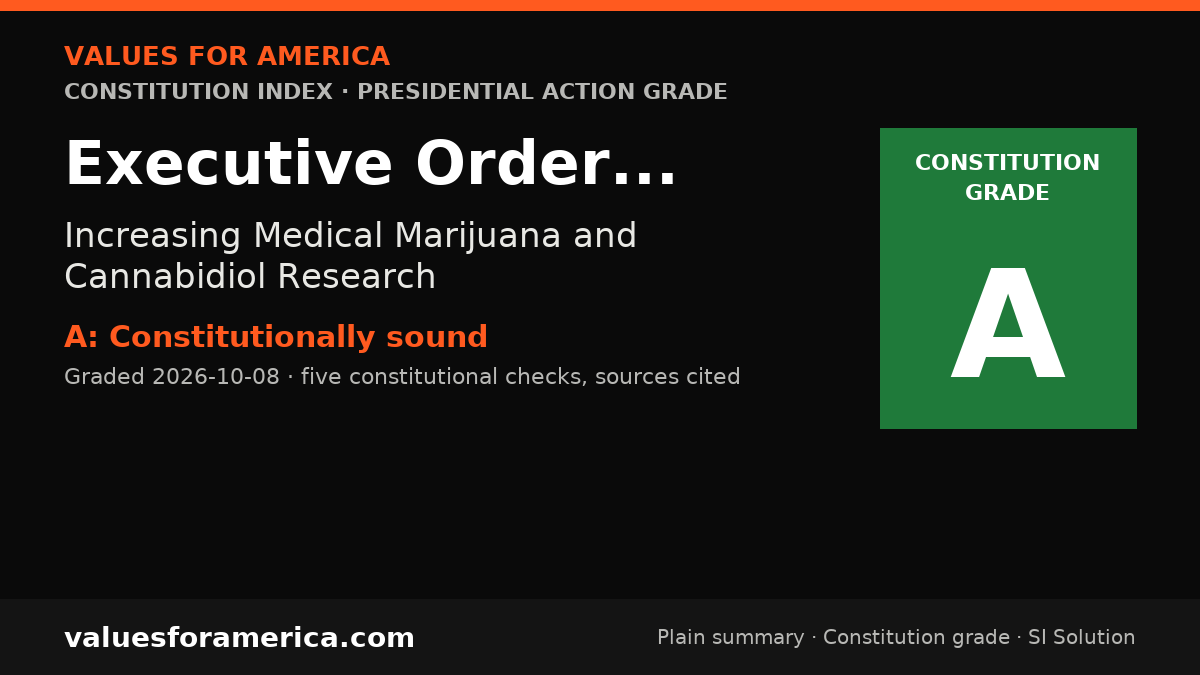
Constitutionally sound
Graded 2026-10-08
SI-generated grade · five published checks · not individually reviewed by a person · methodology
Executive Order 14370 is constitutional. It executes existing CSA authority to reschedule marijuana to Schedule III and improve research on medical marijuana and cannabidiol, with no rights infringement, no taking, no new federal power grab, and explicit respect for state medical programs.
-
✓ Passes · Enumerated powers
President acts under Article II, Section 1 vesting of executive power and Article II, Section 3 duty to take care that laws be faithfully executed, directing the Attorney General to complete CSA rulemaking under 21 U.S.C. 811. Federal drug scheduling rests on Article I, Section 8, Clause 3 Commerce Clause and Clause 18 Necessary and Proper Clause as implemented by the Controlled Substances Act. Or… -
✓ Passes · Bill of Rights
No provision restricts speech, religion, assembly, press, arms, search and seizure, trial rights, or other protections. First Amendment: order encourages research and real-world evidence to inform doctors and patients, expanding information flow. Fourth Amendment: no search, seizure, or surveillance authorized. Ninth and Tenth Amendments: order acknowledges 40 States plus District of Columbia with… -
✓ Passes · Individual sovereignty
Order imposes no restriction on person, property, speech, labor, or belief. It removes research barriers, seeks affordable access, and improves safety information on drug interactions, labeling accuracy, and THC levels, with focus on vulnerable populations including adolescents and seniors. Burden test met: government justifies action as informing voluntary medical decisions, leaving ultimate trea… -
✓ Passes · Decentralization
Order does not consolidate power upward; it reduces federal Schedule I barrier that impeded research and left patients without guidance. (1) Individuals, families, doctors and patients can and do make medical decisions - order supports that with better evidence. (2) Local communities can counsel and dispense under state programs. (3) States have proven they can handle medical regulation - 40 State… -
✓ Passes · Due process and takings
No deprivation of life, liberty, or property, no criminal penalty, no seizure, and no taking under Fifth Amendment Takings Clause. Procedural due process under Fifth Amendment satisfied: rescheduling must proceed in accordance with Federal law including 21 U.S.C. 811, which requires scientific review, proposed rule, 43,000 public comments considered, and administrative law hearing. Substantive due…
Report an error in this grade
What should happen instead
“VFA SI Solution”
Medical Cannabis Evidence and Patient Safety Act
Executive Order 14370 directs completion of an existing marijuana rescheduling rulemaking under federal law, calls for work with Congress on hemp-derived cannabinoid rules, and asks HHS, FDA, CMS, and NIH to develop real-world evidence methods to inform care and patient safety.
Bipartisan rationale: A possible coalition could join members seeking stronger clinical evidence, clearer patient warnings, and reliable product information with members seeking limits on new spending and fidelity to existing federal and state law. The proposal leaves the rescheduling outcome to the statutory process and asks Congress to weigh new research authority and costs. This describes possible interests, not recorded endorsements.
Article I, Section 8 Article I, Section 9, Clause 7 Article II, Section 3 Amendment V Amendment X
Report an error in this Solution

For journalists and bloggers
“Embed this grade”
Free to use with the link back. The badge and card update when the grade changes. Embed terms →
