Published Constitutional Solution
Medical Cannabis Evidence and Patient Safety Act
SI-generated · published by a VFA editor on 2026-10-04 · how publication works · Report an error: hello@valuesforamerica.com
Increasing Medical Marijuana and Cannabidiol Research
Executive Order
Medical Cannabis Evidence and Patient Safety Act
Executive Order 14370 directs completion of an existing marijuana rescheduling rulemaking under federal law, calls for work with Congress on hemp-derived cannabinoid rules, and asks HHS, FDA, CMS, and NIH to develop real-world evidence methods to inform care and patient safety.
Constitutional concerns with the original
- Any direction to complete rescheduling must preserve the Controlled Substances Act procedure and must not predetermine the agency decision.
- A new research program or binding product standard needs statutory authority and an available congressional appropriation.
- Voluntary research and product enforcement need appropriate privacy, notice, and review safeguards while respecting the limits of federal and state authority.
Solution text
Operative provisions
Source basis and limits
Basis: Checked Federal Register document 2025-23846, Executive Order 14370, published December 23, 2025 (90 FR 60541-60543), sections 1-3. Section 2(a) directs the Attorney General to complete marijuana rescheduling rulemaking in accordance with federal law. Section 2(b) calls for work with Congress on hemp-derived cannabinoids and for HHS, FDA, CMS, and NIH to develop real-world evidence methods under federal law. Section 3 preserves existing agency authority and makes implementation subject to appropriations.
Check before relying on this: The order reports prevalence and FDA findings, but those underlying studies and current rulemaking status were not independently verified here. The five-year grant program, $250 million ceiling, reports, GAO review, and grant remedies are VFA proposals, not provisions or cost estimates in the order. Existing FDA authority, fiscal effects, clinical outcomes, and any final scheduling decision need separate verification before legislation.
Bipartisan rationale
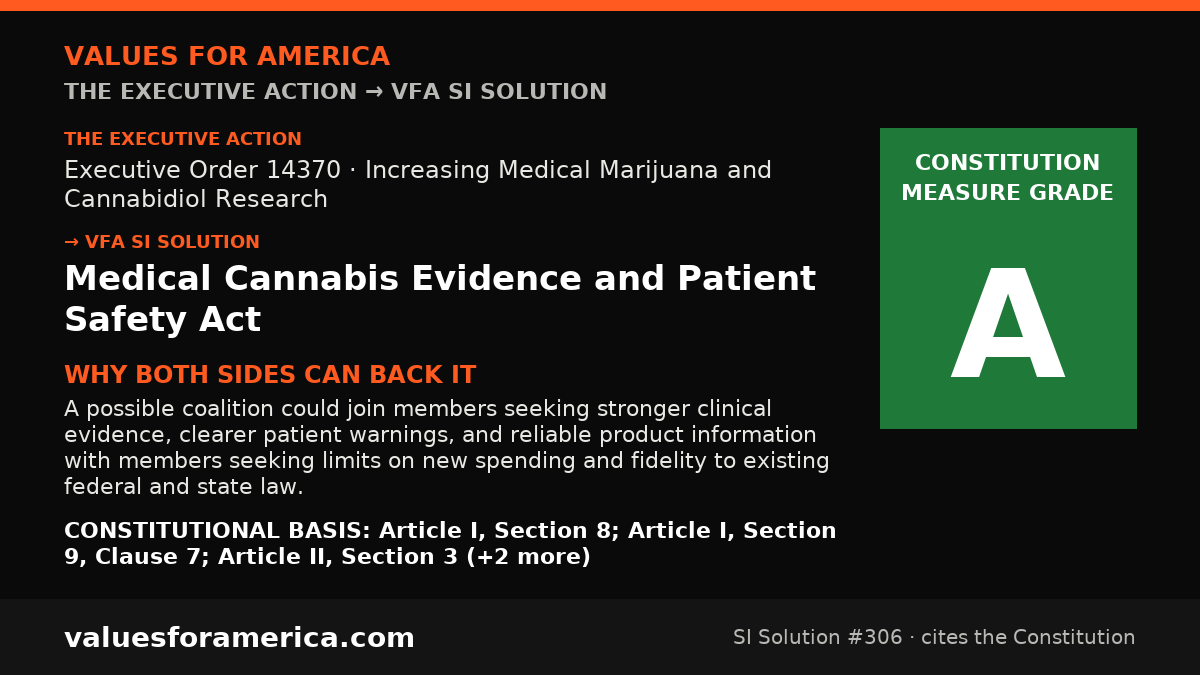
A possible coalition could join members seeking stronger clinical evidence, clearer patient warnings, and reliable product information with members seeking limits on new spending and fidelity to existing federal and state law. The proposal leaves the rescheduling outcome to the statutory process and asks Congress to weigh new research authority and costs. This describes possible interests, not recorded endorsements.
Constitutional citations
- → Article I, Section 8, Clauses 1, 3, and 18 (proposed congressional research and commerce legislation)
- → Article I, Section 9, Clause 7 (appropriations)
- → Article II, Section 3 (execution of existing law)
- → Fifth Amendment (procedural safeguards where applicable)
- → Tenth Amendment (limits of federal and state authority)
Article I, Section 8 Article I, Section 9, Clause 7 Article II, Section 3 Amendment V Amendment X
Possible legislative path
Congressional committees with jurisdiction over health, the Controlled Substances Act, and appropriations could hold hearings on research design, FDA authority, state-law interaction, and a CBO cost estimate. No member support or vote margin has been verified.
Report an error in this Solution

Citizen Consensus
“Do you support this VFA SI Solution?”
One vote per verified account; you can change it any time. Only verified accounts count, results publish once 30 verified people have voted, and state and district results count only people who attested a home ZIP code. How this works.
Email verification is not switched on yet, so no vote counts toward results yet. Votes cast now are saved and count once the voter verifies their email address.
Sign in or create a free account to vote.
Add a short reason (optional)
/280 · no links or contact details · reasons are reviewed before anyone sees them, and many never are shown.
Your vote is saved but held out of published results by an automated integrity check (for example, several accounts voting from one browser).
Your vote is saved. It will count once you verify your email address. Verify on your account page.
Your vote counts nationally. Add your home ZIP code to count in your state and district too.
Your vote counts nationally and in .
Reason saved privately; it is shown only if it passes review.
Verified participants nationwide · n =
Self-selected participants, not a random sample; ± is the 95% sampling margin.
Not enough verified votes yet. Results publish at verified votes.
A sudden surge of votes on this item was flagged and is under review; votes from new accounts in that surge are held out until it is resolved.
Related on VFA
Generated by VFA SI Solutions · 2026.10.04 03:06 UTC · ← Back to the Republic