S.Res. 690 explained · 119th Congress · Agreed to in the Senate
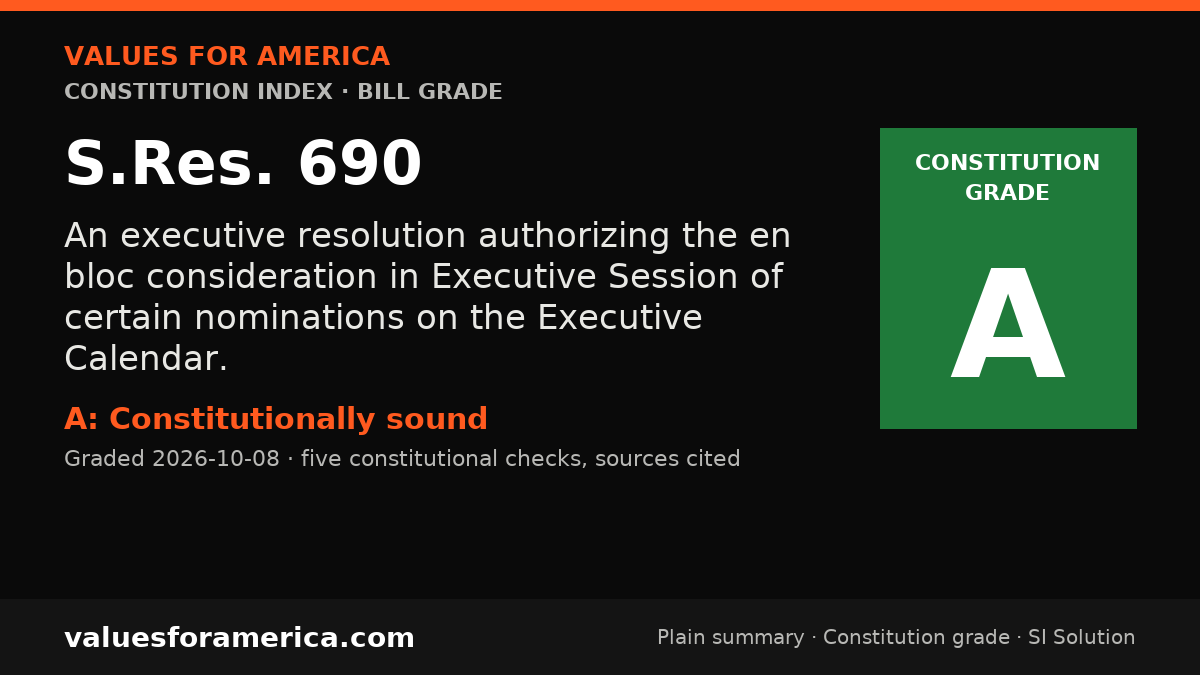
An executive resolution authorizing the en bloc consideration in Executive Session of certain nominations on the Executive Calendar.
Cosponsors: none · per Congress.gov, 2026-10-08
Introduced: 2026-04-27
Latest action (2026-05-11): Resolution agreed to in Senate without amendment by Yea-Nay Vote. 46 - 45. Record Vote Number: 114. (text: CR 4/27/2026 S2056-2057)
What S.Res. 690 does, in plain terms
This resolution authorizes the en bloc consideration of 49 nominations for various roles, including executive officers and ambassadors. For example, nominees are appointed to serve in the Departments of Commerce, Justice, State, and Transportation. The package also includes nominations to serve as U.S. ambassador to Iceland, Slovenia, Sri Lanka, and Vietnam.
Official summary by the Congressional Research Service, via Congress.gov.
Constitution Index
“VFA Constitution grade”
Constitutionally sound
Graded 2026-10-08
SI-generated grade · five published checks · not individually reviewed by a person · methodology
SRES 690 is a routine Senate procedure exercising explicit Article I and Article II powers. It infringes no rights, takes nothing, and operates at the constitutionally required level.
-
✓ Passes · Enumerated powers
The Senate has explicit authority to determine its own proceedings under Article I, Section 5, Clause 2, and to provide advice and consent on nominations under Article II, Section 2, Clause 2. Authorizing en bloc consideration of executive nominations is squarely within those grants. -
✓ Passes · Bill of Rights
No speech, religion, press, arms, search, trial, or other First through Tenth Amendment right is restricted. The resolution only governs Senate voting procedure on nominations. No provision of the Bill of Rights is implicated. -
✓ Passes · Individual sovereignty
The resolution restricts no private conduct regarding person, property, speech, labor, or belief. It governs only internal Senate procedure. No individual liberty interest requires government justification here. -
✓ Passes · Decentralization
Federal nominations cannot be handled by individuals, localities, or states. The Tenth Amendment reserves undelegated powers to states and people, but advice and consent is explicitly delegated to the Senate. Acting at the federal level is the minimum necessary level and consolidates nothing upward. -
✓ Passes · Due process and takings
No person is deprived of life, liberty, or property, and no property is taken. Fifth Amendment due process and takings protections are not triggered by internal Senate scheduling of confirmation votes with recorded Yea-Nay vote and Congressional Record notice.
Sources: Congress.gov: SRES 690 summary
Report an error in this grade
What should pass
“VFA SI Solution”
No solution yet
A sourced SI draft appears here once it passes automated checks (Constitution citation, source verification, independent SI critic). How publication works.
Related on VFA

For journalists and bloggers
“Embed this grade”
Free to use with the link back. The badge and card update when the grade changes. Embed terms →
