S.Con.Res. 37 explained · 119th Congress · Pending in Congress
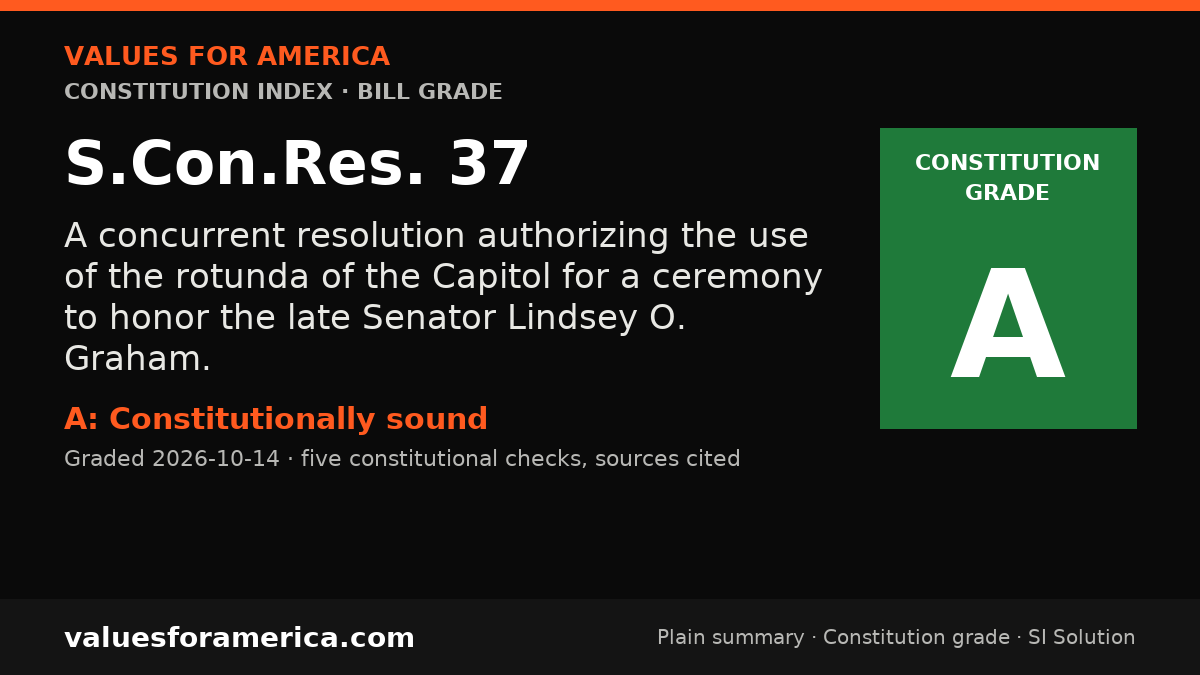
A concurrent resolution authorizing the use of the rotunda of the Capitol for a ceremony to honor the late Senator Lindsey O. Graham.
Cosponsors: none · per Congress.gov, 2026-10-15
Introduced: 2026-07-21
Latest action (2026-07-22): Motion to reconsider laid on the table Agreed to without objection.
What S.Con.Res. 37 does, in plain terms
This concurrent resolution authorizes the Capitol rotunda to be used on July 28, 2026, for a tribute to the late Senator Lindsey O. Graham of the state of South Carolina.
Official summary by the Congressional Research Service, via Congress.gov.
Constitution Index
“VFA Constitution grade”
Constitutionally sound
Graded 2026-10-14
SI-generated grade · five published checks · not individually reviewed by a person · methodology
This concurrent resolution merely authorizes the use of the Capitol rotunda for a ceremonial tribute to a deceased senator. It involves no exercise of coercive federal power, no restriction on individual rights, and no transfer of authority. It is a routine internal housekeeping matter squarely within Congress's constitutional authority to manage its own proceedings and facilities.
-
✓ Passes · Enumerated powers
The Constitution grants Congress the authority to determine the rules of its proceedings and to manage its own internal affairs. Article I, Section 5, Clause 2 provides that 'Each House may determine the Rules of its Proceedings,' which implicitly includes the use of the Capitol building for official ceremonies. Additionally, Article I, Section 8, Clause 18 grants Congress the power to make all la… -
✓ Passes · Bill of Rights
The resolution does not implicate any of the first ten amendments. It does not restrict speech, religion, assembly, press, or petition (First Amendment); it does not affect the right to keep and bear arms (Second Amendment); it does not involve quartering of soldiers (Third Amendment); it does not authorize any search or seizure (Fourth Amendment); it does not affect criminal proceedings, due proc… -
✓ Passes · Individual sovereignty
The resolution imposes no restriction on any individual's person, property, speech, labor, or belief. It merely authorizes the use of a government building for a ceremonial event. No individual is compelled to do anything, and no private right is affected. The burden on government to justify restrictions is not triggered because there is no restriction. -
✓ Passes · Decentralization
This action is a purely internal matter of the federal legislative branch. It does not involve any policy that could be handled by individuals, local communities, or states. The use of the Capitol rotunda is inherently a federal function, and the resolution does not consolidate any decision-making authority that would otherwise reside at a lower level. It passes all four questions: (1) individuals… -
✓ Passes · Due process and takings
The resolution does not deprive any person of life, liberty, or property, and it does not take any private property. It does not involve any adjudicative or administrative proceeding that would require notice or a hearing. There is no due process or takings issue.
Sources: Congress.gov: SCONRES 37 summary
Report an error in this grade
What should pass
“VFA SI Solution”
No solution yet
A sourced SI draft appears here once it passes automated checks (Constitution citation, source verification, independent SI critic). How publication works.
Related on VFA

For journalists and bloggers
“Embed this grade”
Free to use with the link back. The badge and card update when the grade changes. Embed terms →
