S.Con.Res. 33 explained · 119th Congress · Pending in Congress
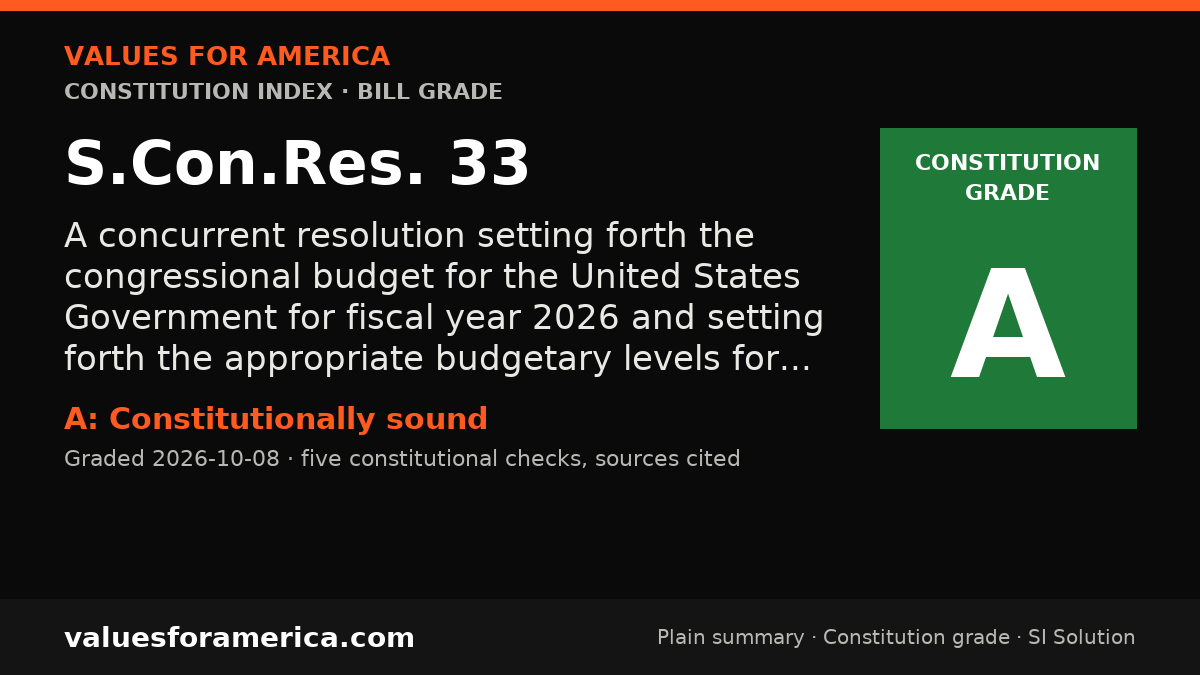
A concurrent resolution setting forth the congressional budget for the United States Government for fiscal year 2026 and setting forth the appropriate budgetary levels for fiscal years 2027 through 2035.
Cosponsors: none · per Congress.gov, 2026-10-08
Introduced: 2026-04-21
Latest action (2026-04-29): On agreeing to the resolution Agreed to by the Yeas and Nays: 215 - 211, 1 Present (Roll no. 143). (text: CR H3147-3146)
What S.Con.Res. 33 does, in plain terms
This concurrent resolution establishes the congressional budget for the federal government for FY2026, sets forth budgetary levels for FY2027-FY2035, and provides reconciliation instructions for legislation that increases the deficit. The resolution recommends levels and amounts for FY2026-FY2035 for federal revenues, new budget authority, budget outlays, deficits, public debt, debt held by the public, and the major functional categories of spending. It also recommends levels and amounts for Social Security and Postal Service discretionary administrative expenses for the purpose of budget enforcement in the Senate. The resolution includes reconciliation instructions that direct the House Homeland Security Committee, the House Judiciary Committee, the Senate Homeland Security and Governmental Affairs Committee, and the Senate Judiciary Committee to submit recommendations for legislation that will increase the deficit over FY2026-FY2035 by not more than $70 billion. Each committee must submit the recommendations to the House or Senate Budget Committee by May 15, 2026. (Under current law, reconciliation bills are considered by Congress using expedited legislative procedures that prevent a filibuster and restrict amendments in the Senate.) In addition, the resolution establishes reserve funds that allow certain adjustments to committee allocations and other budgetary levels to accommodate (1) reconciliation legislation, and (2) legislation that would not increase the deficit over FY2026-FY2035 and supports changes to immigration enforcement and border security policy undertaken by the President. Finally, the resolution sets forth budget enforcement procedures that address issues such as budget points of order in the Senate and emergency spending requirements in the House.
Official summary by the Congressional Research Service, via Congress.gov.
Constitution Index
“VFA Constitution grade”
Constitutionally sound
Graded 2026-10-08
SI-generated grade · five published checks · not individually reviewed by a person · methodology
SCONRES 33 is a routine congressional budget framework exercising core Article I fiscal and rulemaking powers. It imposes no rights restriction, no individual mandate, and no taking, and it operates at the proper federal level for federal budgeting.
-
✓ Passes · Enumerated powers
Congress has explicit authority for this concurrent budget resolution under Article I, Section 8, Clause 1 to lay and collect taxes and provide for the common defence and general welfare, Article I, Section 9, Clause 7 requiring appropriations made by law, and Article I, Section 5, Clause 2 authorizing each House to determine its rules of proceedings, which includes budget enforcement and reconcil… -
✓ Passes · Bill of Rights
The resolution authorizes no search, seizure, speech restriction, arms restriction, or criminal punishment. It sets revenue, spending, deficit and debt levels and reconciliation instructions. No First through Tenth Amendment right is infringed. -
✓ Passes · Individual sovereignty
The resolution restricts no personal conduct, speech, belief, labor, or use of private property. It directs House and Senate committees to report budgetary legislation within deficit limits. The burden on individual liberty is zero, and no justification under the Ninth Amendment retained rights or Fourteenth Amendment liberty is required. -
✓ Passes · Decentralization
Under the Tenth Amendment, budgeting for the federal government is inherently a federal function. (1) Individuals cannot set federal revenues and outlays. (2) Local counties cannot manage national debt and Social Security administration. (3) States cannot set federal budget levels. (4) The action does not consolidate upward beyond the minimum necessary; it exercises only the existing federal fisca… -
✓ Passes · Due process and takings
No deprivation of life, liberty, or property and no taking occurs. The resolution creates no criminal liability, no forfeiture, and no seizure of private property under the Fifth Amendment Due Process and Takings Clauses. Future implementing legislation would be separately subject to due process and just compensation requirements.
Sources: Congress.gov: SCONRES 33 summary
Report an error in this grade
What should pass
“VFA SI Solution”
No solution yet
A sourced SI draft appears here once it passes automated checks (Constitution citation, source verification, independent SI critic). How publication works.
Related on VFA

For journalists and bloggers
“Embed this grade”
Free to use with the link back. The badge and card update when the grade changes. Embed terms →
