S. 3859 explained · 119th Congress · Pending in Congress
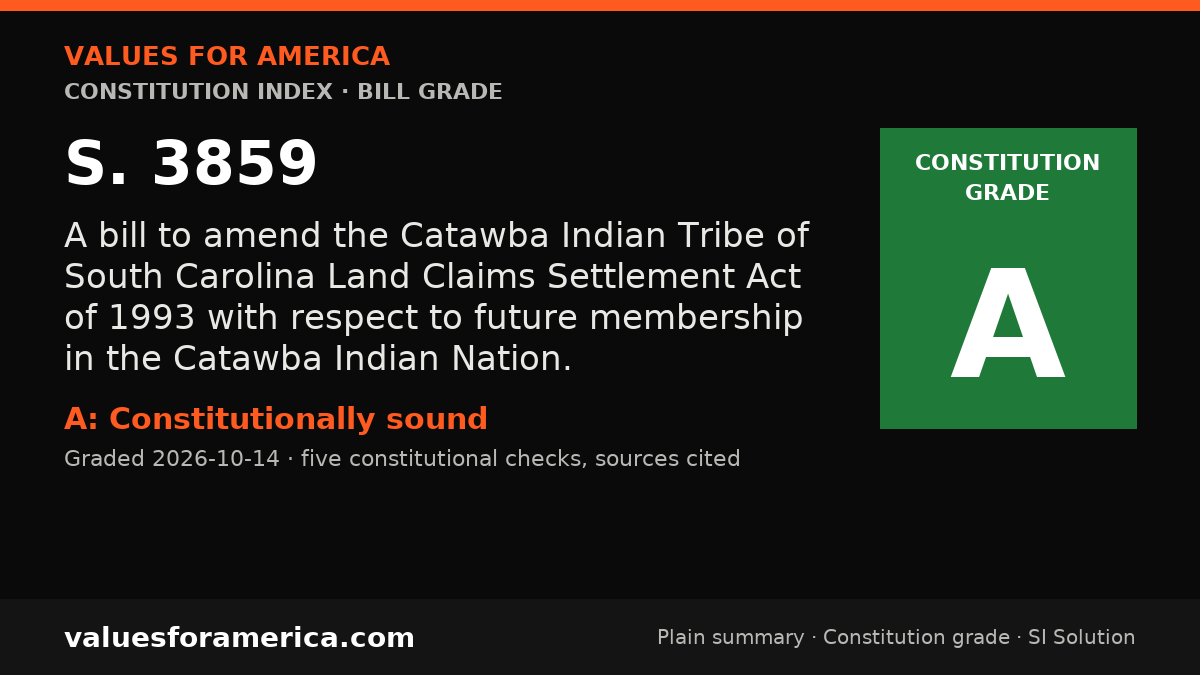
A bill to amend the Catawba Indian Tribe of South Carolina Land Claims Settlement Act of 1993 with respect to future membership in the Catawba Indian Nation.
Cosponsors: 2 (0 D, 2 R) · per Congress.gov, 2026-10-14
Introduced: 2026-02-12
Latest action (2026-09-23): Committee on Indian Affairs. Hearings held.
What S. 3859 does, in plain terms
This bill revises tribal membership requirements for the Catawba Indian Nation (a tribe in South Carolina). The Catawba Indian Tribe of South Carolina Land Claims Settlement Act of 1993 explicitly restricted the tribe’s future membership to lineal descendants of people on the final base membership roll who maintained continuous political relations with the tribe. This bill removes these membership criteria and allows the tribe to determine its membership. (The tribe uses three base membership rolls and anyone who wants to be enrolled must prove lineal descent from someone listed on one of these base membership rolls.)
Official summary by the Congressional Research Service, via Congress.gov.
Constitution Index
“VFA Constitution grade”
Constitutionally sound
Graded 2026-10-14
SI-generated grade · five published checks · not individually reviewed by a person · methodology
The bill is constitutional. It respects the inherent sovereignty of the Catawba Indian Nation to determine its own membership, a power long recognized as central to tribal self-governance. The bill does not expand federal power, infringe on individual rights, or violate due process. It appropriately leaves membership decisions to the tribe, consistent with the federal government's trust responsibility and the principle of tribal self-determination.
-
✓ Passes · Enumerated powers
Congress has plenary authority over Indian affairs under Article I, Section 8, Clause 3 (the Indian Commerce Clause), which grants Congress the power 'to regulate Commerce with foreign Nations, and among the several States, and with the Indian Tribes.' This authority has been consistently interpreted to include the power to legislate on matters of tribal membership and to amend prior settlement ac… -
✓ Passes · Bill of Rights
The bill does not infringe any of the first ten amendments. It does not restrict speech, religion, assembly, press, petition, arms, quartering, search and seizure, self-incrimination, due process, takings, trial rights, or cruel and unusual punishment. The bill only removes federal statutory restrictions on tribal membership criteria, allowing the tribe to determine its own membership. This does n… -
✓ Passes · Individual sovereignty
The bill does not restrict individual liberty. It removes federal restrictions on tribal membership, which could be seen as expanding the tribe's ability to define its own political community. While it may affect who can become a member, this is a matter of tribal self-governance, not a restriction on individual rights. The tribe's membership criteria are subject to the Indian Civil Rights Act (25… -
✓ Passes · Decentralization
The bill moves decision-making from the federal level to the tribal level, which is the most local and appropriate level for determining tribal membership. It does not consolidate power upward; rather, it devolves authority to the tribe. The four-question test: (1) An individual cannot determine tribal membership alone; (2) A local community cannot handle this; (3) A state cannot handle this becau… -
✓ Passes · Due process and takings
The bill does not bypass due process or take property without just compensation. It does not deprive any person of life, liberty, or property without due process of law. The bill simply removes federal statutory criteria for tribal membership, leaving the tribe to establish its own rules. The tribe's membership decisions are subject to the Indian Civil Rights Act, which provides procedural due pro…
Sources: Congress.gov: S 3859 summary
Report an error in this grade
What should pass
“VFA SI Solution”
No solution yet
A sourced SI draft appears here once it passes automated checks (Constitution citation, source verification, independent SI critic). How publication works.
Related on VFA

For journalists and bloggers
“Embed this grade”
Free to use with the link back. The badge and card update when the grade changes. Embed terms →
