S. 307 explained · 119th Congress · Became law
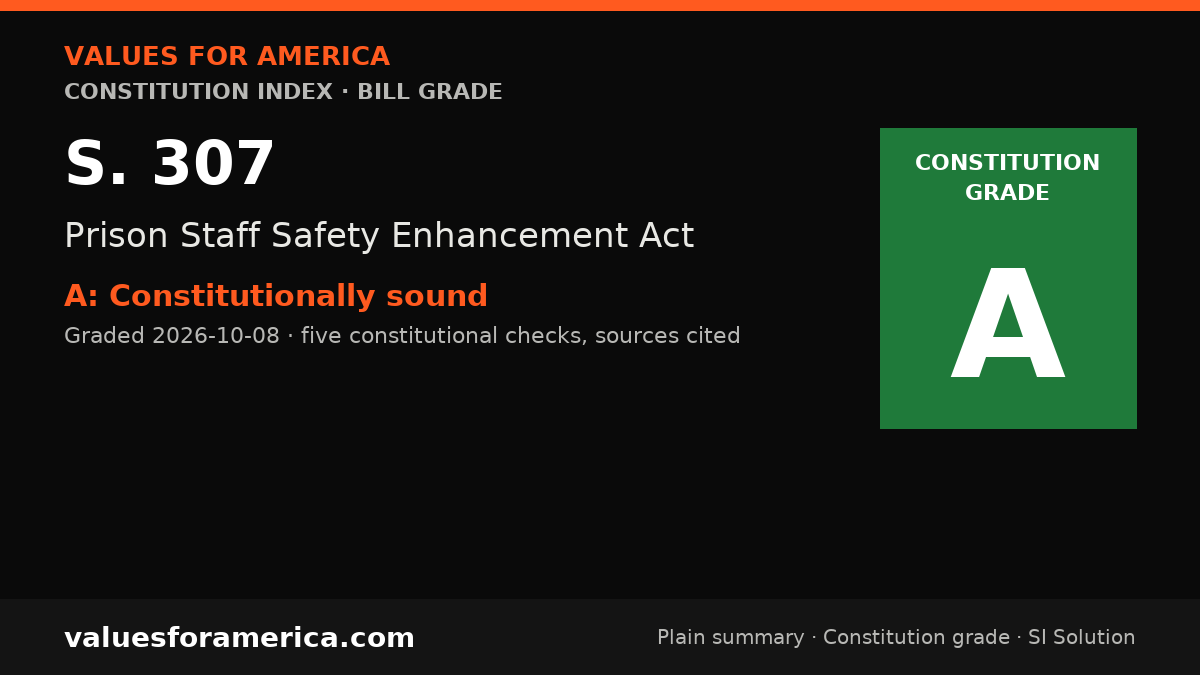
Prison Staff Safety Enhancement Act
Cosponsors: 3 (2 D, 1 R) · per Congress.gov, 2026-10-15
Introduced: 2025-01-29
Latest action (2026-09-16): Became Public Law No: 119-110.
What S. 307 does, in plain terms
Prison Staff Safety Enhancement Act This act establishes requirements for the Department of Justice (DOJ) and component agencies to assess and respond to incidents of sexual harassment and sexual assault by incarcerated individuals against Bureau of Prisons (BOP) staff. Specifically, the act requires DOJ to adopt national standards for the prevention, reduction, and punishment of sexual harassment and sexual assault by incarcerated individuals against correctional officers or other employees of the BOP. Additionally, the act requires the BOP to fully implement the recommendations of the DOJ Inspector General contained in the report titled Evaluation of the Federal Bureau of Prisons’ Efforts to Address Sexual Harassment and Sexual Assault Committed by Inmates Toward Staff.
Official summary by the Congressional Research Service, via Congress.gov.
Constitution Index
“VFA Constitution grade”
Constitutionally sound
Graded 2026-10-08
SI-generated grade · five published checks · not individually reviewed by a person · methodology
Federal staff-safety standards for federal prisons are within congressional authority, create no rights infringement, and consolidate no outside power. Grade A.
-
✓ Passes · Enumerated powers
Congress has authority over federal prisons and federal officers. Article I, Section 8, Clause 18, the Necessary and Proper Clause, supports legislation to manage institutions created under federal law, combined with Article I, Section 8, Clause 1 authority to provide for operations of the federal government and Article IV, Section 3, Clause 2 authority respecting property and operations of the Un… -
✓ Passes · Bill of Rights
The Act creates workplace protections for Bureau of Prisons staff and directs punishment of sexual harassment and assault committed by incarcerated persons against staff. It does not restrict speech under the First Amendment, does not authorize warrantless searches under the Fourth Amendment, does not compel self-incrimination under the Fifth Amendment, and preserves trial rights under the Sixth A… -
✓ Passes · Individual sovereignty
The Act does not restrict the person, property, speech, labor, or belief of free citizens. It regulates conduct inside federal custody, specifically sexual harassment and sexual assault against staff, which is not a protected liberty interest. The burden on incarcerated persons is limited to prohibiting assaultive conduct with compelling justification in staff safety and orderly prison administrat… -
✓ Passes · Decentralization
Management of federal prisons and protection of federal employees cannot be handled by individuals, families, local counties, or states. The Act applies minimum-level decision-making by directing the agency that already operates federal prisons to adopt standards, and does not consolidate state or local corrections under federal control. No Tenth Amendment violation. -
✓ Passes · Due process and takings
The Act requires national prevention standards and implementation of Inspector General recommendations. It does not authorize punishment without notice or hearing, does not presume guilt, and does not take private property. Any discipline for harassment or assault must still proceed through established Bureau disciplinary procedures and judicial review under the Fifth Amendment Due Process Clause.
Sources: Congress.gov: S 307 summary
Report an error in this grade
What should pass
“VFA SI Solution”
No solution yet
A sourced SI draft appears here once it passes automated checks (Constitution citation, source verification, independent SI critic). How publication works.
Related on VFA

For journalists and bloggers
“Embed this grade”
Free to use with the link back. The badge and card update when the grade changes. Embed terms →
