S. 2 explained · 119th Congress · Became law
Secure America Act
Cosponsors: none · per Congress.gov, 2026-10-14
Introduced: 2026-05-20
Latest action (2026-06-10): Became Public Law No: 119-98.
What S. 2 does, in plain terms
Secure America Act This act provides $70 billion in funding to the Department of Homeland Security (DHS), U.S. Customs and Border Protection (CBP), and U.S. Immigration and Customs Enforcement (ICE) through FY2029 for immigration enforcement, border security, and related activities. It is known as a reconciliation bill and includes legislation submitted by certain congressional committees pursuant to provisions in the FY2026 congressional budget resolution (S. Con. Res. 33) that directed the committees to submit legislation to the House or Senate Budget Committee that will increase the deficit. (Reconciliation bills are considered by Congress using expedited legislative procedures that prevent a filibuster and restrict amendments in the Senate.) TITLE I--COMMITTEE ON HOMELAND SECURITY AND GOVERNMENTAL AFFAIRS (Sec. 101) This section provides funding for CBP to hire, pay, train, and equip Border Patrol agents and Border Patrol support personnel to conduct functions other than immigration enforcement and customs functions. The funds provided by this section may not be used to recruit, hire, or train personnel for the duties of processing coordinators after October 31, 2028. (Sec. 102) This section provides funding to ICE for (1) hiring, paying, training, and equipping Homeland Security Investigations (HIS) agents and support personnel; and (2) other necessary expenses for HSI’s mission support and operations and maintenance. It also requires specified funds to be used to hire, pay, and equip additional child exploitation investigators and forensics analysts for certain HSI offices to (1) support the identification and rescue of victims of child sexual exploitation and abuse, and (2) train such personnel and state and local law enforcement regarding identifying victims of child sexual exploitation and abuse. The funds provided by this section must be used for functions other than those related to HSI’s immigration enforcement and customs enforcement missions. (Sec. 103) This section provides funding to CBP for border security, technology, and screening, including procurement and integration of new nonintrusive inspection equipment and associated civil works (e.g., artificial intelligence, machine learning, and other innovative technologies) and other mission support to combat the entry or exit of illicit narcotics at ports of entry and along the southwest, northern, and maritime borders; upgrading and procurement of platforms for rapid air and marine response capabilities; upgrading and procurement of border surveillance technologies along the southwest, northern, and maritime borders; necessary expenses, including the deployment of technology, relating to the biometric entry and exit system under the Intelligence Reform and Terrorism Prevention Act of 2004; enhancing border security by combating drug trafficking, including fentanyl and its precursor chemicals, at the southwest, northern, and maritime borders; and necessary expenses for CBP's mission support and operations and maintenance for functions other than those related to its immigration enforcement and customs missions. None of the funds provided by this section may be used for the procurement or deployment of surveillance towers along the southwest border and the northern border that have not been tested and accepted by CBP to deliver autonomous capabilities. Under this section the term autonomous means a system designed to apply artificial intelligence, machine learning, computer vision, or other algorithms to accurately detect, identify, classify, and track items of interest in real time such that the system can make operational adjustments without the active engagement of personnel or continuous human command or control. (Sec. 104) This section provides additional funding to DHS for the purposes for which funding is provided in this title. TITLE II--COMMITTEE ON THE JUDICIARY (Sec. 201) This section provides funding to CBP for hiring, paying, training, and equipping CBP agents and the necessary support staff, and other necessary expenses for mission support and operations and maintenance, in order to carry out immigration enforcement activities. (Sec. 202) This section provides funding to ICE for immigration enforcement and related activities, including hiring, paying, and training personnel; transportation; information technology; facility and fleet maintenance and sustainment; 287(g) agreements (i.e., agreements that allow state and local law enforcement agencies to perform certain immigration enforcement functions); the Office of the Principal Legal Advisor; operation and maintenance; and operations by ICE to arrest certain unlawful aliens. (Sec. 203) This section provides additional funding to DHS for (1) the purposes for which funding is provided in this title, (2) the assignment of certain DHS employees and state officers to carry out immigration enforcement activities, or (3) the participation of state and local agencies in certain homeland security efforts.
Official summary by the Congressional Research Service, via Congress.gov.
Constitution Index
“VFA Constitution grade”
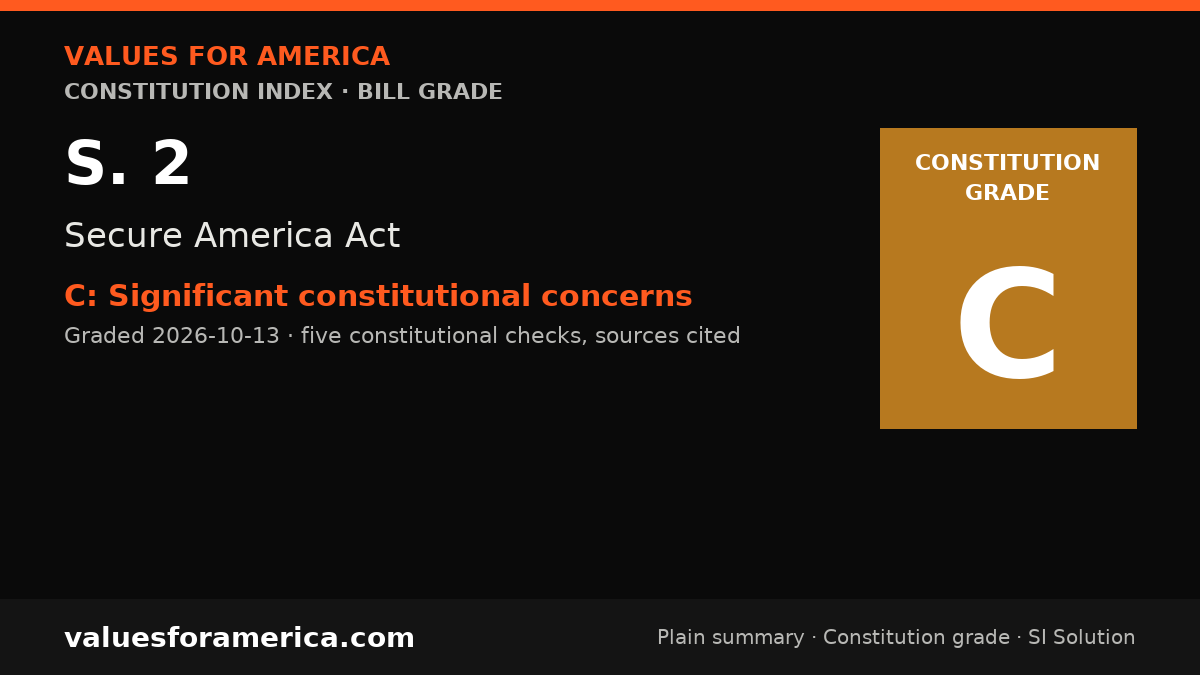
Significant constitutional concerns
Graded 2026-10-13
SI-generated grade · five published checks · not individually reviewed by a person · methodology
The Secure America Act is a large-scale federal funding bill for immigration enforcement and border security. It raises significant constitutional concerns regarding the scope of federal power, potential Fourth Amendment implications of surveillance technologies, and the use of reconciliation procedures to bypass normal legislative deliberation. While border security is a legitimate federal interest under the Commerce Clause and the plenary power over immigration, the bill's broad delegation of authority and the deployment of advanced surveillance systems without robust judicial oversight present serious constitutional tensions. The bill also centralizes decision-making at the federal level, failing the decentralization test. The grade reflects the need for structural revisions to ensure compliance with constitutional principles.
-
✓ Passes · Enumerated powers
The federal government has explicit constitutional authority over immigration and border security. Article I, Section 8, Clause 3 grants Congress the power to regulate commerce with foreign nations, and the Naturalization Clause (Article I, Section 8, Clause 4) provides authority over naturalization. Additionally, the Supreme Court has long recognized the federal government's plenary power over im… -
✗ Concern · Bill of Rights
The bill authorizes the procurement and deployment of advanced surveillance technologies, including artificial intelligence, machine learning, and autonomous systems, along the borders. While border searches are subject to a 'border search exception' to the Fourth Amendment, the use of autonomous surveillance systems that can track individuals without active human control raises serious concerns a… -
✗ Concern · Individual sovereignty
The bill's expansive surveillance and enforcement measures could restrict individual liberties without a compelling constitutional justification. The use of autonomous systems to detect, identify, classify, and track individuals in real time, without active human engagement, raises concerns about the government's ability to monitor and potentially interfere with the lives of individuals without pr… -
✗ Concern · Decentralization
The bill fails the decentralization test. While border security is a federal responsibility, the bill centralizes decision-making and funding at the federal level, with little role for states or local communities. The four-question test: (1) Individuals and families cannot handle border security on their own, so the first question is answered 'no.' (2) Local communities and counties cannot handle … -
✗ Concern · Due process and takings
The bill's use of reconciliation procedures, which prevent a filibuster and restrict amendments, may bypass the normal legislative process and reduce the opportunity for due deliberation and public input. While this is a procedural concern, the substantive due process issue is more significant: the bill authorizes the deployment of autonomous surveillance systems that could lead to the tracking an…
Sources: Congress.gov: S 2 summary
Report an error in this grade
The Framers
“Founders’ Verdict”
Confidence 0.50
Archived SI output (machine-generated)No editorial review recorded. This historical SI verdict was machine-generated by software and predates the review desk; check it against the official bill text.
Synthesis
Two Founders (Madison and Jefferson) found the bill unconstitutional, arguing it exceeds enumerated federal powers, intrudes on state sovereignty, and lacks sufficient constitutional limitation. Two Founders (Hamilton and Marshall) found it constitutional, emphasizing federal power over naturalization and the Necessary and Proper Clause.
The Constitution vests in Congress the power to provide for the common defense and to establish a uniform rule of naturalization (Article I, Section 8, Clause 4). The funding of immigration enforcement is a necessary and proper means to execute these powers, as well as the inherent sovereign authority to control the nation's borders. The use of reconciliation procedures, while a matter of legislative process, does not affect the constitutional validity of the underlying appropriations. The bill's provisions for federal personnel, technology, and cooperation with state and local law enforcement…
This bill concentrates vast and indefinite powers in the federal government over immigration enforcement, extending through FY2029 without clear constitutional limitation. The Constitution enumerates only specific powers to Congress, and the Tenth Amendment reserves all other powers to the States or the people. The bill's authorization for state and local law enforcement to perform federal immigration functions under 287(g) agreements blurs the line between federal and state authority, potentially compelling state officers to execute federal law, which is not a power delegated to the United St…
The bill authorizes a substantial increase in federal funding for immigration enforcement activities without any apparent limitation to the enumerated powers of the general government. The Constitution vests Congress with the power to establish a uniform rule of naturalization (Article I, Section 8, Clause 4) and to regulate commerce with foreign nations (Article I, Section 8, Clause 3), which implicitly includes authority over the admission of aliens. However, the powers of the federal government are few and defined (Federalist No. 45). The general police power, including the authority over p…
The Constitution vests in Congress the power to provide for the common defense and to establish a uniform rule of naturalization. Article I, Section 8, Clause 4 grants Congress authority over naturalization, and the Necessary and Proper Clause (Article I, Section 8, Clause 18) empowers Congress to enact legislation that is appropriate to carry into execution its enumerated powers, including those concerning immigration and border security. In McCulloch v. Maryland, this Court affirmed that Congress may choose any means not prohibited by the Constitution that are conducive to the exercise of a …
Report an error in this Founders' Verdict
What should pass
“VFA SI Solution”
Archived SI output (machine-generated) · No editorial review recorded
This historical draft has no editorial review time on record. Check its claims against the original bill and current law.
Border Security and Naturalization Enforcement Act of 2025
Generated by VFA SI Solutions
Provide funding to the Department of Homeland Security and its components for immigration enforcement activities through FY2029, as part of a budget reconciliation process.
Bipartisan rationale: Honors Democratic priorities: limits enforcement to violent criminals and national security threats, requires due process, prohibits state/local delegation, caps spending, and includes private enforcement. Honors Republican priorities: provides significant funding for border security and enforcement against serious criminals, ties funding to visa fees and foreign aid cuts, and includes a sunset for accountability.
Article I, Section 8, Clause 4 Article I, Section 8, Clause 3 Amendment V Amendment X
Report an error in this Solution
Citizen Consensus
“Do you support this VFA SI Solution?”
One vote per verified account; you can change it any time. Only verified accounts count, results publish once 30 verified people have voted, and state and district results count only people who attested a home ZIP code. How this works.
Email verification is not switched on yet, so no vote counts toward results yet. Votes cast now are saved and count once the voter verifies their email address.
Sign in or create a free account to vote.
Add a short reason (optional)
/280 · no links or contact details · reasons are reviewed before anyone sees them, and many never are shown.
Your vote is saved but held out of published results by an automated integrity check (for example, several accounts voting from one browser).
Your vote is saved. It will count once you verify your email address. Verify on your account page.
Your vote counts nationally. Add your home ZIP code to count in your state and district too.
Your vote counts nationally and in .
Reason saved privately; it is shown only if it passes review.
Verified participants nationwide · n =
Self-selected participants, not a random sample; ± is the 95% sampling margin.
Not enough verified votes yet. Results publish at verified votes.
A sudden surge of votes on this item was flagged and is under review; votes from new accounts in that surge are held out until it is resolved.
Related on VFA

For journalists and bloggers
“Embed this grade”
Free to use with the link back. The badge and card update when the grade changes. Embed terms →
