H.Res. 878 explained · 119th Congress · Pending in Congress
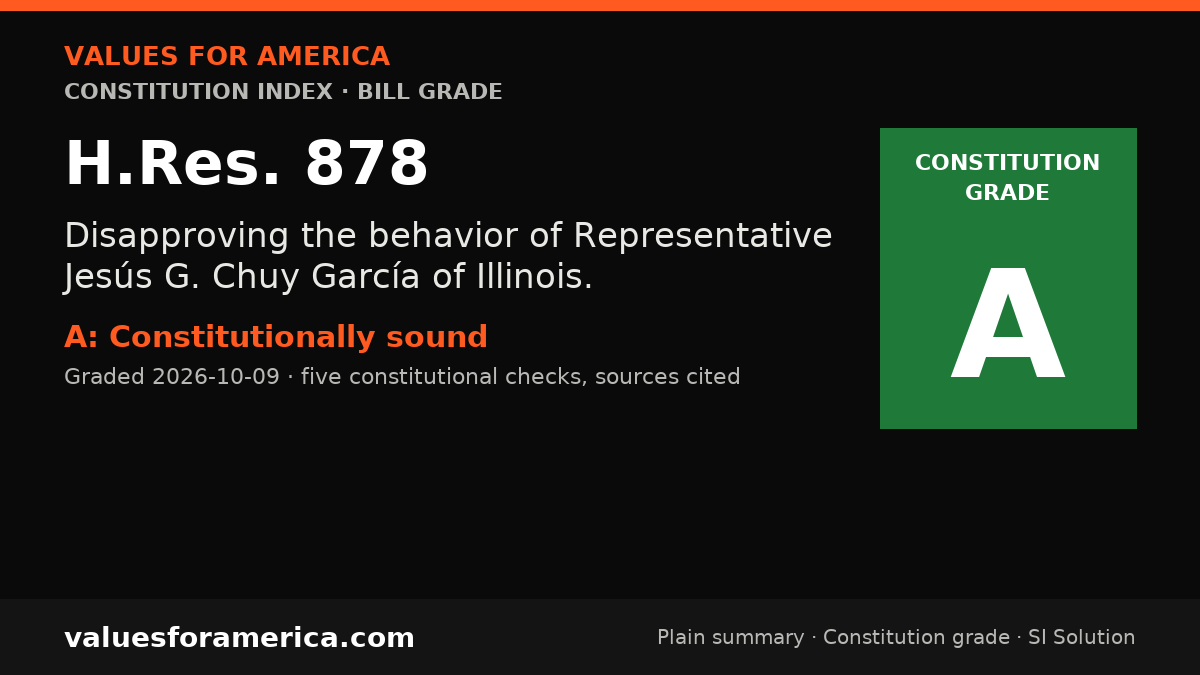
Disapproving the behavior of Representative Jesús G. Chuy García of Illinois.
Cosponsors: none · per Congress.gov, 2026-10-10
Introduced: 2025-11-17
Latest action (2025-11-18): Motion to reconsider laid on the table Agreed to without objection.
What H.Res. 878 does, in plain terms
This resolution expresses that the House of Representatives disapproves of the behavior of Representative Jesús G. “Chuy” García of Illinois.
Official summary by the Congressional Research Service, via Congress.gov.
Constitution Index
“VFA Constitution grade”
Constitutionally sound
Graded 2026-10-09
SI-generated grade · five published checks · not individually reviewed by a person · methodology
HRES 878 is a simple resolution expressing the House of Representatives' disapproval of a member's behavior. This falls squarely within the House's constitutional authority to discipline its own members under Article I, Section 5, Clause 2. It imposes no legal penalty, removes no rights, and does not exceed the decentralized minimum of government because only the House itself can judge the conduct of its own Members. The resolution is consistent with the Constitution.
-
✓ Passes · Enumerated powers
Article I, Section 5, Clause 2 expressly grants each House of Congress the power to punish its Members for disorderly behavior and, with a two-thirds vote, to expel a Member. A resolution disapproving a Representative's behavior is a lesser exercise of this same disciplinary authority and is therefore within Congress's enumerated constitutional power. -
✓ Passes · Bill of Rights
The resolution does not enact a law abridging speech, religion, assembly, press, petition, or any other enumerated right. It is an internal legislative act of disapproval, not a criminal punishment or a prohibition on expression. While the underlying behavior could theoretically involve protected speech, the House's internal disciplinary authority under Article I, Section 5, Clause 2 is a legitima… -
✓ Passes · Individual sovereignty
The resolution does not restrict what any person may do with their own person, property, speech, labor, or belief. It is a formal expression of congressional rebuke, not a legal disability or deprivation. The individual Member retains all rights and privileges of office, aside from the reputational consequence of formal disapproval. The burden of justification has been met by the express constitut… -
✓ Passes · Decentralization
The action concerns the internal discipline of a Member of the United States House of Representatives. No individual, family, local community, county, or state government has any authority to discipline a federal Member of Congress for conduct related to their office. The decision necessarily resides at the federal level, and specifically in the House itself, which is the lowest and most appropria… -
✓ Passes · Due process and takings
The resolution is a simple expression of disapproval and does not deprive the Member of life, liberty, or property. It is not a bill of attainder because it is an exercise of the House's own disciplinary authority under Article I, Section 5, Clause 2, not a legislative punishment imposed outside of judicial trial. No property is taken, and no procedural due process rights are triggered beyond what…
Sources: Congress.gov: HRES 878 summary
Report an error in this grade
What should pass
“VFA SI Solution”
No solution yet
A sourced SI draft appears here once it passes automated checks (Constitution citation, source verification, independent SI critic). How publication works.
Related on VFA

For journalists and bloggers
“Embed this grade”
Free to use with the link back. The badge and card update when the grade changes. Embed terms →
