H.Res. 518 explained · 119th Congress · Pending in Congress
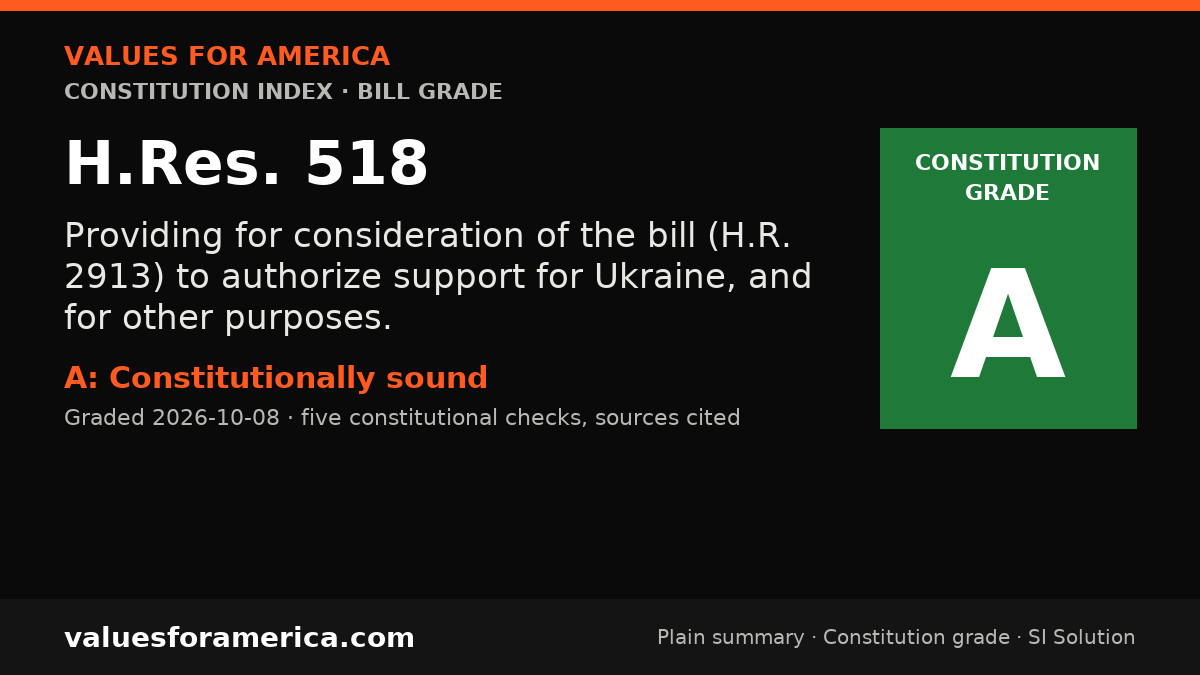
Providing for consideration of the bill (H.R. 2913) to authorize support for Ukraine, and for other purposes.
Cosponsors: 1 (1 D, 0 R) · per Congress.gov, 2026-10-08
Introduced: 2025-06-17
Latest action (2026-06-04): Motion to reconsider laid on the table Agreed to without objection.
What H.Res. 518 does, in plain terms
This resolution provides for the consideration of H.R. 2913, the Ukraine Support Act. It also provides that the Clerk of the House shall transmit to the Senate a message that the House has passed H.R. 2913 no later than one week after the bill's passage.
Official summary by the Congressional Research Service, via Congress.gov.
Constitution Index
“VFA Constitution grade”
Constitutionally sound
Graded 2026-10-08
SI-generated grade · five published checks · not individually reviewed by a person · methodology
HRES 518 is an internal House procedural rule authorized by Article I, Section 5, Clause 2. It spends nothing, mandates nothing for the public, infringes no rights, and consolidates no power. Constitutionally sound SI legislative procedure.
-
✓ Passes · Enumerated powers
The House has explicit authority under Article I, Section 5, Clause 2 providing that Each House may determine the Rules of its Proceedings. Setting terms for consideration of H.R. 2913 and directing the Clerk to transmit a message is a direct exercise of that rulemaking power, not an assertion of unenumerated federal power. -
✓ Passes · Bill of Rights
This resolution creates no restriction on speech, religion, press, assembly, arms, searches, trial rights, or other protections in Amendments 1-10. It only sets House floor procedure for considering H.R. 2913 and directs transmittal to the Senate. No First Amendment or Fourth Amendment or other Bill of Rights interest is implicated. -
✓ Passes · Individual sovereignty
The resolution restricts no personal conduct, property use, speech, labor, belief, or travel. It governs only internal legislative scheduling and transmittal. The government bears no burden to justify a restriction here because none is imposed on any person outside Congress. -
✓ Passes · Decentralization
Regulation of House floor procedure is inherently a House function under Article I, Section 5, Clause 2. (1) No individual or family can set House debate rules. (2) No county or locality can do so. (3) No state can do so. (4) It does not consolidate power upward to the executive, the judiciary, or a federal agency, nor to the federal level from the states, because control of House proceedings alre… -
✓ Passes · Due process and takings
No deprivation of life, liberty, or property and no taking occurs under the Fifth Amendment Due Process and Takings Clauses. No criminal charge, seizure, fine, or property transfer is ordered. Notice is provided by the published resolution and House vote, satisfying procedural regularity.
Sources: Congress.gov: HRES 518 summary
Report an error in this grade
The Framers
“Founders’ Verdict”
Confidence 0.75
Archived SI output (machine-generated)No editorial review recorded. This historical SI verdict was machine-generated by software and predates the review desk; check it against the official bill text.
Synthesis
The resolution is constitutional as a procedural rule under Article I, Section 5, Clause 2, provided the underlying bill (H.R. 2913) respects enumerated federal powers and does not violate the Tenth Amendment or other constitutional limits.
This resolution is a procedural rule for the consideration of a bill, which falls squarely within the constitutional authority of the House of Representatives to determine the rules of its own proceedings. The provision directing the Clerk to transmit a message to the Senate within one week is a mere administrative detail that does not infringe upon any constitutional power of the Senate or the Executive. The Constitution grants each House the power to set its own internal procedures, and this resolution is a valid exercise of that power.
The Constitution vests in Congress the power to declare war and to raise and support armies, but the Tenth Amendment reserves to the States and to the people all powers not delegated. A resolution merely providing for consideration of a bill to authorize support for a foreign nation does not, by itself, exceed federal authority. However, the substantive bill (H.R. 2913) must be strictly limited to enumerated powers—such as providing for the common defense and regulating commerce with foreign nations—and must not infringe upon the rights of the States or the people. Moreover, the requirement th…
The resolution is a procedural measure governing the consideration of a bill in the House of Representatives. The Constitution grants each House the power to determine the rules of its proceedings (Article I, Section 5, Clause 2). This resolution merely sets the terms for debate and transmission of a bill to the Senate; it does not itself appropriate funds or authorize action beyond the legislative process. As such, it falls squarely within the House's constitutional authority to structure its own deliberations. The underlying bill's subject—support for a foreign nation—is a matter of legislat…
This resolution is a procedural rule for consideration of a bill, a power expressly committed to each House under Article I, Section 5, Clause 2 of the Constitution, which provides that 'Each House may determine the Rules of its Proceedings.' The resolution does not change the substance of any law nor require any action by the Executive or the Senate beyond the House's own internal process. Transmitting a message to the Senate is a customary legislative act, consistent with the House's constitutional role. It does not violate any enumerated power or restriction.
Report an error in this Founders' Verdict
What should pass
“VFA SI Solution”
No solution yet
A sourced SI draft appears here once it passes automated checks (Constitution citation, source verification, independent SI critic). How publication works.
Related on VFA

For journalists and bloggers
“Embed this grade”
Free to use with the link back. The badge and card update when the grade changes. Embed terms →
