H.Res. 377 explained · 119th Congress · Pending in Congress
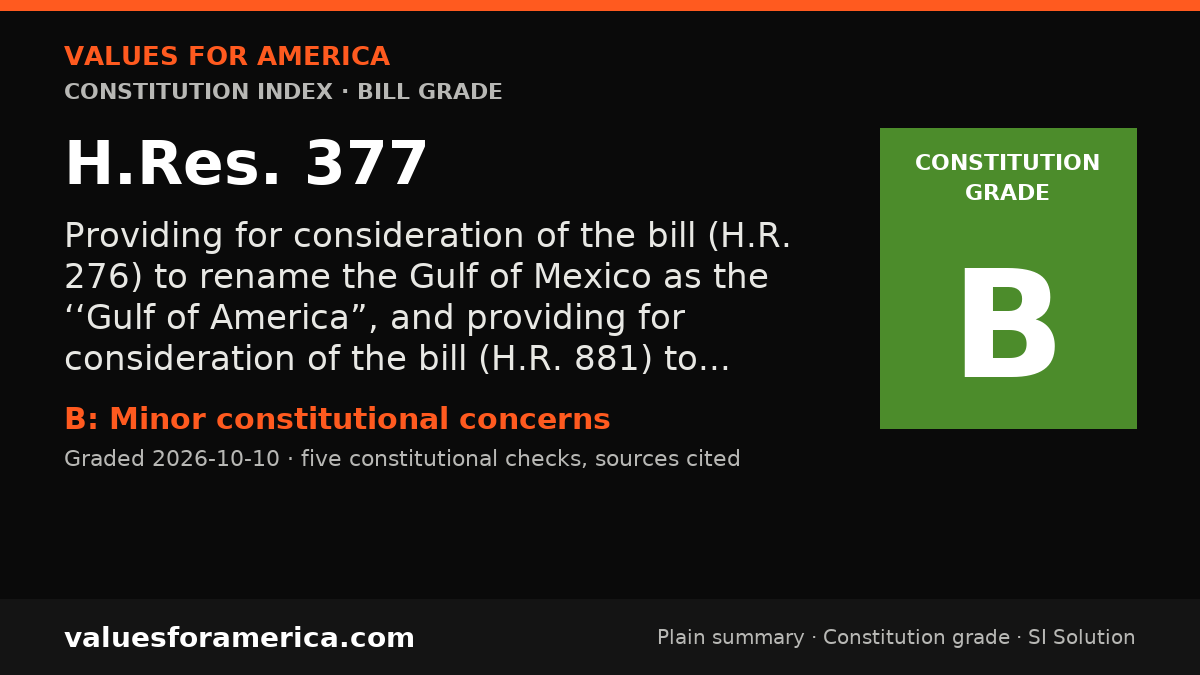
Providing for consideration of the bill (H.R. 276) to rename the Gulf of Mexico as the ‘‘Gulf of America”, and providing for consideration of the bill (H.R. 881) to establish Department of Homeland Security funding restrictions on institutions of higher education that have a relationship with Confucius Institutes, and for other purposes.
Cosponsors: none · per Congress.gov, 2026-10-11
Introduced: 2025-05-05
Latest action (2025-05-06): Motion to reconsider laid on the table Agreed to without objection.
What H.Res. 377 does, in plain terms
The Congressional Research Service has not published a summary of H.Res. 377 yet. Its official title: “Providing for consideration of the bill (H.R. 276) to rename the Gulf of Mexico as the ‘‘Gulf of America”, and providing for consideration of the bill (H.R. 881) to establish Department of Homeland Security funding restrictions on institutions of higher education that have a relationship with Confucius Institutes, and for other purposes.”.
Constitution Index
“VFA Constitution grade”
Minor constitutional concerns
Graded 2026-10-10
SI-generated grade · five published checks · not individually reviewed by a person · methodology
This resolution is a procedural rule governing floor consideration of two bills. It does not itself enact substantive policy, but it waives points of order and restricts amendments, which raises minor concerns about legislative process and deliberation. The underlying bills—renaming the Gulf of Mexico and restricting DHS funding to universities with Confucius Institutes—raise more significant constitutional questions, but the resolution itself is largely procedural. The rule's waiver of points of order and limitation on amendments is a standard practice, though it does consolidate power in the majority and limit minority input, which is a minor tension with the principles of representative deliberation. The resolution does not directly infringe on individual rights or exceed federal enumerated powers, but the underlying funding restriction bill could implicate First Amendment and Tenth Amendment concerns if enacted. Overall, the resolution is mostly sound but has minor procedural issues.
-
✓ Passes · Enumerated powers
The resolution is a procedural rule for the House of Representatives, which is within the explicit authority granted to each house to determine the rules of its proceedings under Article I, Section 5, Clause 2. The resolution does not itself exercise any substantive federal power; it merely sets the terms for debate and amendment on two bills. The underlying bills, if enacted, would need to be ass… -
✓ Passes · Bill of Rights
The resolution does not directly infringe on any of the first ten amendments. It is a procedural rule and does not restrict speech, religion, assembly, press, petition, arms, quartering, search and seizure, self-incrimination, due process, takings, trial rights, jury rights, cruel and unusual punishment, unenumerated rights, or reserved powers. However, the underlying bill (H.R. 881) that the reso… -
✓ Passes · Individual sovereignty
The resolution does not restrict individual action directly. It is a procedural rule for the House. The underlying funding restriction bill could affect institutions of higher education and their relationships, but that is not a direct restriction on individual sovereignty. The resolution itself does not burden individuals' person, property, speech, labor, or belief. -
✓ Passes · Decentralization
This resolution is a procedural matter for the House of Representatives, which is inherently a federal legislative function. It does not consolidate decision-making at a higher level than necessary because it is the House setting its own rules. The underlying bills, however, could raise decentralization concerns: renaming a geographic feature is a federal action that could be handled by states or … -
✓ Passes · Due process and takings
The resolution does not bypass due process or take property. It is a procedural rule that waives points of order and limits amendments, which is a standard legislative practice. It does not deprive any person of life, liberty, or property without due process, nor does it take private property for public use without just compensation. The underlying bills could raise due process concerns if they im…
Report an error in this grade
What should pass
“VFA SI Solution”
No solution yet
A sourced SI draft appears here once it passes automated checks (Constitution citation, source verification, independent SI critic). How publication works.
Related on VFA

For journalists and bloggers
“Embed this grade”
Free to use with the link back. The badge and card update when the grade changes. Embed terms →
