H.Res. 282 explained · 119th Congress · Pending in Congress
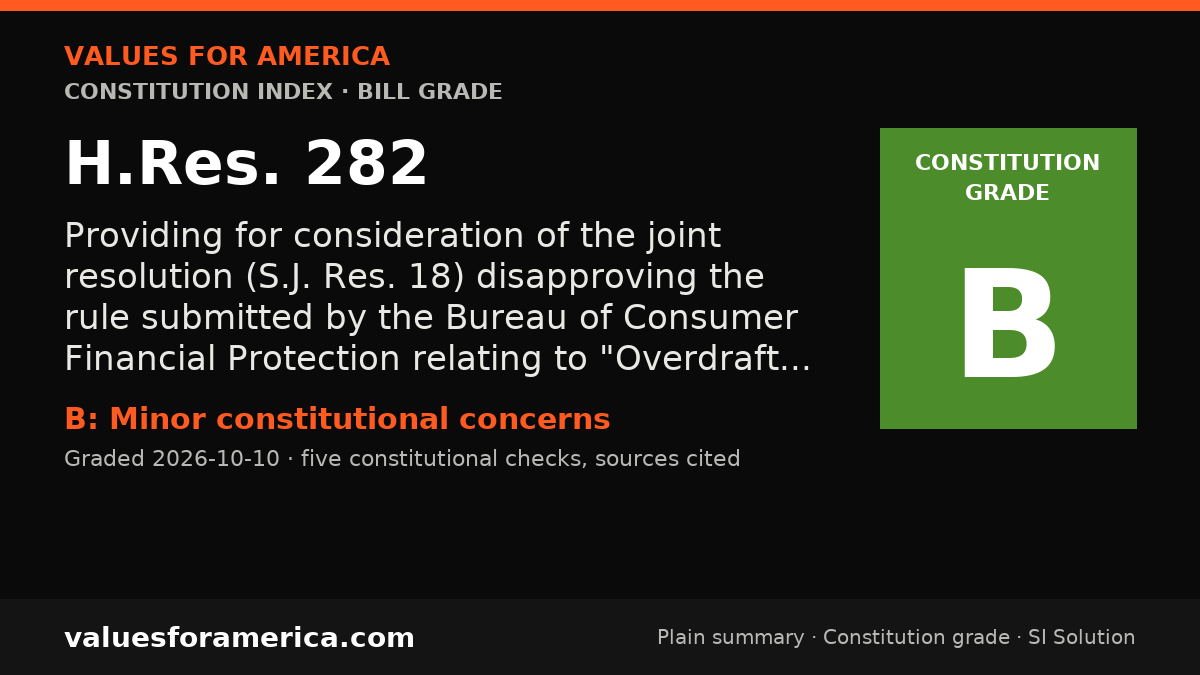
Providing for consideration of the joint resolution (S.J. Res. 18) disapproving the rule submitted by the Bureau of Consumer Financial Protection relating to "Overdraft Lending: Very Large Financial Institutions''; providing for consideration of the joint resolution (S.J. Res. 28) disapproving the rule submitted by the Bureau of Consumer Financial Protection relating to ''Defining Larger Participants of a Market for General-Use Digital Consumer Payment Applications''; providing for consideration of the bill (H.R. 1526) to amend title 28, United States Code, to limit the authority of district courts to provide injunctive relief, and for other purposes; providing for consideration of the bill (H.R. 22) to amend the National Voter Registration Act of 1993 to require proof of United States citizenship to register an individual to vote in elections for Federal office, and for other purposes; and for other purposes.
Cosponsors: none · per Congress.gov, 2026-10-12
Introduced: 2025-04-01
Latest action (2025-04-01): Motion to reconsider laid on the table Agreed to without objection.
What H.Res. 282 does, in plain terms
The Congressional Research Service has not published a summary of H.Res. 282 yet. Its official title: “Providing for consideration of the joint resolution (S.J. Res. 18) disapproving the rule submitted by the Bureau of Consumer Financial Protection relating to "Overdraft Lending: Very Large Financial Institutions''; providing for consideration of the joint resolution (S.J. Res. 28) disapproving the rule submitted by the Bureau of Consumer Financial Protection relating to ''Defining Larger Participants of a Market for General-Use Digital Consumer Payment Applications''; providing for consideration of the bill (H.R. 1526) to amend title 28, United States Code, to limit the authority of district courts to provide injunctive relief, and for other purposes; providing for consideration of the bill (H.R. 22) to amend the National Voter Registration Act of 1993 to require proof of United States citizenship to register an individual to vote in elections for Federal office, and for other purposes; and for other purposes.”.
Constitution Index
“VFA Constitution grade”
Minor constitutional concerns
Graded 2026-10-10
SI-generated grade · five published checks · not individually reviewed by a person · methodology
This resolution is a procedural rule governing floor consideration of several measures. It does not itself enact substantive law, but it facilitates consideration of bills that raise constitutional concerns, particularly H.R. 22 (voter citizenship proof) and H.R. 1526 (limiting injunctive relief). The rule's waiver of points of order and restrictions on discharge motions are internal House procedures, which are within Congress's constitutional authority. However, the underlying bills may infringe on state authority over elections and individual rights, and the rule's limitation on discharge motions could be seen as restricting minority rights, though this is a matter of internal legislative procedure rather than a direct constitutional violation. The grade reflects the procedural nature of the resolution and the potential constitutional issues in the underlying legislation.
-
✓ Passes · Enumerated powers
The resolution is a procedural rule for the House of Representatives, which is explicitly authorized by Article I, Section 5, Clause 2 of the Constitution, granting each house the power to determine the rules of its proceedings. The resolution governs the consideration of specific bills and resolutions, all of which fall within Congress's enumerated powers, such as the power to regulate commerce (… -
✓ Passes · Bill of Rights
The resolution itself does not infringe on any of the first ten amendments. It is a procedural measure that sets the terms for debate and amendment. However, the underlying bills it facilitates consideration of may raise concerns. For instance, H.R. 22, requiring proof of citizenship to register to vote, could potentially burden the right to vote, which is a fundamental right protected by the Four… -
✓ Passes · Individual sovereignty
The resolution does not directly restrict individual liberty. It is a rule for legislative procedure. However, by facilitating the consideration of H.R. 22, which would require proof of citizenship to register to vote, it could indirectly affect the individual's right to vote, a fundamental right. The burden of proof would be on the individual to provide documentation, which could be seen as a res… -
✓ Passes · Decentralization
The resolution is a matter of federal legislative procedure, which is inherently a federal function. It does not consolidate decision-making at a higher level of government than necessary because it is about how the House considers legislation. The underlying bills, however, may have implications for decentralization. For example, H.R. 22 would impose federal requirements on voter registration, wh… -
✓ Passes · Due process and takings
The resolution does not bypass due process or take property without just compensation. It is a procedural rule that sets the terms for debate and amendment. The waiver of points of order is a common practice in the House and does not deprive any person of life, liberty, or property without due process of law. The underlying bills, such as H.R. 1526, which limits injunctive relief, could affect the…
Report an error in this grade
What should pass
“VFA SI Solution”
No solution yet
A sourced SI draft appears here once it passes automated checks (Constitution citation, source verification, independent SI critic). How publication works.
Related on VFA

For journalists and bloggers
“Embed this grade”
Free to use with the link back. The badge and card update when the grade changes. Embed terms →
