H.R. 884 explained · 119th Congress · Pending in Congress
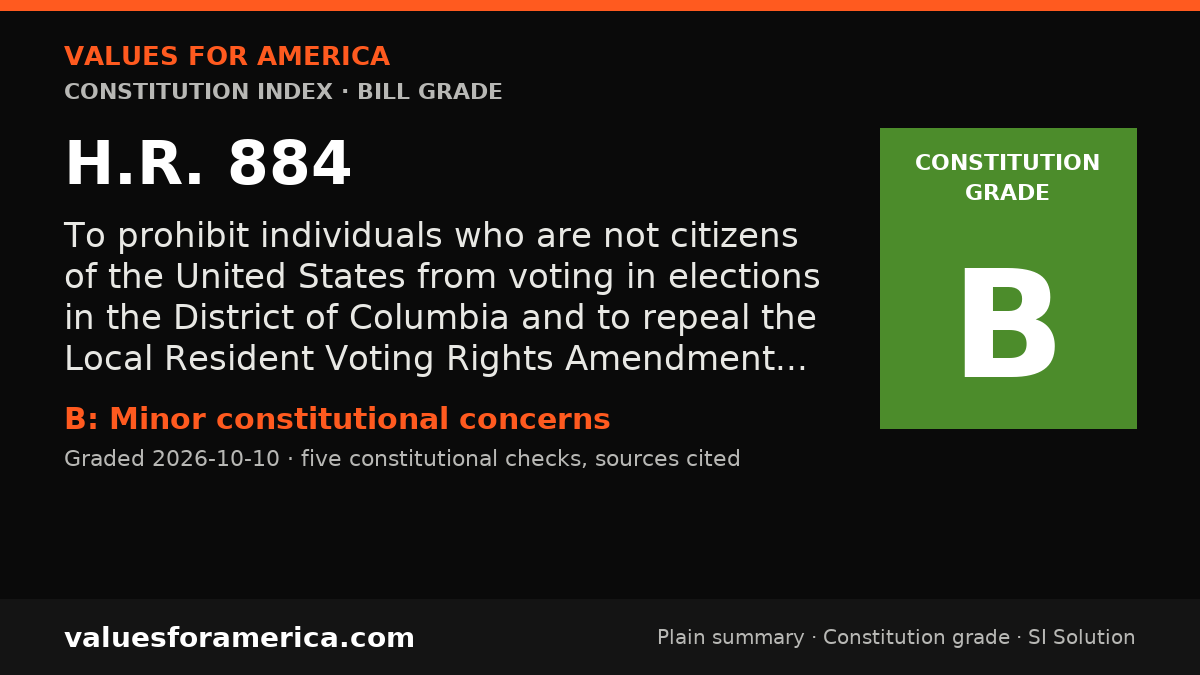
To prohibit individuals who are not citizens of the United States from voting in elections in the District of Columbia and to repeal the Local Resident Voting Rights Amendment Act of 2022.
Cosponsors: 14 (0 D, 14 R) · per Congress.gov, 2026-10-11
Introduced: 2025-01-31
Latest action (2025-06-11): Received in the Senate and Read twice and referred to the Committee on Homeland Security and Governmental Affairs.
What H.R. 884 does, in plain terms
This bill prohibits a non-U.S. citizen from voting in a District of Columbia (DC) election and repeals relevant provisions of DC law. Federal law prohibits noncitizens from voting in a federal election; however, in 2022, DC enacted a law allowing noncitizens who meet residency and other requirements to vote in local elections. This bill repeals the DC law, which went into effect on February 23, 2023.
Official summary by the Congressional Research Service, via Congress.gov.
Constitution Index
“VFA Constitution grade”
Minor constitutional concerns
Graded 2026-10-10
SI-generated grade · five published checks · not individually reviewed by a person · methodology
The bill is a federal action that restricts the ability of noncitizens to vote in District of Columbia local elections. While the Constitution does not explicitly grant noncitizens the right to vote, the District of Columbia's home rule and its residents' voting rights are subject to congressional oversight under Article I, Section 8, Clause 17. The bill does not infringe upon the rights of U.S. citizens, and it does not violate the Bill of Rights. However, the bill raises concerns about federal overreach into local electoral matters, which are traditionally reserved to the states (or, in this case, the District), and it may undermine the principle of decentralization. The bill is likely constitutional but warrants careful consideration of the District's autonomy.
-
✓ Passes · Enumerated powers
Congress has plenary authority over the District of Columbia under Article I, Section 8, Clause 17, which grants Congress exclusive legislative power over the seat of government. This includes the authority to regulate elections in the District. The bill is a valid exercise of that enumerated power. -
✓ Passes · Bill of Rights
The bill does not infringe upon any of the first ten amendments. It does not restrict speech, religion, assembly, press, petition, arms, quartering, search and seizure, self-incrimination, due process, takings, trial rights, or cruel and unusual punishment. Noncitizens do not have a constitutional right to vote, and the bill does not affect the rights of U.S. citizens. -
✓ Passes · Individual sovereignty
The bill restricts the ability of noncitizens to vote in local elections, but voting is not a fundamental right for noncitizens under the Constitution. The government has a compelling interest in ensuring that elections are conducted by citizens, and the restriction is narrowly tailored to that interest. The bill does not restrict the person, property, speech, labor, or belief of individuals in a … -
✗ Concern · Decentralization
The bill consolidates decision-making at the federal level by overriding a local law enacted by the District of Columbia. While the District is not a state and is subject to congressional authority, the principle of decentralization suggests that local communities should have the power to determine their own electoral rules, absent a compelling federal interest. The bill fails the fourth question … -
✓ Passes · Due process and takings
The bill does not bypass due process or take property without just compensation. It does not deprive any person of life, liberty, or property without a fair hearing. The bill is a legislative act that changes the law prospectively, and it does not target any individual or group in a way that violates procedural or substantive due process.
Sources: Congress.gov: HR 884 summary
Report an error in this grade
What should pass
“VFA SI Solution”
No solution yet
A sourced SI draft appears here once it passes automated checks (Constitution citation, source verification, independent SI critic). How publication works.
Related on VFA

For journalists and bloggers
“Embed this grade”
Free to use with the link back. The badge and card update when the grade changes. Embed terms →
