H.R. 7008 explained · 119th Congress · Pending in Congress
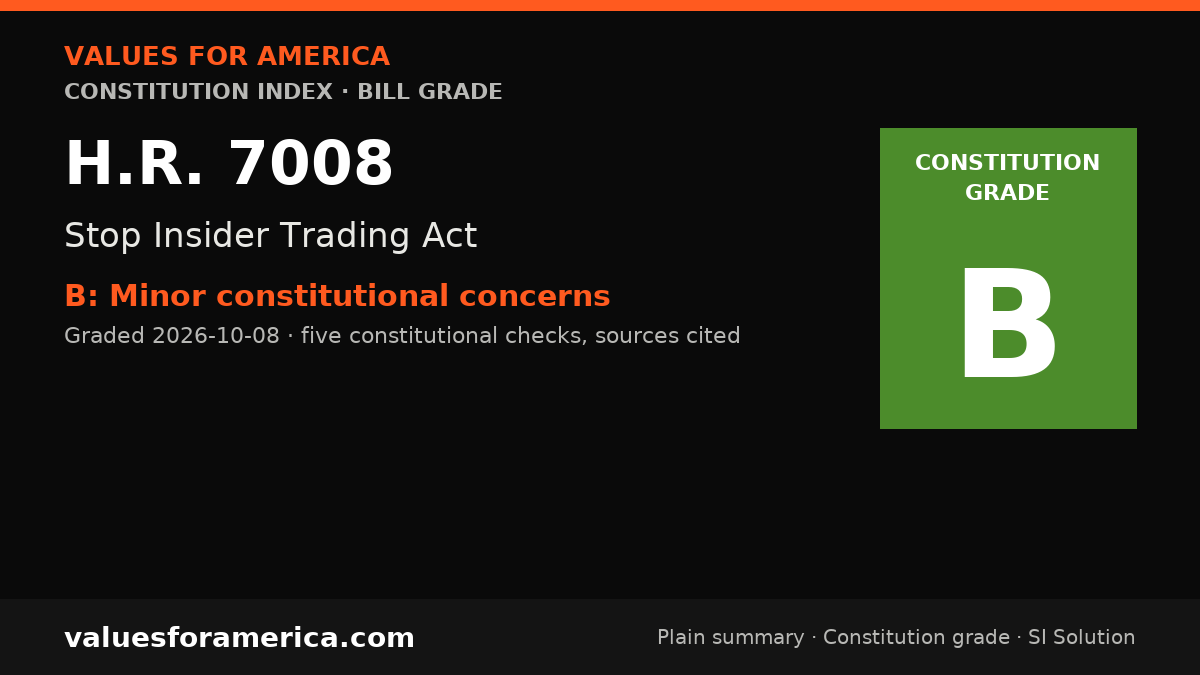
Stop Insider Trading Act
Cosponsors: 93 (2 D, 91 R) · per Congress.gov, 2026-10-14
Introduced: 2026-01-12
Latest action (2026-09-30): Cloture on the motion to proceed to the measure not invoked in Senate by Yea-Nay Vote. 53 - 47. Record Vote Number: 253.
What H.R. 7008 does, in plain terms
Stop Insider Trading Act This bill generally prohibits Members of Congress and their spouses and dependent children from purchasing stocks and requires public notice before these individuals may sell stocks. Specifically, Members of Congress and the spouses and dependent children of Members of Congress may not purchase covered investments. Between 7 and 14 days before a Member or a covered spouse or dependent sells a covered investment, the relevant Member must file public notice of the intent to sell with the Clerk of the House of Representatives or the Secretary of the Senate, as appropriate. The Clerk or Secretary must publish this notice online. If the individual decides not to sell the covered investment, the notice must be withdrawn. Under the bill, a covered investment is a security issued by a publicly traded company or a comparable economic interest. Some investments are exempt, including interest in a widely held investment fund and certain investments held in a trust. Violations of these provisions are subject to a fee and, in the case of a purchase, a requirement to sell the covered investment. The fee must equal (1) the greater of $2,000 or 10% of the transaction value, and (2) any net gain realized from the transaction during a specified period. The fee may not be paid using campaign donations or Members’ official allowances. Certain transactions by covered spouses and dependents are exempt, including transactions made on behalf of another person or made as part of compensation from the individual’s employer.
Official summary by the Congressional Research Service, via Congress.gov.
Constitution Index
“VFA Constitution grade”
Minor constitutional concerns
Graded 2026-10-08
SI-generated grade · five published checks · not individually reviewed by a person · methodology
HR 7008 is constitutional as an internal congressional ethics rule under Article I, Section 5, Clause 2. It does not expand federal power over states or private citizens, infringe the Bill of Rights, or bypass due process. Minor tension remains in extending purchase limits to family members and imposing a gain-based fee, but exemptions and fixed standards keep it sound.
-
✓ Passes · Enumerated powers
Congress has explicit authority to regulate its own Members under Article I, Section 5, Clause 2, which provides each House may determine the Rules of its Proceedings and punish its Members for disorderly Behaviour. Regulating Member financial conflicts and requiring public disclosure is a core exercise of that rulemaking and disciplinary power, supported by the Necessary and Proper Clause in Arti… -
✓ Passes · Bill of Rights
No First through Tenth Amendment right is infringed. The purchase ban and 7-14 day public notice for sales do not restrict speech under the First Amendment, do not authorize search or seizure under the Fourth Amendment, and do not compel self-incrimination under the Fifth Amendment. The fee for violations is civil and regulatory, not criminal punishment under the Sixth Amendment or cruel and unusu… -
✓ Passes · Individual sovereignty
The restriction on purchasing covered securities limits economic liberty, but it applies only as a condition of holding federal elective office and extends to spouses and dependents only to prevent evasion, with exemptions for widely held funds, trusts, and independent employment compensation. The government meets its burden under Article I, Section 5 authority because Members possess nonpublic le… -
✓ Passes · Decentralization
This concerns internal discipline of federal officers, which by definition cannot be handled at a lower level. (1) Individuals cannot regulate congressional conflicts alone. (2) Local communities cannot discipline Members of Congress. (3) States cannot regulate federal congressional ethics without violating separation of powers. (4) It does not consolidate power upward over states or individuals; … -
✓ Passes · Due process and takings
The bill provides procedural due process under the Fifth Amendment Due Process Clause: clear prohibited conduct, advance public notice procedure, defined exemptions for funds, trusts, and third-party or employer compensation transactions, and a fixed fee formula. It requires divestiture of prohibited purchases but that is disgorgement of an unlawful transaction, not a taking of lawfully held prope…
Sources: Congress.gov: HR 7008 summary
Report an error in this grade
What should pass
“VFA SI Solution”
Archived SI output (machine-generated) · No editorial review recorded
This historical draft has no editorial review time on record. Check its claims against the original bill and current law.
Congressional Stock Trading Transparency and Accountability Act of 2025
Generated by VFA SI Solutions
To prohibit Members of Congress and their staff from trading securities based on non-public information obtained through their official duties, and to require public disclosure of such trades within a short timeframe.
Bipartisan rationale: Democratic priorities: Strong transparency and enforcement to prevent corruption, public disclosure of trades, and independent oversight by OCE. Republican priorities: Limited federal intrusion (only covers Congress, not private sector), clear definitions to avoid overreach, sunset provision to ensure review, and reliance on existing criminal statutes rather than creating new federal crimes.
Article I, Section 5, Clause 2 Article I, Section 8, Clause 18 Amendment V
Report an error in this Solution
Citizen Consensus
“Do you support this VFA SI Solution?”
One vote per verified account; you can change it any time. Only verified accounts count, results publish once 30 verified people have voted, and state and district results count only people who attested a home ZIP code. How this works.
Email verification is not switched on yet, so no vote counts toward results yet. Votes cast now are saved and count once the voter verifies their email address.
Sign in or create a free account to vote.
Add a short reason (optional)
/280 · no links or contact details · reasons are reviewed before anyone sees them, and many never are shown.
Your vote is saved but held out of published results by an automated integrity check (for example, several accounts voting from one browser).
Your vote is saved. It will count once you verify your email address. Verify on your account page.
Your vote counts nationally. Add your home ZIP code to count in your state and district too.
Your vote counts nationally and in .
Reason saved privately; it is shown only if it passes review.
Verified participants nationwide · n =
Self-selected participants, not a random sample; ± is the 95% sampling margin.
Not enough verified votes yet. Results publish at verified votes.
A sudden surge of votes on this item was flagged and is under review; votes from new accounts in that surge are held out until it is resolved.
Related on VFA

For journalists and bloggers
“Embed this grade”
Free to use with the link back. The badge and card update when the grade changes. Embed terms →
