H.R. 3616 explained · 119th Congress · Pending in Congress
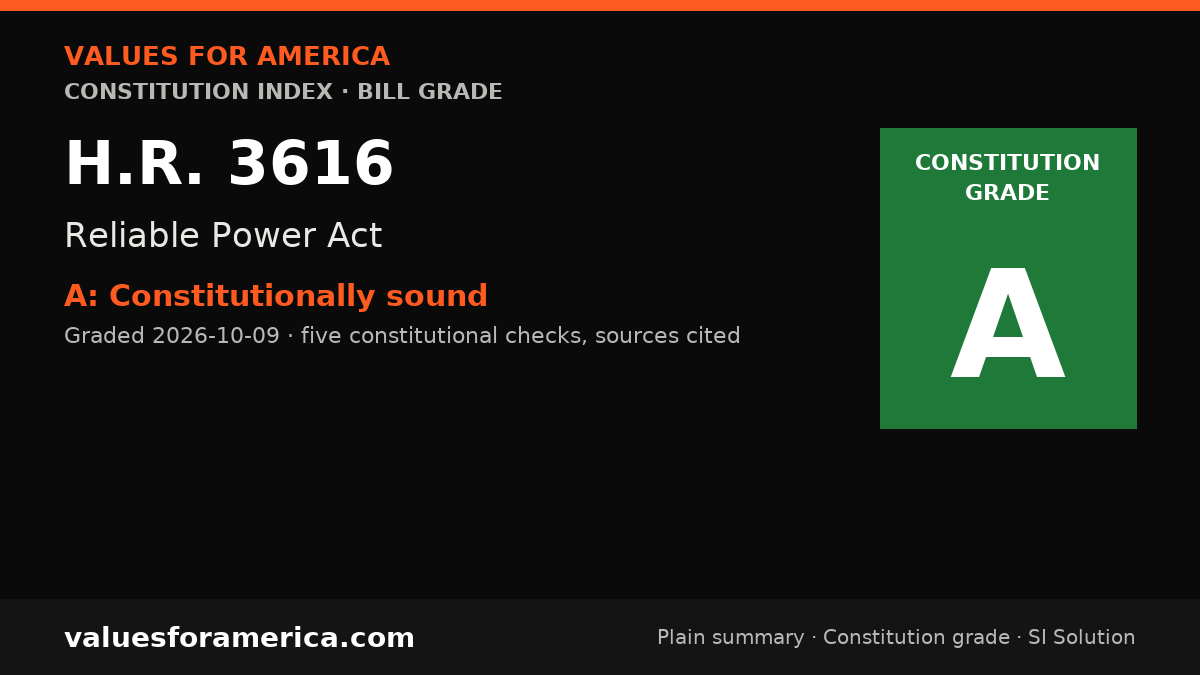
Reliable Power Act
Cosponsors: 20 (0 D, 20 R) · per Congress.gov, 2026-10-09
Introduced: 2025-05-29
Latest action (2025-12-18): Received in the Senate and Read twice and referred to the Committee on Energy and Natural Resources.
What H.R. 3616 does, in plain terms
Reliable Power Act This bill directs the electric reliability organization (i.e., the North American Electric Reliability Corporation) to conduct annual long-term assessments of the reliability of electric power in the bulk-power system. It also establishes a process for the Federal Energy Regulatory Commission (FERC) to review federal regulations before they are finalized if the electric reliability organization finds that the system is at risk of not having sufficient electric generation to maintain reliability. If the electric reliability organization finds that the system does not have sufficient generation to maintain reliability, it must notify FERC that the bulk-power system is in a state of generation inadequacy. FERC must then notify the Department of Energy, the Environmental Protection Agency, and any other appropriate federal agencies of the generation inadequacy. Upon receiving the notice, the federal agency must provide proposed regulations that affect any generation resource in the bulk-power system to FERC for review and comment. If applicable, FERC must provide recommendations to modify the regulations. Federal agencies may not finalize such a regulation until FERC finds that it will not be likely to have a significant negative impact on the ability of the bulk-power system to supply sufficient electric energy necessary to maintain an adequate level of reliability.
Official summary by the Congressional Research Service, via Congress.gov.
Constitution Index
“VFA Constitution grade”
Constitutionally sound
Graded 2026-10-09
SI-generated grade · five published checks · not individually reviewed by a person · methodology
The Reliable Power Act is a constitutional exercise of Congress's interstate commerce power over the bulk-power system. It does not infringe the Bill of Rights, restrict individual liberty, commandeer states, or deprive anyone of property without due process. It creates a reasoned interagency review process aimed at preserving electric reliability.
-
✓ Passes · Enumerated powers
Congress has authority under Article I, Section 8, Clause 3 — the Commerce Clause — to regulate the interstate bulk-power system. Electricity transmitted across state lines is interstate commerce, and Congress has long regulated it through the Federal Power Act. This bill is a valid exercise of that authority. -
✓ Passes · Bill of Rights
The bill imposes obligations on federal agencies and FERC, not on private individuals. It does not restrict speech, religion, assembly, press, petition, arms, protections against unreasonable searches, self-incrimination, trial rights, or cruel punishment. No amendment in the Bill of Rights is implicated. -
✓ Passes · Individual sovereignty
The bill does not limit what individuals may do with their person, property, speech, labor, or beliefs. It regulates the process by which federal agencies issue regulations affecting generation resources. The burden is on the government, not on individuals, and the law supports reliable energy availability. -
✓ Passes · Decentralization
The bulk-power system is inherently interstate, so neither individuals, local communities, nor individual states can fully manage reliability without federal coordination. The bill does not commandeer state governments and does not shift state authority to Washington; it coordinates existing federal agencies through FERC. This is the minimum necessary level for an interstate electrical grid. -
✓ Passes · Due process and takings
The bill does not deprive any person of life, liberty, or property. It creates an administrative review process before regulations are finalized, providing fair notice and structured agency participation. There is no confiscation of property and no bypass of judicial review or other due process protections.
Sources: Congress.gov: HR 3616 summary
Report an error in this grade
What should pass
“VFA SI Solution”
No solution yet
A sourced SI draft appears here once it passes automated checks (Constitution citation, source verification, independent SI critic). How publication works.
Related on VFA

For journalists and bloggers
“Embed this grade”
Free to use with the link back. The badge and card update when the grade changes. Embed terms →
