H.R. 36 explained · 119th Congress · Pending in Congress
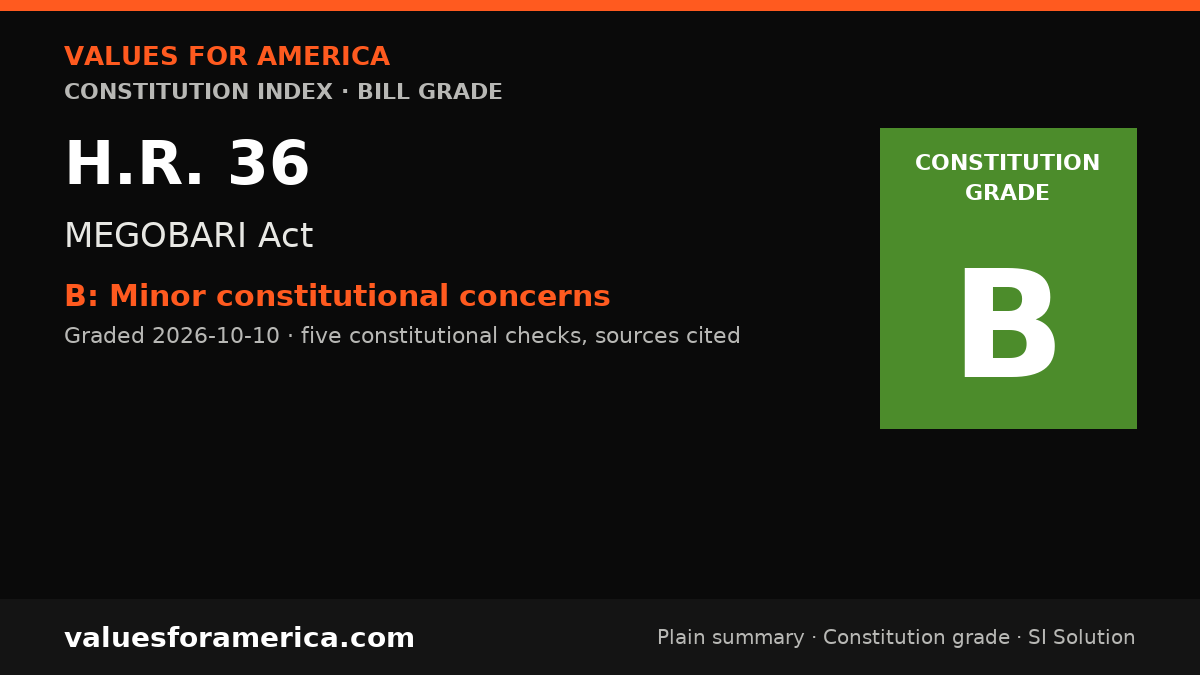
MEGOBARI Act
Cosponsors: 18 (10 D, 8 R) · per Congress.gov, 2026-10-11
Introduced: 2025-01-03
Latest action (2025-05-06): Received in the Senate. Read twice. Placed on Senate Legislative Calendar under General Orders. Calendar No. 70.
What H.R. 36 does, in plain terms
Mobilizing and Enhancing Georgia’s Options for Building Accountability, Resilience, and Independence Act or the MEGOBARI Act This bill requires the President to impose sanctions on certain foreign persons, including Georgian government officials, who are undermining Georgia's security or stability. Specifically, the bill requires the President to impose visa-blocking sanctions and authorizes the President to impose property-blocking sanctions on any foreign person the President determines is involved with actions or policies to undermine Georgia's security or stability. Immediate family members of a sanctioned individual are also subject to these sanctions if they benefited from the sanctioned individual's conduct. The bill also requires the President to impose visa-blocking sanctions on the following foreign persons if the President determines such persons knowingly engaged in significant acts of corruption or acts of violence or intimidation in relation to the blocking of Euro-Atlantic integration in Georgia: any individual who served as a member of the Georgian parliament or as a senior official of a Georgian political party on or after January 1, 2014; any individual who is serving as an official in a leadership position on behalf of the Georgian government; and any immediate family member of such officials who benefited from their conduct. Additionally, for the purpose of potential imposition of sanctions under the International Emergency Economic Powers Act, the President must determine whether there are foreign persons who, on or after the bill's enactment, have engaged in (1) significant corruption in Georgia, or (2) acts to undermine Georgia's security or stability.
Official summary by the Congressional Research Service, via Congress.gov.
Constitution Index
“VFA Constitution grade”
Minor constitutional concerns
Graded 2026-10-10
SI-generated grade · five published checks · not individually reviewed by a person · methodology
The MEGOBARI Act is a federal exercise of the foreign affairs and sanctions powers, which are well-established under the Constitution's enumerated powers. It does not directly infringe on the Bill of Rights, as it targets foreign persons and does not restrict domestic speech or assembly. The primary constitutional tension lies in the delegation of broad discretionary authority to the President to determine who is subject to sanctions, which raises due process concerns regarding fair notice and the potential for arbitrary application. However, given the long-standing precedent for such sanctions in foreign affairs, the bill is mostly sound but would benefit from clearer standards and procedural safeguards.
-
✓ Passes · Enumerated powers
The federal government has explicit constitutional authority over foreign affairs and international commerce. Article I, Section 8, Clause 3 grants Congress the power to regulate commerce with foreign nations, and the President's foreign affairs powers are inherent in the executive authority under Article II. Sanctions against foreign persons for actions undermining a foreign country's stability a… -
✓ Passes · Bill of Rights
The bill imposes sanctions on foreign persons, not U.S. citizens or residents. It does not restrict speech, religion, assembly, press, or petition within the United States. The sanctions are targeted at foreign officials and their families, and do not implicate the First, Second, Third, Fourth, Fifth, Sixth, Seventh, Eighth, Ninth, or Tenth Amendments as applied to U.S. persons. The bill's provisi… -
✓ Passes · Individual sovereignty
The bill restricts the property and entry rights of foreign persons, not U.S. citizens. While the Fifth Amendment's Due Process Clause protects 'persons' generally, the Supreme Court has held that foreign nationals without substantial connections to the United States have limited due process rights in the context of immigration and foreign affairs. The sanctions are based on the government's compe… -
✓ Passes · Decentralization
This is a matter of foreign affairs, which is inherently a federal responsibility. An individual, local community, or state cannot impose international sanctions or conduct foreign policy. The Constitution explicitly reserves foreign affairs to the federal government (Article I, Section 10 prohibits states from entering into treaties or engaging in foreign policy). The bill does not consolidate de… -
✗ Concern · Due process and takings
The bill grants the President broad discretion to impose sanctions based on vague criteria such as 'undermining Georgia's security or stability' and 'significant acts of corruption.' This raises procedural due process concerns because sanctioned individuals may not receive adequate notice or a meaningful opportunity to contest the designation. However, in the context of foreign affairs, courts hav…
Sources: Congress.gov: HR 36 summary
Report an error in this grade
What should pass
“VFA SI Solution”
No solution yet
A sourced SI draft appears here once it passes automated checks (Constitution citation, source verification, independent SI critic). How publication works.
Related on VFA

For journalists and bloggers
“Embed this grade”
Free to use with the link back. The badge and card update when the grade changes. Embed terms →
