H.R. 3357 explained · 119th Congress · Pending in Congress
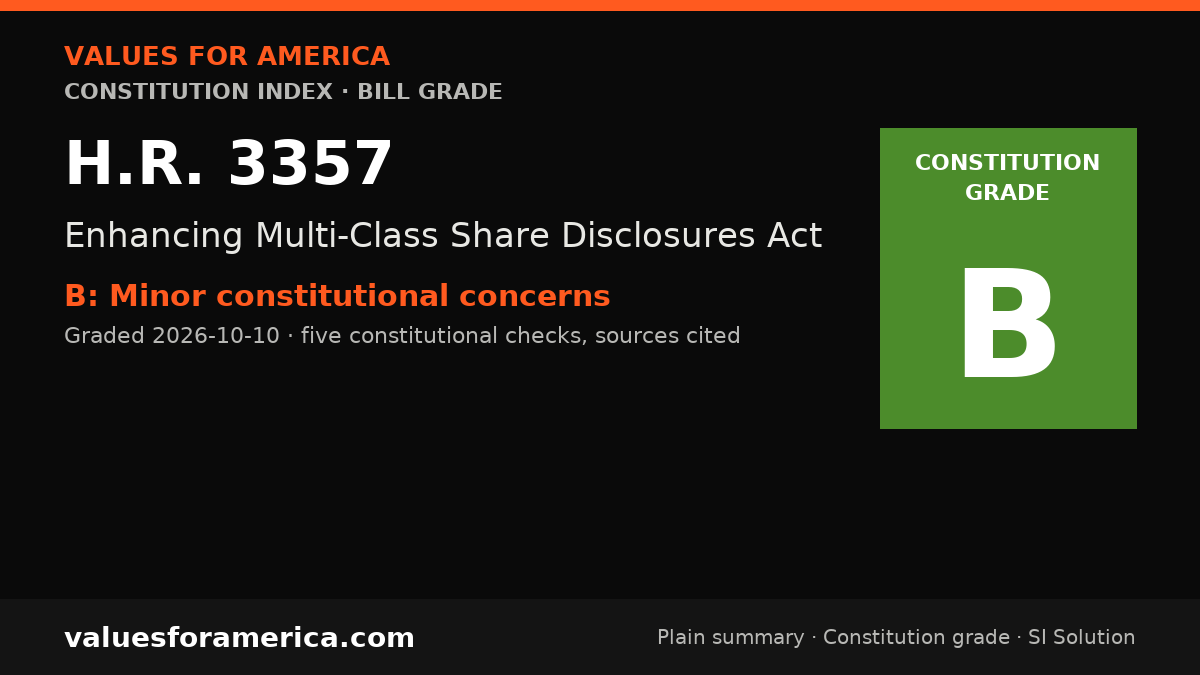
Enhancing Multi-Class Share Disclosures Act
Cosponsors: none · per Congress.gov, 2026-10-11
Introduced: 2025-05-13
Latest action (2025-07-24): Received in the Senate and Read twice and referred to the Committee on Banking, Housing, and Urban Affairs.
What H.R. 3357 does, in plain terms
Enhancing Multi-Class Share Disclosures Act This bill requires issuers of securities with multi-class share structures to disclose certain information in any proxy solicitation or consent solicitation material. A multi-class share structure occurs when a company issues two or more classes of shares that have different voting rights. For example, a company may issue one class of shares with no or few voting rights for the public, and another class with more voting rights for company founders and executives. Under the bill, the issuer must disclose certain information about each director, director nominee, named executive officer, and each beneficial owner of securities with 5% or more of the total combined voting power of all classes of securities entitled to vote in the election of directors. Specifically, the issuer must disclose (1) the number of shares of all classes of securities entitled to vote in the election of directors beneficially owned by such person, and (2) the amount of voting power held by such person.
Official summary by the Congressional Research Service, via Congress.gov.
Constitution Index
“VFA Constitution grade”
Minor constitutional concerns
Graded 2026-10-10
SI-generated grade · five published checks · not individually reviewed by a person · methodology
The bill is a federal securities disclosure requirement grounded in the Commerce Clause and the Securities and Exchange Commission's existing regulatory authority. It does not directly infringe on constitutional rights, but it imposes additional compliance burdens on issuers and may raise minor federalism and due process concerns regarding the scope of disclosure and the potential for overreach into state corporate law.
-
✓ Passes · Enumerated powers
The federal government has authority to regulate securities and interstate commerce under Article I, Section 8, Clause 3 (Commerce Clause). The bill amends the Securities Exchange Act of 1934, which is within the established scope of federal securities regulation. The disclosure requirements are reasonably related to the goal of informing investors and protecting the integrity of interstate securi… -
✓ Passes · Bill of Rights
The bill does not implicate the First, Second, Third, Fourth, Fifth, Sixth, Seventh, Eighth, Ninth, or Tenth Amendments. It mandates corporate disclosures, which are commercial speech and not protected under the First Amendment to the same extent as individual speech. No search or seizure, no criminal penalties, and no infringement on fundamental rights are present. -
✗ Concern · Individual sovereignty
The bill imposes disclosure obligations on issuers and requires them to gather and publish detailed information about beneficial owners and executives. While this is a standard feature of securities regulation, it does restrict the freedom of individuals to keep their financial holdings private. The government has a compelling interest in market transparency and investor protection, which justifie… -
✗ Concern · Decentralization
The bill fails the decentralization test because it consolidates decision-making at the federal level. While securities regulation is inherently interstate and federal oversight is appropriate, the bill imposes uniform federal requirements on all issuers, including those that might be primarily local. However, the interstate nature of securities markets means that federal action is necessary to pr… -
✓ Passes · Due process and takings
The bill does not deprive any person of life, liberty, or property without due process. It imposes disclosure requirements but does not take property or impose penalties without a hearing. The requirements are clear and apply uniformly, providing fair notice to issuers. There is no arbitrary government action; the disclosure is rationally related to the legitimate purpose of informing shareholders…
Sources: Congress.gov: HR 3357 summary
Report an error in this grade
What should pass
“VFA SI Solution”
No solution yet
A sourced SI draft appears here once it passes automated checks (Constitution citation, source verification, independent SI critic). How publication works.
Related on VFA

For journalists and bloggers
“Embed this grade”
Free to use with the link back. The badge and card update when the grade changes. Embed terms →
