H.R. 277 explained · 119th Congress · Pending in Congress
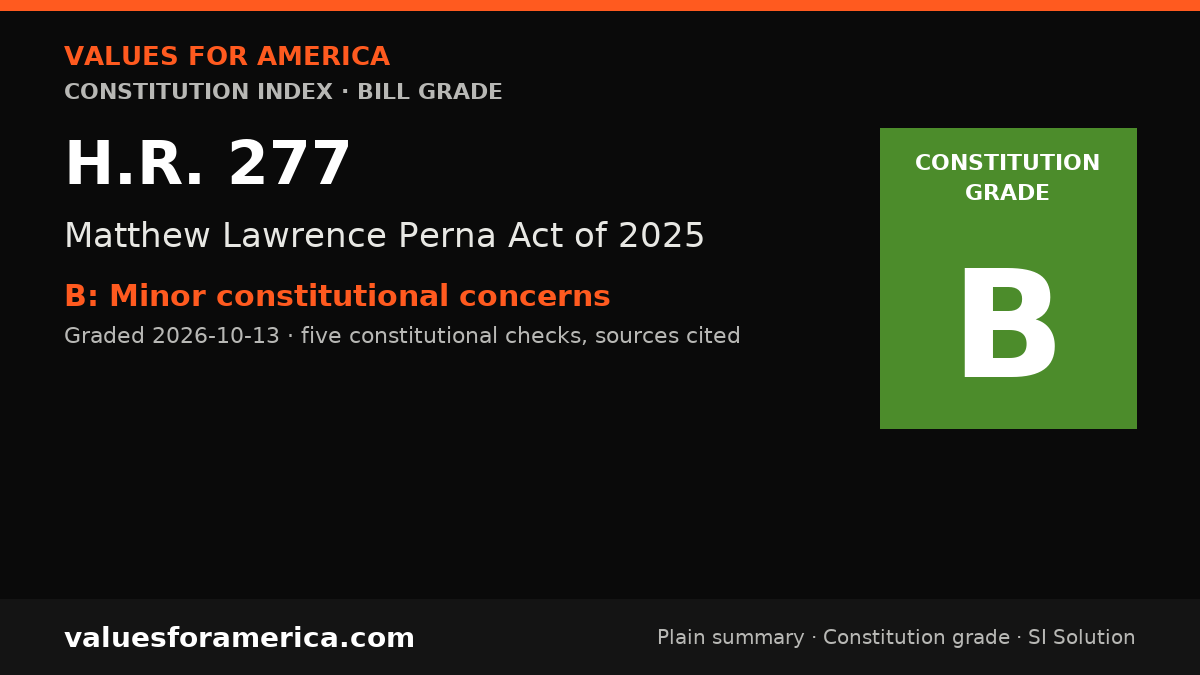
Matthew Lawrence Perna Act of 2025
Cosponsors: 1 (0 D, 1 R) · per Congress.gov, 2026-10-12
Introduced: 2025-01-09
Latest action (2025-01-09): Referred to the Committee on the Judiciary, and in addition to the Committee on Intelligence (Permanent Select), for a period to be subsequently determined by the Speaker, in each case for consideration of such provisions as fall within the jurisdiction of the committee concerned.
What H.R. 277 does, in plain terms
Matthew Lawrence Perna Act of 2025 This bill limits certain actions by the federal government related to the criminal prosecution and sentencing of individuals who are charged with a political protest offense. A political protest offense is a federal criminal offense that arises out of protest activities and is not a crime of violence. The bill also makes other changes that apply more broadly to curtail certain investigations and prosecutions of federal criminal offenses. With respect to individuals who are charged with a political protest offense, the bill prohibits pretrial detention, generally requires the federal criminal trial to begin within 70 days of being charged or making an initial appearance before the court, and expresses the sense of Congress that the sentence imposed should be consistent with the minimum sentence provided by the guideline range applicable to the defendant. With respect to investigations and prosecutions of federal criminal offenses more broadly, the bill makes the United States potentially liable for malicious overprosecution committed by federal investigative or law enforcement officers, limits the use of a national security authority (e.g., the Central Intelligence Agency) against a U.S. citizen, requires federal agencies to disclose whether the United States is or was investigating or surveilling a U.S. citizen when that information is requested under the Freedom of Information Act, and allows a defendant on trial for a criminal offense in the District of Columbia to change the venue of the trial to the U.S. district court that covers his or her primary residence.
Official summary by the Congressional Research Service, via Congress.gov.
Constitution Index
“VFA Constitution grade”
Minor constitutional concerns
Graded 2026-10-13
SI-generated grade · five published checks · not individually reviewed by a person · methodology
The bill is largely protective of constitutional rights and limits federal power, but it raises minor concerns regarding the restriction on pretrial detention for certain offenses and the venue change provision, which may implicate procedural due process and the Sixth Amendment's vicinage requirement. Overall, it aligns with the Constitution's structure and protections.
-
✓ Passes · Enumerated powers
Congress has broad authority under Article I, Section 8, Clause 18 (the Necessary and Proper Clause) to enact laws governing the federal judiciary and criminal procedure, as well as to define the jurisdiction of federal courts. The bill's provisions regarding federal criminal prosecutions, investigations, and venue fall within Congress's enumerated powers to constitute tribunals (Article I, Sectio… -
✓ Passes · Bill of Rights
The bill generally enhances protections under the First Amendment (by protecting political protest), the Fourth Amendment (by limiting surveillance and requiring FOIA disclosure), and the Fifth Amendment (by addressing malicious overprosecution and due process). The prohibition on pretrial detention for political protest offenses that are not crimes of violence does not infringe the Eighth Amendme… -
✓ Passes · Individual sovereignty
The bill expands individual sovereignty by protecting individuals from federal overreach in protest-related prosecutions, limiting surveillance, and providing remedies for malicious overprosecution. It does not restrict individual liberty; rather, it places the burden on the government to justify its actions. The provisions align with the principle that individuals have the right to be free from a… -
✓ Passes · Decentralization
The bill does not consolidate power at a higher level of government; it actually limits federal power and enhances state and individual autonomy. The venue change provision allows trials to be moved to a district covering the defendant's residence, which may be more local. The bill does not fail any of the four questions: individuals and families are not directly involved, but the bill does not re… -
✓ Passes · Due process and takings
The bill enhances due process by prohibiting pretrial detention for certain offenses, requiring speedy trials, and providing a cause of action for malicious overprosecution. The venue change provision respects the defendant's choice and does not deprive the government of due process. The bill does not take property without just compensation; it creates a potential liability for the government, whi…
Sources: Congress.gov: HR 277 summary
Report an error in this grade
What should pass
“VFA SI Solution”
No solution yet
A sourced SI draft appears here once it passes automated checks (Constitution citation, source verification, independent SI critic). How publication works.
Related on VFA

For journalists and bloggers
“Embed this grade”
Free to use with the link back. The badge and card update when the grade changes. Embed terms →
